The Zip and the Two Stories
A free B2-level English story for language learners, readable online in 7 languages, with an option to listen via the free Storyteller app.
A small-town reporter cannot choose between two good assignments until a stuck jacket zip and his editor's advice show him what he would regret missing.
That was the preview! Hear the full story in the free Storyteller app. Get the app
Audio isn't available right now.
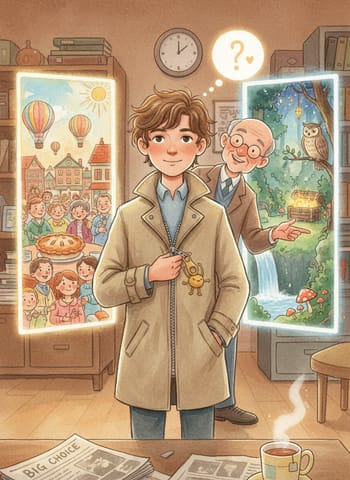
At ten past five, the newsroom of the Courier was as busy as it ever became. Four people were typing and one was eating an apple. Wystan stood by the coat rack with his jacket half on. The zip had stuck halfway up his chest, and nothing he did would move it.
He had been the only full-time reporter at the Courier for six years. He knew the name of every council member and the opening hours of every office in town. He knew the exact sound the printer made before it jammed. What he did not know, at ten past five, was where to go that evening.
"Wystan," Birgit called from the editor's desk. "Have you decided yet?"
"Give me a minute," he said, and pulled at the zip again. It held, as stubborn as a locked door.
The problem was simple to describe. The paper had room for exactly one big story on tomorrow's front page, and Wystan could be in only one place at seven o'clock. At the town hall, the council would vote on a car park behind the high street. It would mean cutting down the last row of old plane trees. Across the river, a young woman was opening a small cinema in a former garage. It had one screen, forty seats and a film nobody else in the region could show.
Either story would have been a good one. That was exactly the difficulty.
"The car park matters to more people," Wystan said, still tugging. "If the vote goes through, those trees are gone for good. Readers will want to know who voted which way."
"They will," Birgit said calmly.
"But the cinema is the kind of story that makes people feel the town is alive. I could write something warm about it." He stopped pulling and sighed. "Which is a thing a reporter should not say about a car park."
Birgit stood and walked over, a pencil still tucked behind her ear. She had run the Courier for nine years. In that time, she had learned not to give advice unless somebody was ready to hear it. She looked at the jacket, and she looked at the zip, and then she looked at him with a faint smile.
"You are forcing it," she said.
"Obviously I am forcing it. It is stuck."
"Stop pulling upward," Birgit said. "Go the other way. Move it down a little, until the teeth loosen, and then start again."
Wystan did as he was told, feeling slightly ridiculous. He slid the zip down about two centimetres, and he felt the tiny teeth come free beneath his fingers. He pulled up again, more gently this time, and the zip rose all the way to his collar in one smooth line.
"Thank you," he said. "That is very good advice for a jacket."
"It is not only for jackets." Birgit shrugged, and she went back to her desk.
Wystan stood there for a moment with the zip fastened to his chin. He thought about what she had said. For the past twenty minutes, he had been pulling in one direction, trying to prove that one story was objectively better than the other. But maybe they were both good enough, and the real question was not which was bigger. The real question was which one he would regret missing.
He tried to picture the car park vote. He saw the council chamber, the long wooden table and the usual quiet speeches. Whatever happened, the result would appear in the official minutes by morning. A reporter from the regional paper would almost certainly be sitting in the back row. The story would be told either way.
Then he pictured the owner in her converted garage, trying to light a projector for the first time in front of a room of strangers. Nobody else from the media was going. Nobody else had even been invited. If he did not go, the evening would pass unrecorded, and on Thursday it would be too late to describe what it had felt like.
"I will take the cinema," he said.
Birgit did not look up from her screen. "Are you sure?"
"I am sure that I would regret the other choice more." He picked up his notebook. "The vote will be reported by somebody. This opening will not be unless I am there. And I will call the council clerk at nine, to get the numbers from her directly."
"That is a sensible plan." Now she did look up, and she was smiling properly. "Take a photographer. And Wystan, ask her what the first film is. Nobody has told me yet."
He reached the garage at twenty to seven. A hand-painted sign above the door read ROLL, in plain white letters. Inside, chairs were still being unpacked from boxes, and a string of small lights hung crookedly along the ceiling. The smell of fresh paint and warm dust filled the air.
The owner was balanced on a stepladder, wrestling with a cable. She was younger than he had expected, with paint on her sleeves, and she nearly fell off the ladder when she saw his press card.
"You came," she said. "I did not think anybody would."
"I almost went to the town hall instead," Wystan said honestly. "Then I decided I would rather see this. By the way, what is the first film?"
"It is called The Lone Tree," she said. "It is a hundred years old, and nobody else in the region has a copy."
By seven o'clock, the forty seats were full. People brought blankets, and one family arrived carrying a folding stool for a child who was too small to see over the row in front. The projector clicked, hummed and hesitated, and for a few seconds the screen stayed blank. Everyone in the room held a breath.
Then the first picture appeared, a pale field with a single tree, and the whole audience let out a soft sigh together. Wystan wrote nothing at all for almost a minute. He realised that he was smiling, and that the people around him were smiling too.
At nine, he stepped outside and called the council clerk. The vote had been a close one, she said, five against four, with the trees spared for another year. She read him the names. He wrote them down in the margin of his notebook, in handwriting that shook slightly from the cold.
He stood on the pavement and watched the light from the garage spill across the road. Behind him, through the open door, a murmur of laughter rose and fell. On his chest, the zip of his jacket sat firmly closed, exactly where he had left it.
Both stories had been waiting for him, he thought. But had he picked the cinema, or had it, somehow, picked him?