The Skis That Were Too Long
Una historia gratuita en inglés de nivel B1 para estudiantes, para leer en línea en 7 idiomas, con opción de escucharla en la app gratuita Storyteller.
Two couriers must deliver a huge pair of skis to a seven-year-old before her first race.
¡Ese fue el avance! Escucha la historia completa en la app gratuita Storyteller. Descargar la app
El audio no está disponible en este momento.
The sorting room of the Highcrest courier hub is never quiet. Parcels hum on the shelves, and letters flutter in their baskets like nervous birds. A brass owl on the desk blinks at every label. It says the name of the town where the parcel belongs. Nadine has worked here for eight years, and she still loves the sound.
La sala de clasificación del centro de mensajería de Highcrest nunca está en silencio. Los paquetes zumban en los estantes y las cartas revolotean en sus cestas como pájaros nerviosos. Un búho de latón sobre el escritorio parpadea ante cada etiqueta. Dice el nombre del pueblo al que pertenece el paquete. Nadine lleva ocho años trabajando aquí y todavía ama ese sonido.
At half past seven, the owl blinks twice and says, "Lowmere."
A las siete y media, el búho parpadea dos veces y dice: «Lowmere».
A long parcel slides down the ramp from the loading door. It is wrapped in brown paper and tied with silver string. It is two and a half metres long. It rests on the floor with one end sticking out into the aisle.
Un paquete largo se desliza por la rampa desde la puerta de carga. Está envuelto en papel marrón y atado con un cordel plateado. Mide dos metros y medio de largo. Descansa en el suelo con un extremo sobresaliendo hacia el pasillo.
"What is that?" Nadine asks.
«¿Qué es eso?», pregunta Nadine.
Hedy, the night supervisor, picks up the label. She reads it twice, then she laughs. "A pair of skis," she says. "For a girl named Pia. She is seven years old."
Hedy, la supervisora nocturna, toma la etiqueta. La lee dos veces y luego se ríe. «Un par de esquís», dice. «Para una niña llamada Pia. Tiene siete años».
"They are taller than the owl. Taller than me!"
«¡Son más altos que el búho! ¡Más altos que yo!».
"The note says she will grow into them." Hedy turns the label over. "It also says, 'Deliver tonight. Her first race starts at nine, and she will not race without them.' Somebody has paid triple for speed."
«La nota dice que crecerá hasta alcanzarlos». Hedy le da la vuelta a la etiqueta. «También dice: "Entregar esta noche. Su primera carrera empieza a las nueve y no correrá sin ellos". Alguien ha pagado el triple por la rapidez».
Nadine looks at the clock above the door. The hands show seven thirty-five. Lowmere lies in the valley, forty minutes away by the evening van. The van leaves from the loading dock at eight, and it never waits for anyone.
Nadine mira el reloj sobre la puerta. Las manecillas marcan las siete treinta y cinco. Lowmere queda en el valle, a cuarenta minutos en la camioneta de la tarde. La camioneta sale del muelle de carga a las ocho y nunca espera a nadie.
"Then we have twenty-five minutes," she says.
«Entonces tenemos veinticinco minutos», dice.
"Enough." Hedy rolls up her sleeves. "We send the skis along the ceiling rail. It carries parcels to the dock in four minutes."
«Suficiente». Hedy se arremanga. «Mandaremos los esquís por el riel del techo. Lleva los paquetes al muelle en cuatro minutos».
The ceiling rail is the pride of the hub. It is a track of iron hooks under the roof. It runs along all four walls and out through an arch to the dock. Every night, hundreds of parcels travel on it, humming like a flock of geese.
El riel del techo es el orgullo del centro. Es una vía de ganchos de hierro bajo el techo. Recorre las cuatro paredes y sale por un arco hacia el muelle. Cada noche viajan por él cientos de paquetes, zumbando como una bandada de gansos.
Nadine climbs a ladder and hangs the skis from two hooks, one near each end. They hang straight and still, and they look almost proud. Hedy pulls the lever.
Nadine sube por una escalera y cuelga los esquís de dos ganchos, uno cerca de cada extremo. Cuelgan rectos e inmóviles, y parecen casi orgullosos. Hedy tira de la palanca.
The rail starts to move, and the skis sail across the room under the lamps. For a minute, everything is perfect.
El riel empieza a moverse y los esquís navegan por la sala bajo las lámparas. Durante un minuto, todo es perfecto.
Then the skis reach the corner. The rail bends to the right, but the skis do not bend with it. Their front tips swing out and strike the wall of the arch with a loud crack. The rail jerks and stops, and every parcel in the room cries out in a different voice.
Entonces los esquís llegan a la esquina. El riel gira a la derecha, pero los esquís no giran con él. Sus puntas delanteras se balancean hacia afuera y golpean la pared del arco con un fuerte crujido. El riel da una sacudida y se detiene, y todos los paquetes de la sala gritan, cada uno con una voz distinta.
"No, no, no," Hedy says. She pulls the lever back and forward. Nothing happens. The skis hang across the arch like a bridge, and a hundred other parcels are stuck behind them.
«No, no, no», dice Hedy. Mueve la palanca hacia atrás y hacia adelante. No pasa nada. Los esquís cuelgan a lo ancho del arco como un puente, y cien paquetes más quedan atascados detrás de ellos.
"The corner is too tight," Nadine says. "I should have measured. We cannot move the skis without cutting them."
«La esquina es demasiado cerrada», dice Nadine. «Debí haber medido. No podemos mover los esquís sin cortarlos».
"We are not cutting them. They belong to a child." Hedy looks at the clock. It says seven forty-five. "Fifteen minutes. The van will leave without us."
«No los vamos a cortar. Son de una niña». Hedy mira el reloj. Marca las siete cuarenta y cinco. «Quince minutos. La camioneta se irá sin nosotras».
From the dock, a bell begins to ring. It is the first warning. It rings once for every five minutes left.
Desde el muelle empieza a sonar una campana. Es la primera advertencia. Suena una vez por cada cinco minutos que quedan.
Nadine runs to the window and looks out. Outside, the valley is dark and wide, and a small cluster of lights glows far below: Lowmere. The hub sits at the top of a steep hill. Next to the window, a huge wooden pipe curves down the slope. It winds round and round to the village square. It is the Long Slide, the old route for heavy crates.
Nadine corre a la ventana y mira afuera. Afuera, el valle es oscuro y ancho, y un pequeño racimo de luces brilla muy abajo: Lowmere. El centro está en la cima de una colina empinada. Junto a la ventana, un enorme tubo de madera baja en curva por la ladera. Da vueltas y más vueltas hasta la plaza del pueblo. Es el Tobogán Largo, la antigua ruta para los cajones pesados.
"What about the slide?" she asks.
«¿Y el tobogán?», pregunta.
"The slide is for crates, not for skis." Hedy shakes her head. "And a crate does not need to be steered. The slide has eleven turns. A long parcel will stick in the third one."
«El tobogán es para cajones, no para esquís». Hedy niega con la cabeza. «Y un cajón no necesita que lo dirijan. El tobogán tiene once curvas. Un paquete largo se atorará en la tercera».
"Then a long parcel needs somebody to steer it."
«Entonces un paquete largo necesita a alguien que lo dirija».
Hedy turns slowly. "Nadine. Please say you do not mean what I think you mean."
Hedy se vuelve despacio. «Nadine. Por favor, dime que no quieres decir lo que creo que quieres decir».
"Think about it. The skis are the right shape for sliding. The slide is the right shape for the skis. The only thing missing is a seat." Nadine is already dragging a flat trolley across the floor, the kind used for sacks of small letters. She puts it on the floor and lays the skis along its sides like two long runners.
«Piénsalo. Los esquís tienen la forma justa para deslizarse. El tobogán tiene la forma justa para los esquís. Lo único que falta es un asiento». Nadine ya está arrastrando por el suelo una carretilla plana, de las que se usan para los sacos de cartas pequeñas. La pone en el suelo y coloca los esquís a lo largo de sus costados, como dos largos patines.
"We will break the rules," Hedy says.
«Vamos a romper las reglas», dice Hedy.
"We will break one rule. The rule says, 'Do not send people down the slide.' It does not say what to do if the people are the only ones who can steer."
«Vamos a romper una regla. La regla dice: "No envíen personas por el tobogán". No dice qué hacer si las personas son las únicas que pueden dirigir».
For a moment, Hedy says nothing. The bell rings a second time. The skis, tied to the trolley, begin to hum. The sound is soft and eager, like a cat at an open door.
Por un momento, Hedy no dice nada. La campana suena por segunda vez. Los esquís, atados a la carretilla, empiezan a zumbar. El sonido es suave y ansioso, como un gato frente a una puerta abierta.
"Even the parcel wants it," Nadine says.
«Hasta el paquete lo quiere», dice Nadine.
"That is the most worrying thing you have said all night." But Hedy sits down on the trolley, and she pulls her hat tight over her ears. "Get in. Hold on to me, and do not scream."
«Eso es lo más preocupante que has dicho en toda la noche». Pero Hedy se sienta en la carretilla y se calza el gorro hasta las orejas. «Sube. Agárrate de mí y no grites».
"I never scream."
«Yo nunca grito».
They push off. The trolley rolls down the ramp, through the window frame, and into the mouth of the wooden pipe. For a few seconds, everything is dark and quiet. Then the slide drops away, and they fall.
Se impulsan. La carretilla rueda por la rampa, atraviesa el marco de la ventana y entra en la boca del tubo de madera. Durante unos segundos, todo es oscuridad y silencio. Entonces el tobogán se desploma bajo ellas y caen.
The first turn comes so fast that Nadine's stomach stays behind. The skis sing on the wood, a clear, high note. The second turn is wide, and Hedy leans to the left to steer. The third turn is the one that worries them. The long skis scrape the wall on the outside, and the trolley shakes.
La primera curva llega tan rápido que el estómago de Nadine se queda atrás. Los esquís cantan sobre la madera, una nota clara y aguda. La segunda curva es amplia, y Hedy se inclina a la izquierda para dirigir. La tercera es la que las preocupa. Los esquís largos raspan la pared por el lado de afuera y la carretilla se sacude.
"Lean right!" Hedy shouts.
«¡Inclínate a la derecha!», grita Hedy.
Nadine leans. The skis slide back to the middle. A shower of sparks bursts from the wood. Then they are through, spinning round the fourth bend and the fifth.
Nadine se inclina. Los esquís vuelven al centro. De la madera brota una lluvia de chispas. Entonces pasan, girando por la cuarta curva y la quinta.
They scream after all, both of them. By the seventh turn, the scream becomes laughter. By the ninth, they have learned how to steer by moving their shoulders together. The tenth turn is almost graceful. At the eleventh, the pipe opens, and the trolley shoots out into the cool night air.
Gritan al final, las dos. Para la séptima curva, el grito se vuelve risa. Para la novena, ya han aprendido a dirigir moviendo los hombros juntas. La décima curva es casi elegante. En la undécima, el tubo se abre y la carretilla sale disparada al fresco aire de la noche.
It lands in the village square with a long, gentle slide across the stones. A crowd of children in thick coats stands near a rope. They all turn to stare.
Aterriza en la plaza del pueblo con un largo y suave deslizamiento sobre las piedras. Un grupo de niños con abrigos gruesos está junto a una cuerda. Todos se vuelven a mirar.
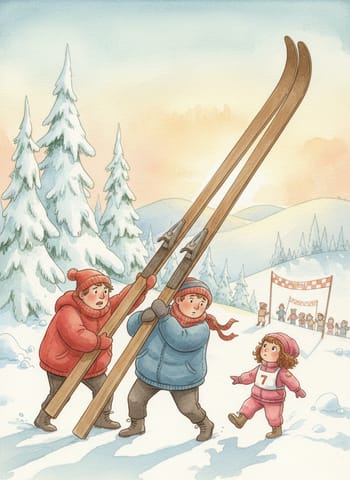
The trolley stops a hand's width from a small girl in a yellow hat. In her mittens she holds a paper number: seven.
La carretilla se detiene a un palmo de una niña pequeña con un gorro amarillo. En sus manoplas sostiene un número de papel: siete.
Hedy checks her watch. "Seven fifty-six," she says, with a shaky voice. "We are early."
Hedy mira su reloj. «Siete cincuenta y seis», dice con voz temblorosa. «Llegamos temprano».
"You are the courier," the girl says. She looks at the skis, then at the two tired women, then at the skis again. Her mouth falls open. "Are those mine? They are enormous."
«Ustedes son las mensajeras», dice la niña. Mira los esquís, luego a las dos mujeres cansadas, y otra vez los esquís. Se le abre la boca. «¿Son míos? Son enormes».
"They are yours," Nadine says. She stands up on legs that feel like soup. "You will grow into them."
«Son tuyos», dice Nadine. Se pone de pie sobre unas piernas que parecen de sopa. «Crecerás hasta alcanzarlos».
The girl steps closer and puts one hand on the tip of a ski. It hums under her mitten. "I think they like me," she says.
La niña se acerca y pone una mano en la punta de un esquí. Zumba bajo su manopla. «Creo que les caigo bien», dice.
"They like everyone," Hedy says. "That is their problem."
«Les cae bien todo el mundo», dice Hedy. «Ese es su problema».
Pia kneels in the snow and ties the skis onto her small boots. They stick out in front of her like two long boats. She stands very straight to keep her balance. The crowd cheers when the starting bell rings. She pushes off, and the skis carry her away across the white hill.
Pia se arrodilla en la nieve y se ata los esquís a las botas pequeñas. Sobresalen frente a ella como dos largos botes. Se pone muy derecha para mantener el equilibrio. La multitud aplaude cuando suena la campana de salida. Ella se impulsa y los esquís la llevan lejos, por la colina blanca.
Nadine and Hedy watch her go, with sparks still in their hair. Then Hedy looks at the long road that leads back up to the hub.
Nadine y Hedy la ven alejarse, con chispas todavía en el cabello. Luego Hedy mira el largo camino que lleva de vuelta al centro.
"Nadine," she says. "How do we get home?"
«Nadine», dice. «¿Cómo volvemos a casa?».
Nadine looks at the pipe, the hill, and the lights far above. "Well," she says, "we can always send ourselves by post."
Nadine mira el tubo, la colina y las luces lejanas allá arriba. «Bueno», dice, «siempre podemos enviarnos por correo».
"Don't," Hedy says. "The last time I did, I arrived with a stamp on my forehead."
«No», dice Hedy. «La última vez que lo hice, llegué con un sello en la frente».