The Skis That Were Too Long
A free B1-level English story for language learners, readable online in 7 languages, with an option to listen via the free Storyteller app.
Two couriers must deliver a huge pair of skis to a seven-year-old before her first race.
That was the preview! Hear the full story in the free Storyteller app. Get the app
Audio isn't available right now.
The sorting room of the Highcrest courier hub is never quiet. Parcels hum on the shelves, and letters flutter in their baskets like nervous birds. A brass owl on the desk blinks at every label. It says the name of the town where the parcel belongs. Nadine has worked here for eight years, and she still loves the sound.
At half past seven, the owl blinks twice and says, "Lowmere."
A long parcel slides down the ramp from the loading door. It is wrapped in brown paper and tied with silver string. It is two and a half metres long. It rests on the floor with one end sticking out into the aisle.
"What is that?" Nadine asks.
Hedy, the night supervisor, picks up the label. She reads it twice, then she laughs. "A pair of skis," she says. "For a girl named Pia. She is seven years old."
"They are taller than the owl. Taller than me!"
"The note says she will grow into them." Hedy turns the label over. "It also says, 'Deliver tonight. Her first race starts at nine, and she will not race without them.' Somebody has paid triple for speed."
Nadine looks at the clock above the door. The hands show seven thirty-five. Lowmere lies in the valley, forty minutes away by the evening van. The van leaves from the loading dock at eight, and it never waits for anyone.
"Then we have twenty-five minutes," she says.
"Enough." Hedy rolls up her sleeves. "We send the skis along the ceiling rail. It carries parcels to the dock in four minutes."
The ceiling rail is the pride of the hub. It is a track of iron hooks under the roof. It runs along all four walls and out through an arch to the dock. Every night, hundreds of parcels travel on it, humming like a flock of geese.
Nadine climbs a ladder and hangs the skis from two hooks, one near each end. They hang straight and still, and they look almost proud. Hedy pulls the lever.
The rail starts to move, and the skis sail across the room under the lamps. For a minute, everything is perfect.
Then the skis reach the corner. The rail bends to the right, but the skis do not bend with it. Their front tips swing out and strike the wall of the arch with a loud crack. The rail jerks and stops, and every parcel in the room cries out in a different voice.
"No, no, no," Hedy says. She pulls the lever back and forward. Nothing happens. The skis hang across the arch like a bridge, and a hundred other parcels are stuck behind them.
"The corner is too tight," Nadine says. "I should have measured. We cannot move the skis without cutting them."
"We are not cutting them. They belong to a child." Hedy looks at the clock. It says seven forty-five. "Fifteen minutes. The van will leave without us."
From the dock, a bell begins to ring. It is the first warning. It rings once for every five minutes left.
Nadine runs to the window and looks out. Outside, the valley is dark and wide, and a small cluster of lights glows far below: Lowmere. The hub sits at the top of a steep hill. Next to the window, a huge wooden pipe curves down the slope. It winds round and round to the village square. It is the Long Slide, the old route for heavy crates.
"What about the slide?" she asks.
"The slide is for crates, not for skis." Hedy shakes her head. "And a crate does not need to be steered. The slide has eleven turns. A long parcel will stick in the third one."
"Then a long parcel needs somebody to steer it."
Hedy turns slowly. "Nadine. Please say you do not mean what I think you mean."
"Think about it. The skis are the right shape for sliding. The slide is the right shape for the skis. The only thing missing is a seat." Nadine is already dragging a flat trolley across the floor, the kind used for sacks of small letters. She puts it on the floor and lays the skis along its sides like two long runners.
"We will break the rules," Hedy says.
"We will break one rule. The rule says, 'Do not send people down the slide.' It does not say what to do if the people are the only ones who can steer."
For a moment, Hedy says nothing. The bell rings a second time. The skis, tied to the trolley, begin to hum. The sound is soft and eager, like a cat at an open door.
"Even the parcel wants it," Nadine says.
"That is the most worrying thing you have said all night." But Hedy sits down on the trolley, and she pulls her hat tight over her ears. "Get in. Hold on to me, and do not scream."
"I never scream."
They push off. The trolley rolls down the ramp, through the window frame, and into the mouth of the wooden pipe. For a few seconds, everything is dark and quiet. Then the slide drops away, and they fall.
The first turn comes so fast that Nadine's stomach stays behind. The skis sing on the wood, a clear, high note. The second turn is wide, and Hedy leans to the left to steer. The third turn is the one that worries them. The long skis scrape the wall on the outside, and the trolley shakes.
"Lean right!" Hedy shouts.
Nadine leans. The skis slide back to the middle. A shower of sparks bursts from the wood. Then they are through, spinning round the fourth bend and the fifth.
They scream after all, both of them. By the seventh turn, the scream becomes laughter. By the ninth, they have learned how to steer by moving their shoulders together. The tenth turn is almost graceful. At the eleventh, the pipe opens, and the trolley shoots out into the cool night air.
It lands in the village square with a long, gentle slide across the stones. A crowd of children in thick coats stands near a rope. They all turn to stare.
The trolley stops a hand's width from a small girl in a yellow hat. In her mittens she holds a paper number: seven.
Hedy checks her watch. "Seven fifty-six," she says, with a shaky voice. "We are early."
"You are the courier," the girl says. She looks at the skis, then at the two tired women, then at the skis again. Her mouth falls open. "Are those mine? They are enormous."
"They are yours," Nadine says. She stands up on legs that feel like soup. "You will grow into them."
The girl steps closer and puts one hand on the tip of a ski. It hums under her mitten. "I think they like me," she says.
"They like everyone," Hedy says. "That is their problem."
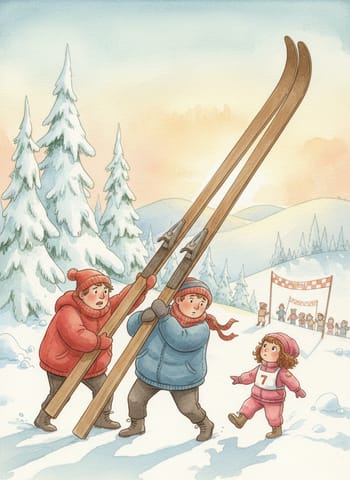
Pia kneels in the snow and ties the skis onto her small boots. They stick out in front of her like two long boats. She stands very straight to keep her balance. The crowd cheers when the starting bell rings. She pushes off, and the skis carry her away across the white hill.
Nadine and Hedy watch her go, with sparks still in their hair. Then Hedy looks at the long road that leads back up to the hub.
"Nadine," she says. "How do we get home?"
Nadine looks at the pipe, the hill, and the lights far above. "Well," she says, "we can always send ourselves by post."
"Don't," Hedy says. "The last time I did, I arrived with a stamp on my forehead."