The Postcard from Port Lumen
Una historia gratuita en inglés de nivel B1 para estudiantes, para leer en línea en 7 idiomas, con opción de escucharla en la app gratuita Storyteller.
A teenager who is learning English helps a visitor find the harbour shown on a postcard, a place no map can name.
¡Ese fue el avance! Escucha la historia completa en la app gratuita Storyteller. Descargar la app
El audio no está disponible en este momento.
Mina opens the wooden shutters of the farm stall at nine o'clock every summer morning. The stall stands beside the gate at the end of the farm lane. On the shelves she sets out jars of honey and boxes of early strawberries. A tin is there for people to leave their coins.
Mina abre los postigos de madera del puesto de la granja a las nueve de cada mañana de verano. El puesto está junto a la entrada, al final del camino de la granja. En los estantes coloca frascos de miel y cajas de las primeras fresas. Hay una lata para que la gente deje sus monedas.
Mina is fifteen, and she is learning English at school. The stall is her favourite classroom. Tourists come along the road on bicycles, and she practises on all of them. She keeps a small notebook in her apron pocket for new words. Today the page says "bargain" and "souvenir."
Mina tiene quince años y estudia inglés en la escuela. El puesto es su aula favorita. Los turistas pasan por el camino en bicicleta, y ella practica con todos. Guarda una pequeña libreta en el bolsillo del delantal para las palabras nuevas. Hoy la página dice «bargain» y «souvenir».
At half past nine, a boy about her age rolls his bicycle up to the gate. He has a dusty backpack and a sunburned nose. He does not look at the strawberries. He looks at a postcard in his hand, and he seems worried.
A las nueve y media, un chico de más o menos su edad se acerca rodando su bicicleta hasta la entrada. Lleva una mochila polvorienta y la nariz quemada por el sol. No mira las fresas. Mira una postal que tiene en la mano, y parece preocupado.
"Hello," he says. "Sorry. Do you speak English?"
«Hola», dice. «Perdona. ¿Hablas inglés?».
"A little," Mina says. "I am learning. Please speak slowly."
«Un poco», dice Mina. «Estoy aprendiendo. Por favor, habla despacio».
"Of course. My name is Evander." He holds up the postcard. "I am looking for a place called Port Lumen. Have you heard of it?"
«Claro. Me llamo Evander». Levanta la postal. «Busco un lugar llamado Port Lumen. ¿Has oído hablar de él?».
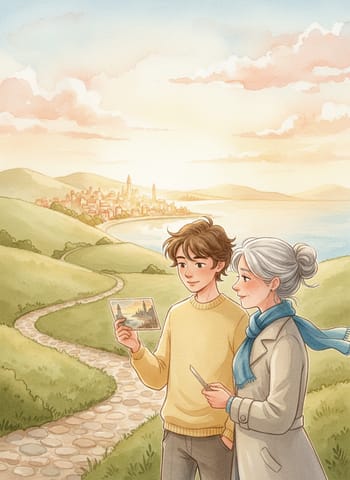
Mina takes the card. The picture shows a small harbour with bright blue water. White boats lie along the shore, and three tall trees stand on a green hill behind them. The colours are soft, as if somebody painted them with a wet brush.
Mina toma la tarjeta. La imagen muestra un pequeño puerto de aguas azul brillante. Hay botes blancos a lo largo de la orilla, y tres árboles altos se alzan en una colina verde detrás de ellos. Los colores son suaves, como si alguien los hubiera pintado con un pincel mojado.
"Port Lumen," she says. She repeats it twice. "No. I do not know this place. There is no sea near here."
«Port Lumen», dice. Lo repite dos veces. «No. No conozco este lugar. No hay mar cerca de aquí».
"I know," Evander says with a tired laugh. "I have asked everyone. I found this card inside a second-hand book in the city. There is no address on it, only a short message. Please turn it over."
«Lo sé», dice Evander con una risa cansada. «Le he preguntado a todo el mundo. Encontré esta tarjeta dentro de un libro de segunda mano en la ciudad. No tiene dirección, solo un mensaje corto. Por favor, dale la vuelta».
On the back, a few lines of handwriting slope across the card. Mina reads them slowly, with her finger under each word. "Wish you were here. Come in the morning, before the lamps go out."
En el reverso, unas pocas líneas de letra manuscrita se inclinan a lo largo de la tarjeta. Mina las lee despacio, con el dedo bajo cada palabra. «Ojalá estuvieras aquí. Ven por la mañana, antes de que se apaguen las lámparas».
"The stamp is from the post office in your village," Evander says. "That is why I came. The woman there said no Port Lumen exists in the whole district. But she looked at the card for a long time. Then she said, 'Try the farm at the end of the lane.' So here I am."
«El sello es de la oficina de correos de tu pueblo», dice Evander. «Por eso vine. La mujer de allí dijo que no existe ningún Port Lumen en todo el distrito. Pero miró la tarjeta durante mucho rato. Luego dijo: "Prueba en la granja al final del camino". Así que aquí estoy».
Mina feels a small, pleasant tingle. It is the feeling she gets when she solves a puzzle. She takes out her phone and opens the map. She types the name. Nothing appears. She tries three different spellings, and still nothing.
Mina siente un hormigueo pequeño y agradable. Es la sensación que tiene cuando resuelve un acertijo. Saca su teléfono y abre el mapa. Escribe el nombre. No aparece nada. Prueba tres ortografías distintas, y sigue sin aparecer nada.
"The map does not know it," she says. "Maybe the painter made it up."
«El mapa no lo conoce», dice. «Quizá el pintor lo inventó».
"Maybe." Evander sits on the low wall beside the gate. "But why would anyone write 'Wish you were here' about a place that does not exist?"
«Quizá». Evander se sienta en el muro bajo junto a la entrada. «Pero ¿por qué alguien escribiría "Ojalá estuvieras aquí" sobre un lugar que no existe?».
Mina does not answer. She is looking at the postcard again, at the three trees on the green hill. Slowly she lifts her eyes to the lane behind her stall. Two tall poplars stand there beside a pale stump.
Mina no responde. Está mirando la postal otra vez, los tres árboles de la colina verde. Lentamente levanta los ojos hacia el camino detrás de su puesto. Dos álamos altos se alzan allí junto a un tocón pálido.
"Evander," she says. "Count the trees in the picture."
«Evander», dice. «Cuenta los árboles de la imagen».
"Three."
«Tres».
"Now count the trees there."
«Ahora cuenta los árboles de allá».
He turns round and counts. "Two trees and a stump." He looks back at the card with wide eyes. "The third one fell."
Él se da vuelta y cuenta. «Dos árboles y un tocón». Mira la tarjeta otra vez con los ojos muy abiertos. «El tercero se cayó».
"A long time ago," Mina says. "My father told me. It was already dead when it fell, before I was born."
«Hace mucho tiempo», dice Mina. «Me lo contó mi padre. Ya estaba muerto cuando se cayó, antes de que yo naciera».
They look at each other. Then Mina reads the message once more. "Before the lamps go out," she says. "What are lamps in the morning? I do not understand."
Se miran. Luego Mina lee el mensaje una vez más. «Antes de que se apaguen las lámparas», dice. «¿Qué son las lámparas por la mañana? No entiendo».
She walks up and down behind the stall, thinking in two languages. She says the sentence in her own language, then in English, then in her own language again. Something about the words feels familiar, as if she heard them as a child.
Camina de un lado a otro detrás del puesto, pensando en dos idiomas. Dice la frase en su idioma, luego en inglés, luego otra vez en su idioma. Algo en las palabras le resulta familiar, como si las hubiera oído de niña.
"Lamps," she says suddenly. "My mother has a word for the flax flowers. She calls them the little lamps of June."
«Lámparas», dice de pronto. «Mi madre tiene una palabra para las flores de lino. Las llama las lamparitas de junio».
"Flax?" Evander asks. "What is flax?"
«¿Lino?», pregunta Evander. «¿Qué es el lino?».
"I do not know the English word for the flower, only the plant." She checks her phone and shows him the screen. "Flax. It is blue. The flowers open in the morning, and they fall before noon. After that, the field is green."
«No sé la palabra en inglés para la flor, solo para la planta». Mira su teléfono y le muestra la pantalla. «Flax. Es azul. Las flores se abren por la mañana y caen antes del mediodía. Después de eso, el campo queda verde».
Evander looks at his watch, and his face changes. "It is ten past ten."
Evander mira su reloj, y su rostro cambia. «Son las diez y diez».
"Then we must go now," says Mina. "If you wait for the afternoon, you will see nothing."
«Entonces tenemos que ir ahora», dice Mina. «Si esperas hasta la tarde, no verás nada».
She turns the shutters half closed and hangs a small sign on the gate. BACK IN TEN MINUTES. Then she runs up the lane with Evander close behind her, the bicycle forgotten against the wall.
Entrecierra los postigos y cuelga un pequeño cartel en la entrada. VUELVO EN DIEZ MINUTOS. Luego corre por el camino con Evander pisándole los talones, la bicicleta olvidada contra la pared.
They pass the two poplars and the stump. The lane climbs a slope between low hedges, and the air smells of cut grass and honey. At the top, Mina stops so suddenly that Evander almost walks into her.
Pasan junto a los dos álamos y el tocón. El camino sube por una cuesta entre setos bajos, y el aire huele a pasto cortado y a miel. Arriba, Mina se detiene tan de repente que Evander casi choca con ella.
"Look," she says.
«Mira», dice.
Below them, a whole field is blue. The flax flowers cover it from edge to edge, thousands upon thousands of them. They tremble a little and shine in the morning light. It looks like a calm sea. Along the far edge, big round bales of hay stand in a loose line. They are wrapped in white plastic, like boats waiting at a shore.
Debajo de ellos, todo un campo es azul. Las flores de lino lo cubren de un borde al otro, miles y miles de ellas. Tiemblan un poco y brillan a la luz de la mañana. Parece un mar en calma. A lo largo del borde lejano, grandes pacas redondas de heno están en una fila suelta. Están envueltas en plástico blanco, como botes que esperan en una orilla.
Evander says nothing for a long time. He holds up the postcard at arm's length. He moves it slowly until the edge of the picture meets the edge of the field. The three trees, the hill, and the shape of the hills behind it all fit together. Even the small white boats are in the right place.
Evander no dice nada durante mucho rato. Sostiene la postal con el brazo extendido. La mueve despacio hasta que el borde de la imagen coincide con el borde del campo. Los tres árboles, la colina y la forma de las colinas detrás encajan por completo. Hasta los pequeños botes blancos están en el lugar correcto.
"It is exactly the same," he says at last. "The painter did not make up a harbour. The painter looked at this field and saw a sea."
«Es exactamente igual», dice por fin. «El pintor no inventó un puerto. El pintor miró este campo y vio un mar».
"And called it a port," Mina says. She looks at the card again and notices something she missed before. In the bottom corner, in tiny letters, are the words "Lumen Farm."
«Y lo llamó puerto», dice Mina. Mira la tarjeta otra vez y nota algo que antes se le había pasado. En la esquina de abajo, con letras diminutas, están las palabras «Lumen Farm».
"Lumen Farm," she repeats, surprised. "That is the name of my family's farm. It is on the gate. I have walked past that sign every day of my life. I never thought about what it means."
«Lumen Farm», repite, sorprendida. «Es el nombre de la granja de mi familia. Está en la entrada. He pasado junto a ese cartel todos los días de mi vida. Nunca pensé en lo que significa».
"Light," says Evander. "Lumen means light."
«Luz», dice Evander. «Lumen significa luz».
"Port of light," Mina says slowly. "Port Lumen." She laughs, and the sound runs across the field.
«Puerto de luz», dice Mina despacio. «Port Lumen». Se ríe, y el sonido recorre el campo.
Down in front of them, a few petals begin to drift from the flowers. They land on the green stems. The little lamps are already going out. Evander puts the postcard safely into his shirt pocket. Then he takes a photograph of the field with his phone. He takes six more before the colour starts to fade.
Frente a ellos, algunos pétalos empiezan a desprenderse de las flores. Caen sobre los tallos verdes. Las lamparitas ya se están apagando. Evander guarda la postal con cuidado en el bolsillo de la camisa. Luego le toma una fotografía al campo con su teléfono. Toma seis más antes de que el color empiece a desvanecerse.
"I came here to find a place on a map," he says. "But you found it with a stump and a flower. Thank you, Mina. You did my work better than I did."
«Vine a encontrar un lugar en un mapa», dice. «Pero tú lo encontraste con un tocón y una flor. Gracias, Mina. Hiciste mi trabajo mejor que yo».
"It is my farm," she says. "It is easy."
«Es mi granja», dice ella. «Es fácil».
"Not for me." He looks at the field one more time. "So what do I call this place now?"
«No para mí». Mira el campo una vez más. «Entonces, ¿cómo llamo a este lugar ahora?».
Mina smiles and tucks the notebook back into her apron. She has a new English word for the page today: "flax."
Mina sonríe y guarda la libreta en el delantal. Hoy tiene una palabra nueva en inglés para la página: «flax».
"Port Lumen," she says. "Welcome."
«Port Lumen», dice. «Bienvenido».