The Postcard from Port Lumen
A free B1-level English story for language learners, readable online in 7 languages, with an option to listen via the free Storyteller app.
A teenager who is learning English helps a visitor find the harbour shown on a postcard, a place no map can name.
That was the preview! Hear the full story in the free Storyteller app. Get the app
Audio isn't available right now.
Mina opens the wooden shutters of the farm stall at nine o'clock every summer morning. The stall stands beside the gate at the end of the farm lane. On the shelves she sets out jars of honey and boxes of early strawberries. A tin is there for people to leave their coins.
Mina is fifteen, and she is learning English at school. The stall is her favourite classroom. Tourists come along the road on bicycles, and she practises on all of them. She keeps a small notebook in her apron pocket for new words. Today the page says "bargain" and "souvenir."
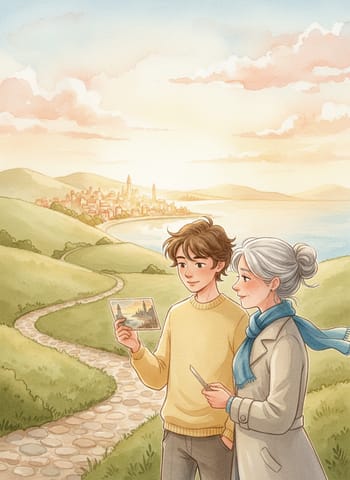
At half past nine, a boy about her age rolls his bicycle up to the gate. He has a dusty backpack and a sunburned nose. He does not look at the strawberries. He looks at a postcard in his hand, and he seems worried.
"Hello," he says. "Sorry. Do you speak English?"
"A little," Mina says. "I am learning. Please speak slowly."
"Of course. My name is Evander." He holds up the postcard. "I am looking for a place called Port Lumen. Have you heard of it?"
Mina takes the card. The picture shows a small harbour with bright blue water. White boats lie along the shore, and three tall trees stand on a green hill behind them. The colours are soft, as if somebody painted them with a wet brush.
"Port Lumen," she says. She repeats it twice. "No. I do not know this place. There is no sea near here."
"I know," Evander says with a tired laugh. "I have asked everyone. I found this card inside a second-hand book in the city. There is no address on it, only a short message. Please turn it over."
On the back, a few lines of handwriting slope across the card. Mina reads them slowly, with her finger under each word. "Wish you were here. Come in the morning, before the lamps go out."
"The stamp is from the post office in your village," Evander says. "That is why I came. The woman there said no Port Lumen exists in the whole district. But she looked at the card for a long time. Then she said, 'Try the farm at the end of the lane.' So here I am."
Mina feels a small, pleasant tingle. It is the feeling she gets when she solves a puzzle. She takes out her phone and opens the map. She types the name. Nothing appears. She tries three different spellings, and still nothing.
"The map does not know it," she says. "Maybe the painter made it up."
"Maybe." Evander sits on the low wall beside the gate. "But why would anyone write 'Wish you were here' about a place that does not exist?"
Mina does not answer. She is looking at the postcard again, at the three trees on the green hill. Slowly she lifts her eyes to the lane behind her stall. Two tall poplars stand there beside a pale stump.
"Evander," she says. "Count the trees in the picture."
"Three."
"Now count the trees there."
He turns round and counts. "Two trees and a stump." He looks back at the card with wide eyes. "The third one fell."
"A long time ago," Mina says. "My father told me. It was already dead when it fell, before I was born."
They look at each other. Then Mina reads the message once more. "Before the lamps go out," she says. "What are lamps in the morning? I do not understand."
She walks up and down behind the stall, thinking in two languages. She says the sentence in her own language, then in English, then in her own language again. Something about the words feels familiar, as if she heard them as a child.
"Lamps," she says suddenly. "My mother has a word for the flax flowers. She calls them the little lamps of June."
"Flax?" Evander asks. "What is flax?"
"I do not know the English word for the flower, only the plant." She checks her phone and shows him the screen. "Flax. It is blue. The flowers open in the morning, and they fall before noon. After that, the field is green."
Evander looks at his watch, and his face changes. "It is ten past ten."
"Then we must go now," says Mina. "If you wait for the afternoon, you will see nothing."
She turns the shutters half closed and hangs a small sign on the gate. BACK IN TEN MINUTES. Then she runs up the lane with Evander close behind her, the bicycle forgotten against the wall.
They pass the two poplars and the stump. The lane climbs a slope between low hedges, and the air smells of cut grass and honey. At the top, Mina stops so suddenly that Evander almost walks into her.
"Look," she says.
Below them, a whole field is blue. The flax flowers cover it from edge to edge, thousands upon thousands of them. They tremble a little and shine in the morning light. It looks like a calm sea. Along the far edge, big round bales of hay stand in a loose line. They are wrapped in white plastic, like boats waiting at a shore.
Evander says nothing for a long time. He holds up the postcard at arm's length. He moves it slowly until the edge of the picture meets the edge of the field. The three trees, the hill, and the shape of the hills behind it all fit together. Even the small white boats are in the right place.
"It is exactly the same," he says at last. "The painter did not make up a harbour. The painter looked at this field and saw a sea."
"And called it a port," Mina says. She looks at the card again and notices something she missed before. In the bottom corner, in tiny letters, are the words "Lumen Farm."
"Lumen Farm," she repeats, surprised. "That is the name of my family's farm. It is on the gate. I have walked past that sign every day of my life. I never thought about what it means."
"Light," says Evander. "Lumen means light."
"Port of light," Mina says slowly. "Port Lumen." She laughs, and the sound runs across the field.
Down in front of them, a few petals begin to drift from the flowers. They land on the green stems. The little lamps are already going out. Evander puts the postcard safely into his shirt pocket. Then he takes a photograph of the field with his phone. He takes six more before the colour starts to fade.
"I came here to find a place on a map," he says. "But you found it with a stump and a flower. Thank you, Mina. You did my work better than I did."
"It is my farm," she says. "It is easy."
"Not for me." He looks at the field one more time. "So what do I call this place now?"
Mina smiles and tucks the notebook back into her apron. She has a new English word for the page today: "flax."
"Port Lumen," she says. "Welcome."