Mina opens the wooden shutters of the farm stall at nine o'clock every summer morning. The stall stands beside the gate at the end of the farm lane. On the shelves she sets out jars of honey and boxes of early strawberries. A tin is there for people to leave their coins.
每年夏天的早晨,米娜九点钟都会打开农家小摊的木窗板。小摊就立在农场小路尽头的大门旁。架子上摆着一罐罐蜂蜜和一盒盒早熟的草莓。还有一个铁盒,供人们放硬币。
Mina is fifteen, and she is learning English at school. The stall is her favourite classroom. Tourists come along the road on bicycles, and she practises on all of them. She keeps a small notebook in her apron pocket for new words. Today the page says "bargain" and "souvenir."
米娜十五岁,在学校里学英语。这个小摊是她最喜欢的教室。游客们骑着自行车沿路而来,她拿每个人练习。围裙口袋里总揣着一本小笔记本,用来记新单词。今天这一页上写着“便宜货”和“纪念品”。
At half past nine, a boy about her age rolls his bicycle up to the gate. He has a dusty backpack and a sunburned nose. He does not look at the strawberries. He looks at a postcard in his hand, and he seems worried.
九点半,一个和她年纪相仿的男孩推着自行车来到大门口。他背着一个满是灰尘的背包,鼻子被晒得通红。他没有看草莓。他在看手里的一张明信片,神情有些焦虑。
"Hello," he says. "Sorry. Do you speak English?"
“你好,”他说,“不好意思。你会说英语吗?”
"A little," Mina says. "I am learning. Please speak slowly."
“会一点,”米娜说,“我在学。请说慢一点。”
"Of course. My name is Evander." He holds up the postcard. "I am looking for a place called Port Lumen. Have you heard of it?"
“当然。我叫埃文德。”他举起明信片。“我在找一个叫卢门港的地方。你听说过吗?”
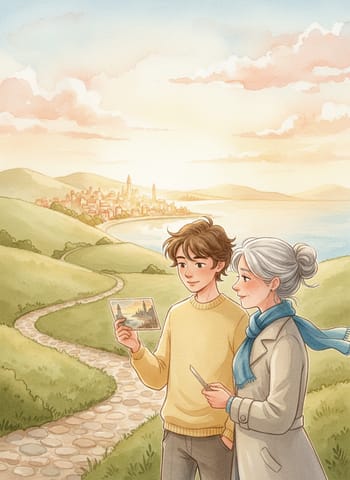
Mina takes the card. The picture shows a small harbour with bright blue water. White boats lie along the shore, and three tall trees stand on a green hill behind them. The colours are soft, as if somebody painted them with a wet brush.
米娜接过卡片。画面上是一个小小的港湾,水蓝得鲜亮。白色的小船沿着岸边排开,身后的绿色山坡上立着三棵高大的树。色彩柔和,像是有人用湿画笔画成的。
"Port Lumen," she says. She repeats it twice. "No. I do not know this place. There is no sea near here."
“卢门港,”她说。她把这个名字重复了两遍。“没有。我不知道这个地方。这附近没有海。”
"I know," Evander says with a tired laugh. "I have asked everyone. I found this card inside a second-hand book in the city. There is no address on it, only a short message. Please turn it over."
“我知道,”埃文德疲惫地笑了笑,“我问遍了所有人。这张卡片是我在城里一本二手书里发现的。上面没有地址,只有一句简短的留言。请翻过来看看。”
On the back, a few lines of handwriting slope across the card. Mina reads them slowly, with her finger under each word. "Wish you were here. Come in the morning, before the lamps go out."
卡片背面,几行手写的字斜斜地爬过纸面。米娜一边读,一边用手指在每个词下面慢慢移动。“真希望你在这里。早晨来吧,趁灯还没熄灭。”
"The stamp is from the post office in your village," Evander says. "That is why I came. The woman there said no Port Lumen exists in the whole district. But she looked at the card for a long time. Then she said, 'Try the farm at the end of the lane.' So here I am."
“邮戳是你们村邮局的,”埃文德说,“所以我才来了。那里的女士说,整个地区根本没有卢门港这个地方。可她盯着卡片看了很久。然后她说:‘去小路尽头的那家农场试试。’于是我就来了。”
Mina feels a small, pleasant tingle. It is the feeling she gets when she solves a puzzle. She takes out her phone and opens the map. She types the name. Nothing appears. She tries three different spellings, and still nothing.
米娜心里泛起一阵小小的、愉快的悸动。这是她解开谜题时才有的感觉。她掏出手机,打开地图,输入这个名字。什么也没出现。她试了三种不同的拼法,还是什么都没有。
"The map does not know it," she says. "Maybe the painter made it up."
“地图不认识它,”她说,“也许是画家编出来的。”
"Maybe." Evander sits on the low wall beside the gate. "But why would anyone write 'Wish you were here' about a place that does not exist?"
“也许吧。”埃文德在大门旁的矮墙上坐下。“可是,为什么有人会对一个不存在的地方写‘真希望你在这里’呢?”
Mina does not answer. She is looking at the postcard again, at the three trees on the green hill. Slowly she lifts her eyes to the lane behind her stall. Two tall poplars stand there beside a pale stump.
米娜没有回答。她又看着那张明信片,看着绿色山坡上的三棵树。慢慢地,她抬起眼睛,望向摊位身后的小路。那里有两棵高高的杨树,旁边是一截苍白的树桩。
"Evander," she says. "Count the trees in the picture."
“埃文德,”她说,“数数画里的树。”
"Three."
“三棵。”
"Now count the trees there."
“现在数数那边的树。”
He turns round and counts. "Two trees and a stump." He looks back at the card with wide eyes. "The third one fell."
他转过身去数。“两棵树,一截树桩。”他睁大眼睛回头看着卡片。“第三棵倒了。”
"A long time ago," Mina says. "My father told me. It was already dead when it fell, before I was born."
“很久以前了,”米娜说,“我爸爸告诉过我。它倒下之前就已经枯死了,那是在我出生以前。”
They look at each other. Then Mina reads the message once more. "Before the lamps go out," she says. "What are lamps in the morning? I do not understand."
他们对视了一眼。然后米娜又把留言读了一遍。“趁灯还没熄灭,”她说,“早晨怎么会有灯?我不明白。”
She walks up and down behind the stall, thinking in two languages. She says the sentence in her own language, then in English, then in her own language again. Something about the words feels familiar, as if she heard them as a child.
她在摊位后面来回踱步,用两种语言思考。她先用自己的母语念出这句话,再用英语念,然后又用母语念。这些词里有某种熟悉的东西,仿佛她小时候听到过。
"Lamps," she says suddenly. "My mother has a word for the flax flowers. She calls them the little lamps of June."
“灯,”她忽然说,“我妈妈有个叫亚麻花的说法。她管它们叫六月的小灯。”
"Flax?" Evander asks. "What is flax?"
“Flax?”埃文德问,“Flax 是什么?”
"I do not know the English word for the flower, only the plant." She checks her phone and shows him the screen. "Flax. It is blue. The flowers open in the morning, and they fall before noon. After that, the field is green."
“这种花的英语我不知道,我只知道这种植物。”她查了查手机,把屏幕给他看。“Flax。它是蓝色的。花在早晨开放,中午之前就谢了。那以后,田里就只剩一片绿。”
Evander looks at his watch, and his face changes. "It is ten past ten."
埃文德看了看手表,脸色变了。“十点十分了。”
"Then we must go now," says Mina. "If you wait for the afternoon, you will see nothing."
“那我们现在就得走,”米娜说,“要是等到下午,你什么也看不到。”
She turns the shutters half closed and hangs a small sign on the gate. BACK IN TEN MINUTES. Then she runs up the lane with Evander close behind her, the bicycle forgotten against the wall.
她把窗板半掩上,在大门上挂了一块小牌子:十分钟后回来。然后她沿着小路跑了上去,埃文德紧跟在后面,自行车被忘在了墙边。
They pass the two poplars and the stump. The lane climbs a slope between low hedges, and the air smells of cut grass and honey. At the top, Mina stops so suddenly that Evander almost walks into her.
他们经过那两棵杨树和那截树桩。小路在低矮的树篱之间爬上一道斜坡,空气里弥漫着青草和蜂蜜的气味。到了坡顶,米娜猛地停住,埃文德差点撞到她身上。
"Look," she says.
“看,”她说。
Below them, a whole field is blue. The flax flowers cover it from edge to edge, thousands upon thousands of them. They tremble a little and shine in the morning light. It looks like a calm sea. Along the far edge, big round bales of hay stand in a loose line. They are wrapped in white plastic, like boats waiting at a shore.
在他们下方,整片田野都是蓝色的。亚麻花从这头铺到那头,成千上万朵。它们微微颤动,在晨光里闪闪发亮。那看起来像一片平静的海。远处的田边,一排大大的圆形干草捆松散地立着。它们裹着白色的塑料膜,像停在岸边等候的小船。
Evander says nothing for a long time. He holds up the postcard at arm's length. He moves it slowly until the edge of the picture meets the edge of the field. The three trees, the hill, and the shape of the hills behind it all fit together. Even the small white boats are in the right place.
埃文德很久都没有说话。他把明信片举到一臂远的地方,慢慢移动,直到画面的边缘与田野的边缘重合。三棵树、山坡,还有身后起伏的丘陵,全都严丝合缝。连那些白色的小船也都在恰当的位置上。
"It is exactly the same," he says at last. "The painter did not make up a harbour. The painter looked at this field and saw a sea."
“一模一样,”他终于说,“画家并没有编造一个港湾。画家看着这片田野,看见了一片海。”
"And called it a port," Mina says. She looks at the card again and notices something she missed before. In the bottom corner, in tiny letters, are the words "Lumen Farm."
“还把它叫作港口。”米娜说。她又看了看卡片,注意到了之前漏掉的一样东西。在底角,有几个极小的字:“卢门农场”。
"Lumen Farm," she repeats, surprised. "That is the name of my family's farm. It is on the gate. I have walked past that sign every day of my life. I never thought about what it means."
“卢门农场,”她吃惊地重复道,“那是我家农场的名字。就写在大门上。我每天都从那块牌子旁边走过。我从没想过它是什么意思。”
"Light," says Evander. "Lumen means light."
“光,”埃文德说,“‘卢门’的意思是光。”
"Port of light," Mina says slowly. "Port Lumen." She laughs, and the sound runs across the field.
“光之港,”米娜慢慢地说,“卢门港。”她笑了起来,笑声在田野上奔跑。
Down in front of them, a few petals begin to drift from the flowers. They land on the green stems. The little lamps are already going out. Evander puts the postcard safely into his shirt pocket. Then he takes a photograph of the field with his phone. He takes six more before the colour starts to fade.
在他们面前下方,几片花瓣开始从花上飘落。它们落在绿色的茎上。小灯已经在熄灭了。埃文德把明信片小心地放进衬衫口袋,然后用手机给田野拍了一张照片。颜色开始褪去之前,他又拍了六张。
"I came here to find a place on a map," he says. "But you found it with a stump and a flower. Thank you, Mina. You did my work better than I did."
“我来这里,是为了在地图上找一个地方,”他说,“可你是靠一截树桩和一朵花找到的。谢谢你,米娜。你干得比我这个找人的还好。”
"It is my farm," she says. "It is easy."
“这是我家的农场,”她说,“很容易的。”
"Not for me." He looks at the field one more time. "So what do I call this place now?"
“对我可不容易。”他又看了一眼田野。“那么,现在我该怎么称呼这个地方呢?”
Mina smiles and tucks the notebook back into her apron. She has a new English word for the page today: "flax."
米娜笑了笑,把笔记本塞回围裙里。今天,她的这一页有了一个新的英语单词:“flax”。
"Port Lumen," she says. "Welcome."
“卢门港,”她说,“欢迎你来。”