The Postcard from Port Lumen
Uma história gratuita em inglês de nível B1 para estudantes, para ler online em 7 idiomas, com opção de ouvir no app gratuito Storyteller.
A teenager who is learning English helps a visitor find the harbour shown on a postcard, a place no map can name.
Essa foi a prévia! Ouça a história completa no app gratuito Storyteller. Baixar o app
O áudio não está disponível no momento.
Mina opens the wooden shutters of the farm stall at nine o'clock every summer morning. The stall stands beside the gate at the end of the farm lane. On the shelves she sets out jars of honey and boxes of early strawberries. A tin is there for people to leave their coins.
Mina abre as janelas de madeira da barraca da fazenda às nove horas de toda manhã de verão. A barraca fica ao lado do portão, no fim da estradinha da fazenda. Nas prateleiras, ela arruma potes de mel e caixas de morangos temporões. Há uma lata para as pessoas deixarem as moedas.
Mina is fifteen, and she is learning English at school. The stall is her favourite classroom. Tourists come along the road on bicycles, and she practises on all of them. She keeps a small notebook in her apron pocket for new words. Today the page says "bargain" and "souvenir."
Mina tem quinze anos e está aprendendo inglês na escola. A barraca é a sala de aula favorita dela. Turistas passam pela estrada de bicicleta, e ela pratica com todos eles. Guarda no bolso do avental um caderninho para palavras novas. Hoje a página diz "bargain" e "souvenir".
At half past nine, a boy about her age rolls his bicycle up to the gate. He has a dusty backpack and a sunburned nose. He does not look at the strawberries. He looks at a postcard in his hand, and he seems worried.
Às nove e meia, um garoto da idade dela chega empurrando a bicicleta até o portão. Tem uma mochila empoeirada e o nariz queimado de sol. Ele não olha para os morangos. Olha para um cartão-postal na mão, e parece preocupado.
"Hello," he says. "Sorry. Do you speak English?"
"Olá", diz ele. "Desculpe. Você fala inglês?"
"A little," Mina says. "I am learning. Please speak slowly."
"Um pouco", diz Mina. "Estou aprendendo. Por favor, fale devagar."
"Of course. My name is Evander." He holds up the postcard. "I am looking for a place called Port Lumen. Have you heard of it?"
"Claro. Meu nome é Evander." Ele ergue o postal. "Estou procurando um lugar chamado Port Lumen. Você já ouviu falar?"
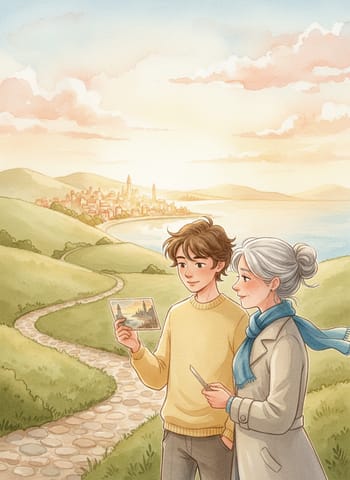
Mina takes the card. The picture shows a small harbour with bright blue water. White boats lie along the shore, and three tall trees stand on a green hill behind them. The colours are soft, as if somebody painted them with a wet brush.
Mina pega o cartão. A imagem mostra um pequeno porto com água de um azul vivo. Barcos brancos estão ao longo da margem, e três árvores altas se erguem numa colina verde ao fundo. As cores são suaves, como se alguém as tivesse pintado com um pincel molhado.
"Port Lumen," she says. She repeats it twice. "No. I do not know this place. There is no sea near here."
"Port Lumen", diz ela. Repete duas vezes. "Não. Não conheço esse lugar. Não há mar perto daqui."
"I know," Evander says with a tired laugh. "I have asked everyone. I found this card inside a second-hand book in the city. There is no address on it, only a short message. Please turn it over."
"Eu sei", diz Evander com uma risada cansada. "Perguntei a todo mundo. Encontrei este cartão dentro de um livro usado, na cidade. Não tem endereço, só uma mensagem curta. Por favor, vire."
On the back, a few lines of handwriting slope across the card. Mina reads them slowly, with her finger under each word. "Wish you were here. Come in the morning, before the lamps go out."
No verso, algumas linhas de letra inclinada atravessam o cartão. Mina lê devagar, com o dedo embaixo de cada palavra. "Queria que você estivesse aqui. Venha de manhã, antes que os lampiões se apaguem."
"The stamp is from the post office in your village," Evander says. "That is why I came. The woman there said no Port Lumen exists in the whole district. But she looked at the card for a long time. Then she said, 'Try the farm at the end of the lane.' So here I am."
"O selo é da agência dos correios do seu povoado", diz Evander. "Por isso eu vim. A mulher de lá disse que não existe nenhum Port Lumen em todo o distrito. Mas ela ficou olhando o cartão por muito tempo. Depois disse: 'Tente a fazenda no fim da estradinha'. Então aqui estou."
Mina feels a small, pleasant tingle. It is the feeling she gets when she solves a puzzle. She takes out her phone and opens the map. She types the name. Nothing appears. She tries three different spellings, and still nothing.
Mina sente um pequeno formigamento agradável. É a sensação que ela tem quando resolve um enigma. Pega o celular e abre o mapa. Digita o nome. Nada aparece. Tenta três grafias diferentes, e continua sem aparecer nada.
"The map does not know it," she says. "Maybe the painter made it up."
"O mapa não conhece", diz ela. "Talvez o pintor tenha inventado."
"Maybe." Evander sits on the low wall beside the gate. "But why would anyone write 'Wish you were here' about a place that does not exist?"
"Talvez." Evander senta no muro baixo ao lado do portão. "Mas por que alguém escreveria 'Queria que você estivesse aqui' sobre um lugar que não existe?"
Mina does not answer. She is looking at the postcard again, at the three trees on the green hill. Slowly she lifts her eyes to the lane behind her stall. Two tall poplars stand there beside a pale stump.
Mina não responde. Está olhando o postal de novo, as três árvores da colina verde. Devagar, levanta os olhos para a estradinha atrás da barraca. Dois choupos altos estão ali, ao lado de um toco pálido.
"Evander," she says. "Count the trees in the picture."
"Evander", diz ela. "Conte as árvores da imagem."
"Three."
"Três."
"Now count the trees there."
"Agora conte as árvores de lá."
He turns round and counts. "Two trees and a stump." He looks back at the card with wide eyes. "The third one fell."
Ele se vira e conta. "Duas árvores e um toco." Olha de volta para o cartão, de olhos arregalados. "A terceira caiu."
"A long time ago," Mina says. "My father told me. It was already dead when it fell, before I was born."
"Há muito tempo", diz Mina. "Meu pai me contou. Ela já estava morta quando caiu, antes de eu nascer."
They look at each other. Then Mina reads the message once more. "Before the lamps go out," she says. "What are lamps in the morning? I do not understand."
Eles se olham. Então Mina lê a mensagem mais uma vez. "Antes que os lampiões se apaguem", diz ela. "O que são lampiões de manhã? Não entendo."
She walks up and down behind the stall, thinking in two languages. She says the sentence in her own language, then in English, then in her own language again. Something about the words feels familiar, as if she heard them as a child.
Ela anda de um lado para o outro atrás da barraca, pensando em dois idiomas. Diz a frase na própria língua, depois em inglês, depois na própria língua de novo. Algo nas palavras parece familiar, como se ela as tivesse ouvido na infância.
"Lamps," she says suddenly. "My mother has a word for the flax flowers. She calls them the little lamps of June."
"Lampiões", diz ela de repente. "Minha mãe tem uma palavra para as flores do linho. Ela as chama de lampiõezinhos de junho."
"Flax?" Evander asks. "What is flax?"
"Linho?", pergunta Evander. "O que é linho?"
"I do not know the English word for the flower, only the plant." She checks her phone and shows him the screen. "Flax. It is blue. The flowers open in the morning, and they fall before noon. After that, the field is green."
"Não sei a palavra em inglês para a flor, só para a planta." Ela confere no celular e mostra a tela para ele. "Flax. É azul. As flores abrem de manhã e caem antes do meio-dia. Depois disso, o campo fica verde."
Evander looks at his watch, and his face changes. "It is ten past ten."
Evander olha o relógio, e seu rosto muda. "São dez e dez."
"Then we must go now," says Mina. "If you wait for the afternoon, you will see nothing."
"Então temos que ir agora", diz Mina. "Se você esperar até a tarde, não vai ver nada."
She turns the shutters half closed and hangs a small sign on the gate. BACK IN TEN MINUTES. Then she runs up the lane with Evander close behind her, the bicycle forgotten against the wall.
Ela fecha as janelas pela metade e pendura uma plaquinha no portão. VOLTO EM DEZ MINUTOS. Depois corre pela estradinha com Evander logo atrás, a bicicleta esquecida encostada no muro.
They pass the two poplars and the stump. The lane climbs a slope between low hedges, and the air smells of cut grass and honey. At the top, Mina stops so suddenly that Evander almost walks into her.
Eles passam pelos dois choupos e pelo toco. A estradinha sobe uma ladeira entre cercas vivas baixas, e o ar cheira a grama cortada e mel. No alto, Mina para tão de repente que Evander quase esbarra nela.
"Look," she says.
"Olhe", diz ela.
Below them, a whole field is blue. The flax flowers cover it from edge to edge, thousands upon thousands of them. They tremble a little and shine in the morning light. It looks like a calm sea. Along the far edge, big round bales of hay stand in a loose line. They are wrapped in white plastic, like boats waiting at a shore.
Lá embaixo, um campo inteiro está azul. As flores de linho o cobrem de ponta a ponta, milhares e milhares delas. Tremem um pouco e brilham na luz da manhã. Parece um mar calmo. Na beira mais distante, grandes fardos redondos de feno formam uma fila solta. Estão embrulhados em plástico branco, como barcos esperando numa margem.
Evander says nothing for a long time. He holds up the postcard at arm's length. He moves it slowly until the edge of the picture meets the edge of the field. The three trees, the hill, and the shape of the hills behind it all fit together. Even the small white boats are in the right place.
Evander não diz nada por muito tempo. Segura o postal com o braço esticado. Move-o devagar até que a borda da imagem se encontre com a borda do campo. As três árvores, a colina e o formato dos morros ao fundo se encaixam. Até os pequenos barcos brancos estão no lugar certo.
"It is exactly the same," he says at last. "The painter did not make up a harbour. The painter looked at this field and saw a sea."
"É exatamente igual", diz ele por fim. "O pintor não inventou um porto. O pintor olhou para este campo e viu um mar."
"And called it a port," Mina says. She looks at the card again and notices something she missed before. In the bottom corner, in tiny letters, are the words "Lumen Farm."
"E chamou de porto", diz Mina. Ela olha o cartão outra vez e percebe algo que não havia visto. No canto inferior, em letras minúsculas, estão as palavras "Lumen Farm".
"Lumen Farm," she repeats, surprised. "That is the name of my family's farm. It is on the gate. I have walked past that sign every day of my life. I never thought about what it means."
"Lumen Farm", repete ela, surpresa. "É o nome da fazenda da minha família. Está no portão. Passei por essa placa todos os dias da minha vida. Nunca pensei no que significa."
"Light," says Evander. "Lumen means light."
"Luz", diz Evander. "Lumen significa luz."
"Port of light," Mina says slowly. "Port Lumen." She laughs, and the sound runs across the field.
"Porto da luz", diz Mina devagar. "Port Lumen." Ela ri, e o som corre pelo campo.
Down in front of them, a few petals begin to drift from the flowers. They land on the green stems. The little lamps are already going out. Evander puts the postcard safely into his shirt pocket. Then he takes a photograph of the field with his phone. He takes six more before the colour starts to fade.
Bem na frente deles, algumas pétalas começam a flutuar das flores. Pousam nos caules verdes. Os lampiõezinhos já estão se apagando. Evander guarda o postal com cuidado no bolso da camisa. Depois tira uma fotografia do campo com o celular. Tira mais seis antes que a cor comece a desbotar.
"I came here to find a place on a map," he says. "But you found it with a stump and a flower. Thank you, Mina. You did my work better than I did."
"Vim aqui para encontrar um lugar num mapa", diz ele. "Mas você o encontrou com um toco e uma flor. Obrigado, Mina. Você fez meu trabalho melhor do que eu."
"It is my farm," she says. "It is easy."
"É a minha fazenda", diz ela. "É fácil."
"Not for me." He looks at the field one more time. "So what do I call this place now?"
"Não para mim." Ele olha o campo mais uma vez. "Então como eu chamo este lugar agora?"
Mina smiles and tucks the notebook back into her apron. She has a new English word for the page today: "flax."
Mina sorri e guarda o caderninho de volta no avental. Hoje ela tem uma palavra nova em inglês para a página: "flax".
"Port Lumen," she says. "Welcome."
"Port Lumen", diz ela. "Bem-vindo."