The Postcard from Port Lumen
Cerita bahasa Inggris gratis level B1 untuk pelajar, bisa dibaca online dalam 7 bahasa, dengan pilihan untuk mendengarkannya di aplikasi Storyteller gratis.
A teenager who is learning English helps a visitor find the harbour shown on a postcard, a place no map can name.
Itu cuplikannya! Dengarkan cerita lengkapnya di aplikasi Storyteller gratis. Unduh aplikasi
Audio belum tersedia saat ini.
Mina opens the wooden shutters of the farm stall at nine o'clock every summer morning. The stall stands beside the gate at the end of the farm lane. On the shelves she sets out jars of honey and boxes of early strawberries. A tin is there for people to leave their coins.
Mina membuka daun jendela kayu di kios pertanian setiap pagi musim panas pukul sembilan. Kios itu berdiri di samping gerbang di ujung jalan setapak pertanian. Di rak-raknya ia menata stoples madu dan kotak-kotak stroberi awal musim. Sebuah kaleng tersedia untuk orang menaruh koin mereka.
Mina is fifteen, and she is learning English at school. The stall is her favourite classroom. Tourists come along the road on bicycles, and she practises on all of them. She keeps a small notebook in her apron pocket for new words. Today the page says "bargain" and "souvenir."
Mina berusia lima belas tahun, dan ia belajar bahasa Inggris di sekolah. Kios itu adalah ruang kelas favoritnya. Para turis datang menyusuri jalan dengan sepeda, dan ia berlatih dengan semuanya. Ia menyimpan buku catatan kecil di saku celemeknya untuk kata-kata baru. Hari ini halamannya bertuliskan "bargain" dan "souvenir."
At half past nine, a boy about her age rolls his bicycle up to the gate. He has a dusty backpack and a sunburned nose. He does not look at the strawberries. He looks at a postcard in his hand, and he seems worried.
Pukul setengah sepuluh, seorang anak laki-laki seusianya menuntun sepedanya ke gerbang. Ia membawa ransel berdebu dan hidungnya terbakar matahari. Ia tidak melihat stroberi. Ia menatap sebuah kartu pos di tangannya, dan ia tampak khawatir.
"Hello," he says. "Sorry. Do you speak English?"
"Halo," katanya. "Maaf. Apa kamu bisa bahasa Inggris?"
"A little," Mina says. "I am learning. Please speak slowly."
"Sedikit," kata Mina. "Aku sedang belajar. Tolong bicara pelan-pelan."
"Of course. My name is Evander." He holds up the postcard. "I am looking for a place called Port Lumen. Have you heard of it?"
"Tentu. Namaku Evander." Ia mengangkat kartu pos itu. "Aku sedang mencari sebuah tempat bernama Port Lumen. Pernah dengar?"
Mina takes the card. The picture shows a small harbour with bright blue water. White boats lie along the shore, and three tall trees stand on a green hill behind them. The colours are soft, as if somebody painted them with a wet brush.
Mina mengambil kartu itu. Gambarnya menunjukkan pelabuhan kecil dengan air biru yang cerah. Perahu-perahu putih berjajar di tepi pantai, dan tiga pohon tinggi berdiri di bukit hijau di belakangnya. Warna-warnanya lembut, seolah seseorang melukisnya dengan kuas basah.
"Port Lumen," she says. She repeats it twice. "No. I do not know this place. There is no sea near here."
"Port Lumen," katanya. Ia mengulanginya dua kali. "Tidak. Aku tidak tahu tempat ini. Tidak ada laut di dekat sini."
"I know," Evander says with a tired laugh. "I have asked everyone. I found this card inside a second-hand book in the city. There is no address on it, only a short message. Please turn it over."
"Aku tahu," kata Evander sambil tertawa letih. "Aku sudah bertanya kepada semua orang. Kartu ini kutemukan di dalam buku bekas di kota. Tidak ada alamat di sana, hanya pesan singkat. Tolong balik kartunya."
On the back, a few lines of handwriting slope across the card. Mina reads them slowly, with her finger under each word. "Wish you were here. Come in the morning, before the lamps go out."
Di bagian belakang, beberapa baris tulisan tangan miring melintasi kartu. Mina membacanya pelan-pelan, dengan jari di bawah setiap kata. "Wish you were here. Come in the morning, before the lamps go out."
"The stamp is from the post office in your village," Evander says. "That is why I came. The woman there said no Port Lumen exists in the whole district. But she looked at the card for a long time. Then she said, 'Try the farm at the end of the lane.' So here I am."
"Cap posnya dari kantor pos di desamu," kata Evander. "Itu sebabnya aku datang. Ibu di sana bilang tidak ada Port Lumen di seluruh distrik ini. Tapi ia menatap kartu itu lama sekali. Lalu ia bilang, 'Coba ke pertanian di ujung jalan setapak.' Jadi, aku di sini."
Mina feels a small, pleasant tingle. It is the feeling she gets when she solves a puzzle. She takes out her phone and opens the map. She types the name. Nothing appears. She tries three different spellings, and still nothing.
Mina merasakan getaran kecil yang menyenangkan. Itu perasaan yang ia rasakan saat berhasil memecahkan teka-teki. Ia mengeluarkan ponselnya dan membuka peta. Ia mengetik nama itu. Tidak ada yang muncul. Ia mencoba tiga ejaan berbeda, dan tetap tidak ada.
"The map does not know it," she says. "Maybe the painter made it up."
"Peta tidak mengenalnya," katanya. "Mungkin pelukisnya mengarangnya."
"Maybe." Evander sits on the low wall beside the gate. "But why would anyone write 'Wish you were here' about a place that does not exist?"
"Mungkin." Evander duduk di tembok rendah di samping gerbang. "Tapi kenapa orang menulis 'Wish you were here' tentang tempat yang tidak ada?"
Mina does not answer. She is looking at the postcard again, at the three trees on the green hill. Slowly she lifts her eyes to the lane behind her stall. Two tall poplars stand there beside a pale stump.
Mina tidak menjawab. Ia menatap kartu pos itu lagi, pada tiga pohon di bukit hijau. Perlahan ia mengangkat pandangannya ke jalan setapak di belakang kiosnya. Dua pohon poplar tinggi berdiri di sana di samping sebuah tunggul yang pucat.
"Evander," she says. "Count the trees in the picture."
"Evander," katanya. "Hitung pohon di gambar itu."
"Three."
"Tiga."
"Now count the trees there."
"Sekarang hitung pohon di sana."
He turns round and counts. "Two trees and a stump." He looks back at the card with wide eyes. "The third one fell."
Ia menoleh dan menghitung. "Dua pohon dan satu tunggul." Ia memandang kartu itu lagi dengan mata terbelalak. "Pohon yang ketiga tumbang."
"A long time ago," Mina says. "My father told me. It was already dead when it fell, before I was born."
"Sudah lama sekali," kata Mina. "Ayahku yang cerita. Pohon itu sudah mati saat tumbang, sebelum aku lahir."
They look at each other. Then Mina reads the message once more. "Before the lamps go out," she says. "What are lamps in the morning? I do not understand."
Mereka saling memandang. Lalu Mina membaca pesan itu sekali lagi. "Before the lamps go out," katanya. "Lampu apa di pagi hari? Aku tidak mengerti."
She walks up and down behind the stall, thinking in two languages. She says the sentence in her own language, then in English, then in her own language again. Something about the words feels familiar, as if she heard them as a child.
Ia berjalan mondar-mandir di belakang kios, berpikir dalam dua bahasa. Ia mengucapkan kalimat itu dalam bahasanya sendiri, lalu dalam bahasa Inggris, lalu dalam bahasanya lagi. Ada sesuatu pada kata-kata itu yang terasa akrab, seolah ia pernah mendengarnya waktu kecil.
"Lamps," she says suddenly. "My mother has a word for the flax flowers. She calls them the little lamps of June."
"Lampu," katanya tiba-tiba. "Ibuku punya sebutan untuk bunga rami. Ia menyebutnya lampu-lampu kecil bulan Juni."
"Flax?" Evander asks. "What is flax?"
"Rami?" tanya Evander. "Apa itu rami?"
"I do not know the English word for the flower, only the plant." She checks her phone and shows him the screen. "Flax. It is blue. The flowers open in the morning, and they fall before noon. After that, the field is green."
"Aku tidak tahu kata Inggris untuk bunganya, hanya untuk tanamannya." Ia memeriksa ponselnya dan menunjukkan layarnya kepadanya. "Flax. Warnanya biru. Bunganya mekar di pagi hari, dan gugur sebelum tengah hari. Setelah itu, ladangnya hijau."
Evander looks at his watch, and his face changes. "It is ten past ten."
Evander melihat jam tangannya, dan wajahnya berubah. "Sudah pukul sepuluh lewat sepuluh."
"Then we must go now," says Mina. "If you wait for the afternoon, you will see nothing."
"Kalau begitu kita harus pergi sekarang," kata Mina. "Kalau kamu menunggu sampai sore, kamu tidak akan melihat apa-apa."
She turns the shutters half closed and hangs a small sign on the gate. BACK IN TEN MINUTES. Then she runs up the lane with Evander close behind her, the bicycle forgotten against the wall.
Ia menutup separuh daun jendela dan menggantung sebuah papan kecil di gerbang. KEMBALI DALAM SEPULUH MENIT. Lalu ia berlari menyusuri jalan setapak dengan Evander mengikuti dekat di belakangnya, sepedanya terlupakan bersandar di tembok.
They pass the two poplars and the stump. The lane climbs a slope between low hedges, and the air smells of cut grass and honey. At the top, Mina stops so suddenly that Evander almost walks into her.
Mereka melewati dua pohon poplar dan tunggul itu. Jalan setapak itu mendaki lereng di antara pagar tanaman yang rendah, dan udara berbau rumput yang baru dipotong dan madu. Di puncak, Mina berhenti begitu mendadak sampai Evander hampir menabraknya.
"Look," she says.
"Lihat," katanya.
Below them, a whole field is blue. The flax flowers cover it from edge to edge, thousands upon thousands of them. They tremble a little and shine in the morning light. It looks like a calm sea. Along the far edge, big round bales of hay stand in a loose line. They are wrapped in white plastic, like boats waiting at a shore.
Di bawah mereka, seluruh ladang berwarna biru. Bunga-bunga rami menutupinya dari tepi ke tepi, ribuan dan ribuan jumlahnya. Bunga-bunga itu bergetar sedikit dan berkilau dalam cahaya pagi. Tampak seperti laut yang tenang. Di sepanjang tepi yang jauh, gulungan-gulungan jerami besar yang bulat berjajar longgar. Gulungan itu terbungkus plastik putih, seperti perahu yang menunggu di tepi pantai.
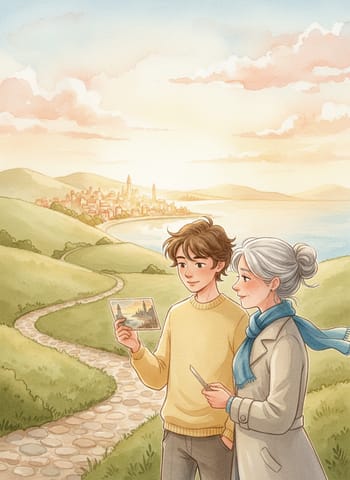
Evander says nothing for a long time. He holds up the postcard at arm's length. He moves it slowly until the edge of the picture meets the edge of the field. The three trees, the hill, and the shape of the hills behind it all fit together. Even the small white boats are in the right place.
Evander tidak berkata apa-apa untuk waktu yang lama. Ia mengangkat kartu pos itu dengan lengan terentang. Ia menggesernya pelan-pelan sampai tepi gambar bertemu dengan tepi ladang. Tiga pohon, bukit, dan bentuk perbukitan di belakangnya, semuanya cocok. Bahkan perahu-perahu putih kecil itu berada di tempat yang tepat.
"It is exactly the same," he says at last. "The painter did not make up a harbour. The painter looked at this field and saw a sea."
"Persis sama," katanya akhirnya. "Pelukisnya tidak mengarang pelabuhan. Pelukisnya memandang ladang ini dan melihat laut."
"And called it a port," Mina says. She looks at the card again and notices something she missed before. In the bottom corner, in tiny letters, are the words "Lumen Farm."
"Dan menyebutnya pelabuhan," kata Mina. Ia melihat kartu itu lagi dan memperhatikan sesuatu yang tadi terlewat. Di sudut bawah, dengan huruf-huruf kecil, tertulis kata-kata "Lumen Farm."
"Lumen Farm," she repeats, surprised. "That is the name of my family's farm. It is on the gate. I have walked past that sign every day of my life. I never thought about what it means."
"Lumen Farm," ulangnya, terkejut. "Itu nama pertanian keluargaku. Tulisannya ada di gerbang. Setiap hari seumur hidupku aku melewati papan itu. Aku tidak pernah memikirkan artinya."
"Light," says Evander. "Lumen means light."
"Cahaya," kata Evander. "Lumen artinya cahaya."
"Port of light," Mina says slowly. "Port Lumen." She laughs, and the sound runs across the field.
"Pelabuhan cahaya," kata Mina pelan. "Port Lumen." Ia tertawa, dan suaranya berlari melintasi ladang.
Down in front of them, a few petals begin to drift from the flowers. They land on the green stems. The little lamps are already going out. Evander puts the postcard safely into his shirt pocket. Then he takes a photograph of the field with his phone. He takes six more before the colour starts to fade.
Di depan mereka, beberapa kelopak mulai melayang dari bunga-bunga. Kelopak itu mendarat di atas batang-batang hijau. Lampu-lampu kecil itu sudah mulai padam. Evander menyimpan kartu pos itu dengan aman ke saku bajunya. Lalu ia memotret ladang itu dengan ponselnya. Ia mengambil enam foto lagi sebelum warnanya mulai memudar.
"I came here to find a place on a map," he says. "But you found it with a stump and a flower. Thank you, Mina. You did my work better than I did."
"Aku datang untuk mencari sebuah tempat di peta," katanya. "Tapi kamu menemukannya dengan sebuah tunggul dan sekuntum bunga. Terima kasih, Mina. Kamu mengerjakan tugasku lebih baik daripada aku."
"It is my farm," she says. "It is easy."
"Ini pertanianku," katanya. "Mudah saja."
"Not for me." He looks at the field one more time. "So what do I call this place now?"
"Tidak untukku." Ia memandang ladang itu sekali lagi. "Jadi, sekarang aku harus menyebut tempat ini apa?"
Mina smiles and tucks the notebook back into her apron. She has a new English word for the page today: "flax."
Mina tersenyum dan menyelipkan buku catatannya kembali ke celemeknya. Hari ini ia punya kata Inggris baru untuk halaman itu: "flax."
"Port Lumen," she says. "Welcome."
"Port Lumen," katanya. "Selamat datang."