The Half Page in the Map Room
Cerita bahasa Inggris gratis level B1 untuk pelajar, bisa dibaca online dalam 7 bahasa, dengan pilihan untuk mendengarkannya di aplikasi Storyteller gratis.
An assistant in a library basement tracks down the missing half of a torn diary page and learns to trust her own choices.
Itu cuplikannya! Dengarkan cerita lengkapnya di aplikasi Storyteller gratis. Unduh aplikasi
Audio belum tersedia saat ini.
Madu starts every morning in the library basement, where the old maps sleep in flat steel drawers. The air smells of dust and cold metal. A long lamp hangs over the work table and hums.
Madu memulai setiap pagi di ruang bawah tanah perpustakaan, tempat peta-peta tua tertidur di dalam laci-laci baja yang datar. Udaranya berbau debu dan logam dingin. Sebuah lampu panjang tergantung di atas meja kerja dan berdengung pelan.
She has worked here for five weeks. Her job is simple on paper. She opens a drawer, checks each map against a long list, and writes the answer on a card. In practice, the job is full of small choices, and Madu hates choices that nobody has approved.
Ia sudah bekerja di sini selama lima minggu. Di atas kertas, tugasnya sederhana. Ia membuka sebuah laci, mencocokkan setiap peta dengan daftar panjang, lalu menuliskan hasilnya pada sebuah kartu. Dalam praktiknya, pekerjaan itu penuh pilihan kecil, dan Madu benci pilihan yang tidak pernah disetujui siapa pun.
Today the list says that drawer twelve should hold forty maps. Madu counts thirty-nine.
Hari ini daftar itu menyebutkan bahwa laci dua belas seharusnya berisi empat puluh peta. Madu menghitung tiga puluh sembilan.
"One is missing," she says to herself. "Of course it is."
"Satu hilang," katanya pada dirinya sendiri. "Tentu saja."
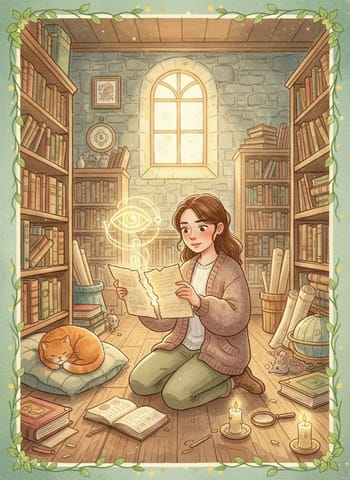
She counts again. Then she checks the tubes on the shelf above the drawer, because maps sometimes hide in them. The third tube is stuffed with brown paper. Inside the paper, she finds something that is not a map. It is half of a page from a diary, torn straight down the middle.
Ia menghitung lagi. Lalu ia memeriksa tabung-tabung di rak di atas laci itu, karena peta kadang bersembunyi di sana. Tabung ketiga disumpal kertas cokelat. Di dalam kertas itu, ia menemukan sesuatu yang bukan peta. Itu setengah halaman buku harian, sobek lurus tepat di tengahnya.
The handwriting is small and slanted. Madu holds the page under the lamp and reads the first line.
Tulisan tangannya kecil dan miring. Madu memegang halaman itu di bawah lampu dan membaca baris pertamanya.
"Day nine. The survey crew reached the river road. I drew the ford in pencil, and it must go in the big sheet before the ink dries."
"Hari kesembilan. Tim survei sampai di jalan sungai. Saya menggambar tempat penyeberangannya dengan pensil, dan itu harus masuk ke lembar besar sebelum tintanya kering."
She stops reading. Half of every sentence has disappeared along the torn edge. Without the other half, the words are only a puzzle.
Ia berhenti membaca. Separuh dari setiap kalimat hilang di sepanjang tepi yang sobek. Tanpa separuh lainnya, kata-kata itu hanya teka-teki.
Nami comes down the stairs with a mug and a stack of folders. She is the senior conservator, and she walks like someone who has never been late in her life.
Nami menuruni tangga sambil membawa cangkir dan setumpuk map. Ia kepala konservator, dan ia berjalan seperti orang yang seumur hidupnya tidak pernah terlambat.
"You look like you found a ghost," Nami says.
"Kamu kelihatan seperti baru bertemu hantu," kata Nami.
"I found half a diary page." Madu holds it out. "It was in a tube in drawer twelve. I think it belongs to the missing map."
"Saya menemukan setengah halaman buku harian." Madu mengulurkannya. "Ada di dalam tabung di laci dua belas. Saya rasa ini milik peta yang hilang itu."
Nami puts down her mug and reads the page slowly. She tilts it toward the lamp. "This writer is a mapmaker's assistant. The ink is from the nineteen thirties, I would guess. Where is the other half?"
Nami meletakkan cangkirnya dan membaca halaman itu pelan-pelan. Ia memiringkannya ke arah lampu. "Penulisnya asisten pembuat peta. Tintanya dari tahun tiga puluhan, kira-kira. Di mana separuh yang lain?"
"I have no idea."
"Saya tidak tahu."
"Then we should find it," Nami says. "What would you do first?"
"Kalau begitu kita harus mencarinya," kata Nami. "Apa yang akan kamu lakukan pertama kali?"
Madu feels the old familiar pressure in her chest. She wants to say, "Whatever you think is best." That is her habit. In every job she has had, she waits for somebody to hand her the next step.
Madu merasakan tekanan lama yang sudah akrab di dadanya. Ia ingin berkata, "Apa pun yang menurut Anda terbaik." Itu kebiasaannya. Di setiap pekerjaan yang pernah ia jalani, ia menunggu seseorang menyerahkan langkah berikutnya.
This time she takes a breath and thinks. A torn page does not travel far. If someone tore it, they used the halves for something. If the maps in drawer twelve share a survey, the other half might sit with that survey.
Kali ini ia menarik napas dan berpikir. Halaman yang sobek tidak akan berpindah jauh. Kalau ada yang menyobeknya, mereka memakai kedua potongannya untuk sesuatu. Kalau peta-peta di laci dua belas berasal dari survei yang sama, separuh yang lain mungkin tersimpan bersama survei itu.
"I would check the other drawers from the same survey," Madu says. "The list gives a survey code for each map. Drawers twelve and thirteen share the code."
"Saya akan memeriksa laci-laci lain dari survei yang sama," kata Madu. "Daftar itu mencantumkan kode survei untuk setiap peta. Laci dua belas dan tiga belas punya kode yang sama."
"Good. Go on."
"Bagus. Lanjutkan."
"And if that fails, I would look in the atlases upstairs. People use scraps as bookmarks."
"Dan kalau itu gagal, saya akan mencarinya di atlas-atlas di lantai atas. Orang sering memakai potongan kertas sebagai pembatas buku."
Nami smiles into her mug. "You see? You are not as helpless as you pretend."
Nami tersenyum ke dalam cangkirnya. "Nah, kan? Kamu tidak seputus asa yang kamu pura-purakan."
They spend the next hour with the drawers. Madu opens drawer thirteen first. She lifts each map with both hands, the way Nami taught her. She slides it onto a clean sheet. There are thirty-six maps, a river chart, and a folded coastline. There is no loose page anywhere.
Mereka menghabiskan satu jam berikutnya dengan laci-laci itu. Madu membuka laci tiga belas lebih dulu. Ia mengangkat setiap peta dengan kedua tangan, seperti yang diajarkan Nami. Ia menggesernya ke atas lembaran bersih. Ada tiga puluh enam peta, sebuah bagan sungai, dan sebuah peta garis pantai yang terlipat. Tidak ada halaman lepas di mana pun.
Nami checks drawers fourteen and fifteen.
Nami memeriksa laci empat belas dan lima belas.
"Nothing," she says finally. "It was a clever idea, but the page is somewhere else."
"Tidak ada apa-apa," katanya akhirnya. "Idemu cerdas, tapi halaman itu ada di tempat lain."
"The atlases, then."
"Kalau begitu, atlas-atlas itu."
"The atlases are on the third floor, and the reading room opens in twenty minutes." Nami looks at the clock. "We cannot bring a damaged page into a public room without a folder. Do you know how to make one?"
"Atlas-atlas ada di lantai tiga, dan ruang baca dibuka dua puluh menit lagi." Nami melihat jam. "Kita tidak boleh membawa halaman yang rusak ke ruang umum tanpa map pelindung. Kamu tahu cara membuatnya?"
Madu does. Last week, Nami showed her how to fold thin paper into a sleeve. The sleeve holds a fragile page flat. She never expected to use the skill alone.
Madu tahu. Minggu lalu, Nami menunjukkan cara melipat kertas tipis menjadi sarung. Sarung itu menjaga halaman rapuh tetap rata. Ia tidak pernah mengira akan memakai keterampilan itu sendirian.
She cuts the paper, folds it twice, and slides the half page inside. Her hands shake a little, but the folds are straight.
Ia memotong kertas, melipatnya dua kali, dan menyelipkan setengah halaman itu ke dalamnya. Tangannya sedikit gemetar, tetapi lipatannya lurus.
"Perfect," Nami says. "I will stay down here and finish the count. You go upstairs. If you find the other half, do not pull it out of the book. Call me first."
"Sempurna," kata Nami. "Aku akan tetap di sini dan menyelesaikan hitungan. Kamu naik ke atas. Kalau kamu menemukan separuh yang lain, jangan menariknya keluar dari buku. Telepon aku dulu."
"Why not just pull it out?"
"Kenapa tidak langsung ditarik saja?"
"Because the book might be worth more than the page," Nami says. "Go on."
"Karena bukunya mungkin lebih berharga daripada halamannya," kata Nami. "Sudah, pergilah."
Madu climbs two flights of stairs with the folder against her chest. The reading room is quiet. A young man sleeps over a newspaper at the nearest table. Madu walks past him to the shelf of old atlases.
Madu menaiki dua tangga dengan map itu didekapnya ke dada. Ruang bacanya sepi. Seorang pemuda tertidur di atas koran di meja terdekat. Madu berjalan melewatinya menuju rak atlas-atlas tua.
There are nineteen of them, some with cracked leather covers. She cannot open all nineteen. She needs a smarter way.
Ada sembilan belas atlas di sana, beberapa dengan sampul kulit yang retak. Ia tidak bisa membuka kesembilan belasnya. Ia butuh cara yang lebih cerdas.
She thinks about the diary again. The writer talked about a river road and a ford. A mapmaker's assistant keeps his diary in the same bag as his instruments. He might use a page to mark a place he plans to draw. So the page belongs near a map of the river road.
Ia memikirkan buku harian itu lagi. Penulisnya berbicara tentang jalan sungai dan tempat penyeberangan. Seorang asisten pembuat peta menyimpan buku hariannya di tas yang sama dengan peralatannya. Ia mungkin memakai selembar halaman untuk menandai tempat yang akan ia gambar. Jadi halaman itu pasti berada di dekat peta jalan sungai.
Madu runs her finger along the spines. One atlas has a title about regional roads. She pulls it out and lays it on the nearest table.
Madu menyusuri punggung buku dengan jarinya. Satu atlas berjudul tentang jalan-jalan regional. Ia menariknya keluar dan meletakkannya di meja terdekat.
A thin strip of paper sticks out of the book, just near the middle. She holds her breath.
Selembar kertas tipis menyembul dari buku itu, tepat di dekat bagian tengah. Ia menahan napas.
Carefully, she opens the atlas at the strip. It is the other half of the page. The edge is torn in a jagged line, and the handwriting looks exactly the same.
Dengan hati-hati, ia membuka atlas itu pada selembar kertas tadi. Itu separuh halaman yang lain. Tepinya sobek bergerigi, dan tulisan tangannya persis sama.
"Found you," she whispers.
"Ketemu kamu," bisiknya.
She does not touch it. She takes out her phone and photographs the page where it lies. Then she goes back to the stairs, two steps at a time, and calls Nami from the landing.
Ia tidak menyentuhnya. Ia mengeluarkan ponselnya dan memotret halaman itu di tempatnya. Lalu ia kembali ke tangga, menaikinya dua anak tangga sekaligus, dan menelepon Nami dari bordes.
Nami arrives eight minutes later, a little out of breath. She reads the strip in place, and her eyebrows rise.
Nami tiba delapan menit kemudian, sedikit terengah-engah. Ia membaca potongan itu di tempatnya, dan alisnya terangkat.
"Look at that torn edge," she says. "The paper fibres are long and fuzzy. If we put the two halves side by side, they will fit like a key and a lock."
"Lihat tepi yang sobek itu," katanya. "Serat kertasnya panjang dan berbulu. Kalau kita meletakkan kedua separuhnya berdampingan, keduanya akan pas seperti kunci dan gembok."
"Can we try?"
"Boleh kita coba?"
"We can try right now."
"Kita bisa mencobanya sekarang juga."
They carry the atlas and the folder to a table by the window. Nami removes the strip with a thin steel tool, slowly, while Madu holds her breath again. The strip comes free without a sound. Madu lays the first half on a clean sheet, and Nami places the second beside it.
Mereka membawa atlas dan map itu ke meja di dekat jendela. Nami melepas potongan itu dengan alat baja tipis, perlahan, sementara Madu kembali menahan napas. Potongan itu terlepas tanpa suara. Madu meletakkan separuh pertama di atas lembaran bersih, dan Nami menaruh separuh kedua di sampingnya.
The edges meet. Not perfectly, because a little paper is missing, but well enough to read.
Kedua tepinya bertemu. Tidak sempurna, karena sedikit kertas hilang, tetapi cukup baik untuk dibaca.
"Day nine," Madu reads out loud. "The survey crew reached the river road. I drew the ford in pencil, and it must go in the big sheet before the ink dries. Tell Mr Halloran that sheet twenty-two is in drawer twelve, under the blue cover."
"Hari kesembilan," Madu membaca dengan suara keras. "Tim survei sampai di jalan sungai. Saya menggambar tempat penyeberangannya dengan pensil, dan itu harus masuk ke lembar besar sebelum tintanya kering. Beri tahu Pak Halloran bahwa lembar dua puluh dua ada di laci dua belas, di bawah sampul biru."
Nami gives a quiet laugh. "Under the blue cover. So the missing map is hiding inside another folder."
Nami tertawa pelan. "Di bawah sampul biru. Jadi peta yang hilang itu bersembunyi di dalam map lain."
They hurry back to the basement. In drawer twelve, Madu lifts a map with a blue cardboard cover. Under it lies a fortieth map, a large sheet with a hand-drawn river and a small, careful ford.
Mereka bergegas kembali ke ruang bawah tanah. Di laci dua belas, Madu mengangkat sebuah peta bersampul karton biru. Di bawahnya terbaring peta keempat puluh, lembaran besar dengan sungai gambar tangan dan tempat penyeberangan kecil yang digambar teliti.
"Sheet twenty-two," she says, smiling. "It was there all along."
"Lembar dua puluh dua," katanya sambil tersenyum. "Ternyata selama ini ada di situ."
Nami helps her fix the torn page with thin tissue and a safe paste. When they finish, the two halves look like one. Madu puts the page into a clear sleeve and writes a new card for the drawer.
Nami membantunya memperbaiki halaman yang sobek itu dengan kertas tisu tipis dan perekat yang aman. Setelah selesai, kedua separuh itu tampak seperti satu. Madu memasukkan halaman itu ke dalam sarung bening dan menulis kartu baru untuk laci itu.
She hesitates over the last line, where the card asks for a name.
Ia ragu pada baris terakhir, tempat kartu itu meminta sebuah nama.
"Should I write yours?" she asks. "You are the senior conservator."
"Perlu saya tulis nama Anda?" tanyanya. "Anda kepala konservator."
"You found it, you wrote the card, and you made the folder," Nami says. "I only held the lamp. So put your name on the card, Madu."
"Kamu yang menemukannya, kamu yang menulis kartunya, dan kamu yang membuat map pelindungnya," kata Nami. "Aku cuma memegang lampu. Jadi tulis namamu di kartu itu, Madu."
Madu looks at the empty line for a moment. Then she picks up the pen and writes her own name, slowly and clearly.
Madu menatap baris kosong itu sejenak. Lalu ia mengambil pena dan menuliskan namanya sendiri, pelan dan jelas.