The Half Page in the Map Room
Una historia gratuita en inglés de nivel B1 para estudiantes, para leer en línea en 7 idiomas, con opción de escucharla en la app gratuita Storyteller.
An assistant in a library basement tracks down the missing half of a torn diary page and learns to trust her own choices.
¡Ese fue el avance! Escucha la historia completa en la app gratuita Storyteller. Descargar la app
El audio no está disponible en este momento.
Madu starts every morning in the library basement, where the old maps sleep in flat steel drawers. The air smells of dust and cold metal. A long lamp hangs over the work table and hums.
Madu empieza cada mañana en el sótano de la biblioteca, donde los mapas antiguos duermen en cajones planos de acero. El aire huele a polvo y a metal frío. Una larga lámpara cuelga sobre la mesa de trabajo y zumba.
She has worked here for five weeks. Her job is simple on paper. She opens a drawer, checks each map against a long list, and writes the answer on a card. In practice, the job is full of small choices, and Madu hates choices that nobody has approved.
Lleva cinco semanas trabajando aquí. Su tarea es sencilla sobre el papel. Abre un cajón, revisa cada mapa contra una larga lista y escribe la respuesta en una ficha. En la práctica, el trabajo está lleno de pequeñas decisiones, y Madu odia las decisiones que nadie ha aprobado.
Today the list says that drawer twelve should hold forty maps. Madu counts thirty-nine.
Hoy la lista dice que el cajón doce debería contener cuarenta mapas. Madu cuenta treinta y nueve.
"One is missing," she says to herself. "Of course it is."
«Falta uno», se dice a sí misma. «Por supuesto».
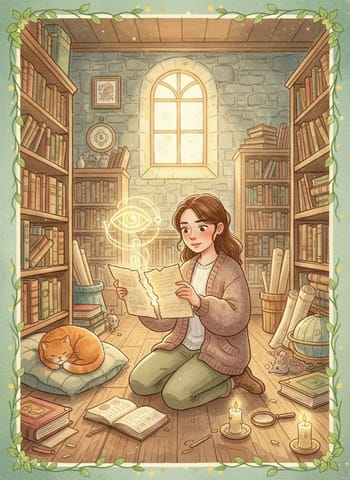
She counts again. Then she checks the tubes on the shelf above the drawer, because maps sometimes hide in them. The third tube is stuffed with brown paper. Inside the paper, she finds something that is not a map. It is half of a page from a diary, torn straight down the middle.
Cuenta otra vez. Luego revisa los tubos del estante sobre el cajón, porque a veces los mapas se esconden en ellos. El tercer tubo está lleno de papel café. Dentro del papel, encuentra algo que no es un mapa. Es la mitad de una página de un diario, rasgada justo por el medio.
The handwriting is small and slanted. Madu holds the page under the lamp and reads the first line.
La letra es pequeña e inclinada. Madu sostiene la página bajo la lámpara y lee la primera línea.
"Day nine. The survey crew reached the river road. I drew the ford in pencil, and it must go in the big sheet before the ink dries."
«Día nueve. La cuadrilla de agrimensores llegó al camino del río. Dibujé el vado a lápiz, y tiene que pasar a la hoja grande antes de que se seque la tinta».
She stops reading. Half of every sentence has disappeared along the torn edge. Without the other half, the words are only a puzzle.
Deja de leer. La mitad de cada oración ha desaparecido a lo largo del borde rasgado. Sin la otra mitad, las palabras son solo un rompecabezas.
Nami comes down the stairs with a mug and a stack of folders. She is the senior conservator, and she walks like someone who has never been late in her life.
Nami baja las escaleras con una taza y una pila de carpetas. Es la conservadora principal, y camina como alguien que nunca ha llegado tarde en su vida.
"You look like you found a ghost," Nami says.
«Tienes cara de haber visto un fantasma», dice Nami.
"I found half a diary page." Madu holds it out. "It was in a tube in drawer twelve. I think it belongs to the missing map."
«Encontré media página de un diario». Madu se la extiende. «Estaba en un tubo del cajón doce. Creo que pertenece al mapa que falta».
Nami puts down her mug and reads the page slowly. She tilts it toward the lamp. "This writer is a mapmaker's assistant. The ink is from the nineteen thirties, I would guess. Where is the other half?"
Nami deja su taza y lee la página despacio. La inclina hacia la lámpara. «Quien escribió esto es ayudante de un cartógrafo. La tinta es de los años treinta, diría yo. ¿Dónde está la otra mitad?».
"I have no idea."
«No tengo idea».
"Then we should find it," Nami says. "What would you do first?"
«Entonces deberíamos encontrarla», dice Nami. «¿Qué harías primero?».
Madu feels the old familiar pressure in her chest. She wants to say, "Whatever you think is best." That is her habit. In every job she has had, she waits for somebody to hand her the next step.
Madu siente la vieja y conocida presión en el pecho. Quiere decir: «Lo que tú creas mejor». Ese es su hábito. En cada trabajo que ha tenido, espera a que alguien le entregue el siguiente paso.
This time she takes a breath and thinks. A torn page does not travel far. If someone tore it, they used the halves for something. If the maps in drawer twelve share a survey, the other half might sit with that survey.
Esta vez respira hondo y piensa. Una página rasgada no viaja lejos. Si alguien la rasgó, usó las mitades para algo. Si los mapas del cajón doce comparten un levantamiento, la otra mitad podría estar con ese levantamiento.
"I would check the other drawers from the same survey," Madu says. "The list gives a survey code for each map. Drawers twelve and thirteen share the code."
«Revisaría los otros cajones del mismo levantamiento», dice Madu. «La lista da un código de levantamiento para cada mapa. Los cajones doce y trece comparten el código».
"Good. Go on."
«Bien. Sigue».
"And if that fails, I would look in the atlases upstairs. People use scraps as bookmarks."
«Y si eso falla, buscaría en los atlas del piso de arriba. La gente usa pedazos de papel como marcapáginas».
Nami smiles into her mug. "You see? You are not as helpless as you pretend."
Nami sonríe dentro de su taza. «¿Ves? No eres tan indefensa como finges».
They spend the next hour with the drawers. Madu opens drawer thirteen first. She lifts each map with both hands, the way Nami taught her. She slides it onto a clean sheet. There are thirty-six maps, a river chart, and a folded coastline. There is no loose page anywhere.
Pasan la hora siguiente con los cajones. Madu abre primero el cajón trece. Levanta cada mapa con las dos manos, como Nami le enseñó. Lo desliza sobre una hoja limpia. Hay treinta y seis mapas, una carta de un río y una costa doblada. No hay ninguna página suelta por ningún lado.
Nami checks drawers fourteen and fifteen.
Nami revisa los cajones catorce y quince.
"Nothing," she says finally. "It was a clever idea, but the page is somewhere else."
«Nada», dice por fin. «Fue una idea inteligente, pero la página está en otra parte».
"The atlases, then."
«Los atlas, entonces».
"The atlases are on the third floor, and the reading room opens in twenty minutes." Nami looks at the clock. "We cannot bring a damaged page into a public room without a folder. Do you know how to make one?"
«Los atlas están en el tercer piso, y la sala de lectura abre en veinte minutos». Nami mira el reloj. «No podemos llevar una página dañada a una sala pública sin una carpeta. ¿Sabes hacer una?».
Madu does. Last week, Nami showed her how to fold thin paper into a sleeve. The sleeve holds a fragile page flat. She never expected to use the skill alone.
Madu sí sabe. La semana pasada, Nami le mostró cómo doblar papel fino para hacer una funda. La funda mantiene plana una página frágil. Nunca esperó usar esa habilidad sola.
She cuts the paper, folds it twice, and slides the half page inside. Her hands shake a little, but the folds are straight.
Corta el papel, lo dobla dos veces y desliza dentro la media página. Le tiemblan un poco las manos, pero los dobleces quedan rectos.
"Perfect," Nami says. "I will stay down here and finish the count. You go upstairs. If you find the other half, do not pull it out of the book. Call me first."
«Perfecto», dice Nami. «Yo me quedo aquí a terminar el conteo. Tú sube. Si encuentras la otra mitad, no la saques del libro. Llámame primero».
"Why not just pull it out?"
«¿Por qué no sacarla sin más?».
"Because the book might be worth more than the page," Nami says. "Go on."
«Porque el libro podría valer más que la página», dice Nami. «Ve».
Madu climbs two flights of stairs with the folder against her chest. The reading room is quiet. A young man sleeps over a newspaper at the nearest table. Madu walks past him to the shelf of old atlases.
Madu sube dos tramos de escaleras con la carpeta contra el pecho. La sala de lectura está en silencio. Un joven duerme sobre un periódico en la mesa más cercana. Madu pasa junto a él hasta el estante de los atlas antiguos.
There are nineteen of them, some with cracked leather covers. She cannot open all nineteen. She needs a smarter way.
Hay diecinueve, algunos con tapas de cuero agrietadas. No puede abrir los diecinueve. Necesita una manera más inteligente.
She thinks about the diary again. The writer talked about a river road and a ford. A mapmaker's assistant keeps his diary in the same bag as his instruments. He might use a page to mark a place he plans to draw. So the page belongs near a map of the river road.
Piensa otra vez en el diario. El autor hablaba de un camino del río y un vado. El ayudante de un cartógrafo guarda su diario en la misma bolsa que sus instrumentos. Podría usar una página para marcar un lugar que planea dibujar. Así que la página debe estar cerca de un mapa del camino del río.
Madu runs her finger along the spines. One atlas has a title about regional roads. She pulls it out and lays it on the nearest table.
Madu recorre los lomos con el dedo. Un atlas tiene un título sobre caminos regionales. Lo saca y lo pone en la mesa más cercana.
A thin strip of paper sticks out of the book, just near the middle. She holds her breath.
Una delgada tira de papel sobresale del libro, justo hacia la mitad. Contiene la respiración.
Carefully, she opens the atlas at the strip. It is the other half of the page. The edge is torn in a jagged line, and the handwriting looks exactly the same.
Con cuidado, abre el atlas por la tira. Es la otra mitad de la página. El borde está rasgado en una línea irregular, y la letra se ve exactamente igual.
"Found you," she whispers.
«Te encontré», susurra.
She does not touch it. She takes out her phone and photographs the page where it lies. Then she goes back to the stairs, two steps at a time, and calls Nami from the landing.
No la toca. Saca su teléfono y fotografía la página donde está. Luego vuelve a las escaleras, de a dos escalones, y llama a Nami desde el rellano.
Nami arrives eight minutes later, a little out of breath. She reads the strip in place, and her eyebrows rise.
Nami llega ocho minutos después, algo sin aliento. Lee la tira en su lugar, y sus cejas suben.
"Look at that torn edge," she says. "The paper fibres are long and fuzzy. If we put the two halves side by side, they will fit like a key and a lock."
«Mira ese borde rasgado», dice. «Las fibras del papel son largas y esponjosas. Si ponemos las dos mitades juntas, encajarán como una llave y una cerradura».
"Can we try?"
«¿Podemos probar?».
"We can try right now."
«Podemos probar ahora mismo».
They carry the atlas and the folder to a table by the window. Nami removes the strip with a thin steel tool, slowly, while Madu holds her breath again. The strip comes free without a sound. Madu lays the first half on a clean sheet, and Nami places the second beside it.
Llevan el atlas y la carpeta a una mesa junto a la ventana. Nami retira la tira con una delgada herramienta de acero, lentamente, mientras Madu vuelve a contener el aliento. La tira se suelta sin un sonido. Madu pone la primera mitad sobre una hoja limpia, y Nami coloca la segunda al lado.
The edges meet. Not perfectly, because a little paper is missing, but well enough to read.
Los bordes se juntan. No perfectamente, porque falta un poco de papel, pero lo bastante bien para leer.
"Day nine," Madu reads out loud. "The survey crew reached the river road. I drew the ford in pencil, and it must go in the big sheet before the ink dries. Tell Mr Halloran that sheet twenty-two is in drawer twelve, under the blue cover."
«Día nueve», lee Madu en voz alta. «La cuadrilla de agrimensores llegó al camino del río. Dibujé el vado a lápiz, y tiene que pasar a la hoja grande antes de que se seque la tinta. Dígale al señor Halloran que la hoja veintidós está en el cajón doce, bajo la cubierta azul».
Nami gives a quiet laugh. "Under the blue cover. So the missing map is hiding inside another folder."
Nami da una risa tranquila. «Bajo la cubierta azul. Así que el mapa perdido se esconde dentro de otra carpeta».
They hurry back to the basement. In drawer twelve, Madu lifts a map with a blue cardboard cover. Under it lies a fortieth map, a large sheet with a hand-drawn river and a small, careful ford.
Vuelven apuradas al sótano. En el cajón doce, Madu levanta un mapa con una cubierta de cartón azul. Debajo yace un cuadragésimo mapa, una hoja grande con un río dibujado a mano y un pequeño y cuidadoso vado.
"Sheet twenty-two," she says, smiling. "It was there all along."
«Hoja veintidós», dice, sonriendo. «Estuvo ahí todo el tiempo».
Nami helps her fix the torn page with thin tissue and a safe paste. When they finish, the two halves look like one. Madu puts the page into a clear sleeve and writes a new card for the drawer.
Nami la ayuda a reparar la página rasgada con papel de seda fino y un adhesivo seguro. Cuando terminan, las dos mitades parecen una sola. Madu pone la página en una funda transparente y escribe una ficha nueva para el cajón.
She hesitates over the last line, where the card asks for a name.
Duda en la última línea, donde la ficha pide un nombre.
"Should I write yours?" she asks. "You are the senior conservator."
«¿Escribo el tuyo?», pregunta. «Eres la conservadora principal».
"You found it, you wrote the card, and you made the folder," Nami says. "I only held the lamp. So put your name on the card, Madu."
«Tú la encontraste, tú escribiste la ficha y tú hiciste la carpeta», dice Nami. «Yo solo sostuve la lámpara. Así que pon tu nombre en la ficha, Madu».
Madu looks at the empty line for a moment. Then she picks up the pen and writes her own name, slowly and clearly.
Madu mira la línea vacía un momento. Luego toma la pluma y escribe su propio nombre, despacio y con claridad.