The Tooth in the Fare Tin
Una historia gratuita en inglés de nivel B1 para estudiantes, para leer en línea en 7 idiomas, con opción de escucharla en la app gratuita Storyteller.
A ferry worker finds a baby tooth in the fare tin and follows three clues to its owner.
¡Ese fue el avance! Escucha la historia completa en la app gratuita Storyteller. Descargar la app
El audio no está disponible en este momento.
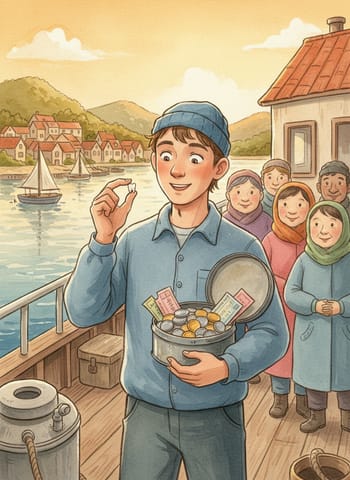
The ferry across the Long River has no engine. It is a flat wooden boat, wide enough for ten people and one cart. A thick rope runs from one bank to the other. To cross, you take the rope in your hands and pull. Rumi does this forty times a day, and her arms are as hard as fence posts.
El transbordador que cruza el Río Largo no tiene motor. Es un bote plano de madera, lo bastante ancho para diez personas y una carreta. Una gruesa soga va de una orilla a la otra. Para cruzar, tomas la soga con las manos y tiras. Rumi hace esto cuarenta veces al día, y sus brazos son duros como postes de cerca.
She is twenty-three, and this is her second summer on the ferry. She likes the work. The river is slow and brown, and the boat moves with a soft creak, hand over hand. The only part she dislikes is the fare tin. It is an old biscuit tin that sits by the rope. It is always nearly empty.
Tiene veintitrés años y este es su segundo verano en el transbordador. Le gusta el trabajo. El río es lento y marrón, y el bote avanza con un suave crujido, mano sobre mano. Lo único que no le gusta es la lata del pasaje. Es una vieja lata de galletas que está junto a la soga. Siempre está casi vacía.
The fare is two small coins. Rumi does not ask for it. People drop the coins in the tin when they board, and most of them do. A few forget. A few have no change. She never chases anyone. But she counts the tin each night, and she knows when something is wrong.
El pasaje son dos monedas pequeñas. Rumi no lo pide. La gente deja caer las monedas en la lata al subir, y la mayoría lo hace. Algunos se olvidan. Algunos no tienen cambio. Ella nunca persigue a nadie. Pero cuenta la lata cada noche y sabe cuando algo anda mal.
On this particular morning, she opens the lid and finds something unusual. Between three coins lies a small white envelope. It is thin, a little crumpled, and sealed with a piece of tape. On the front, in neat pencil, are two words: FOR FARE.
Esta mañana en particular, abre la tapa y encuentra algo inusual. Entre tres monedas hay un pequeño sobre blanco. Es delgado, un poco arrugado y está sellado con un pedazo de cinta adhesiva. En el frente, en pulcro lápiz, hay tres palabras: PARA EL PASAJE.
"That's new," Rumi says to nobody.
«Eso es nuevo», dice Rumi a nadie.
She opens it carefully. Inside, wrapped in a tissue, is a tiny tooth. It is a baby tooth, small and white, with a narrow root. She holds it in her palm and looks at it for a long time. Then she puts it back in the tissue and sits down on the bench to think.
Lo abre con cuidado. Dentro, envuelto en un pañuelo de papel, hay un diminuto diente. Es un diente de leche, pequeño y blanco, con una raíz estrecha. Lo sostiene en la palma y lo mira durante mucho tiempo. Luego lo vuelve a poner en el pañuelo y se sienta en la banca a pensar.
"All right," she says. "Who pays a ferry with a tooth?"
«Muy bien», dice. «¿Quién paga un transbordador con un diente?».
It is a question she cannot ignore. She loves a small mystery almost as much as the river. This is the best one she has had all summer. She decides to solve it before the last crossing of the day. She will write down everything she learns, on the back of her ticket book.
Es una pregunta que no puede ignorar. Le gusta un pequeño misterio casi tanto como el río. Este es el mejor que ha tenido en todo el verano. Decide resolverlo antes del último cruce del día. Anotará todo lo que averigüe, en el reverso de su talonario de boletos.
The first clue is the envelope itself. Rumi studies the writing. The pencil is soft and careful. It is the writing of someone who wants to be understood. It is not a child's handwriting, and it is not a doctor's. The tape is new, but the paper is soft and old. It spent years in a drawer. Somebody wrote this a long time ago, then put it away, and only recently took it out again.
La primera pista es el sobre mismo. Rumi estudia la escritura. El lápiz es suave y cuidadoso. Es la letra de alguien que quiere ser entendido. No es letra de niño, ni de médico. La cinta es nueva, pero el papel es suave y viejo. Pasó años en un cajón. Alguien escribió esto hace mucho tiempo, luego lo guardó, y solo hace poco lo sacó otra vez.
"A grown-up's writing, old paper," Rumi writes. "A tooth that waited."
«Letra de adulto, papel viejo», escribe Rumi. «Un diente que esperó».
The second clue comes at noon. The boat is almost full. A farmer with a basket of onions sits near the front. Two women with bright scarves lean on the side. A boy with a fishing rod keeps asking her if the river is deep. And at the back, standing by himself, is a young man with a very large backpack.
La segunda pista llega al mediodía. El bote está casi lleno. Un granjero con una canasta de cebollas se sienta cerca de la proa. Dos mujeres con pañuelos de colores brillantes se apoyan en el costado. Un niño con una caña de pescar sigue preguntándole si el río es profundo. Y al fondo, de pie solo, hay un joven con una mochila muy grande.
Rumi has not seen him before. He is about nineteen, with a thin face and a short haircut that looks new. He holds the strap of his backpack in both hands, like a child at a station. Every few minutes, he pats the pocket of his jacket and then looks anxiously at the tin.
Rumi no lo ha visto antes. Tiene unos diecinueve años, la cara delgada y un corte de pelo corto que parece nuevo. Sujeta la correa de su mochila con las dos manos, como un niño en una estación. Cada pocos minutos se palpa el bolsillo de la chaqueta y luego mira con ansiedad la lata.
"Excuse me," he says, when the boat is halfway across. "How much is the fare?"
«Disculpe», dice, cuando el bote está a mitad de camino. «¿Cuánto cuesta el pasaje?».
"Two small coins," Rumi says. She keeps pulling the rope. "Put them in the tin."
«Dos monedas pequeñas», dice Rumi. Sigue tirando de la soga. «Póngalas en la lata».
"I only have big notes," the young man says. "I just came out of the bank in town. I don't have any coins at all."
«Solo tengo billetes grandes», dice el joven. «Acabo de salir del banco del pueblo. No tengo ninguna moneda».
"Then you owe me, and you can pay next time."
«Entonces me debe, y puede pagarme la próxima vez».
"There won't be a next time," he says. "I'm going to the city, to start a job. Tomorrow I begin at a shop that fixes bicycles. I may not come back for a year."
«No habrá próxima vez», dice. «Voy a la ciudad, a empezar un trabajo. Mañana empiezo en una tienda que arregla bicicletas. Puede que no vuelva en un año».
He pats his pocket again.
Se palpa el bolsillo otra vez.
"I wanted to pay properly. I really did."
«Quería pagar como es debido. De verdad».
Rumi looks at him over her shoulder. He is very serious. She likes him already, in the way you like a nervous stranger who is trying hard.
Rumi lo mira por encima del hombro. Está muy serio. Ya le cae bien, como te cae bien un desconocido nervioso que se esfuerza mucho.
The third clue is small and almost invisible. When the young man speaks, he rubs his jaw, on the left side, with two fingers. He does it without noticing, as people do when they think about something old. Rumi watches the gesture. Then she looks at the tin, and then at his pocket again.
La tercera pista es pequeña y casi invisible. Cuando el joven habla, se frota la mandíbula, del lado izquierdo, con dos dedos. Lo hace sin darse cuenta, como hace la gente cuando piensa en algo antiguo. Rumi observa el gesto. Luego mira la lata, y otra vez su bolsillo.
"What's your name?" she asks.
«¿Cómo se llama?», pregunta.
"Takeshi."
«Takeshi».
"Takeshi," she says. "Do you know what is in the envelope?"
«Takeshi», dice. «¿Sabe qué hay en el sobre?».
He goes completely still. The boy with the fishing rod looks up. Takeshi takes a long breath and says, in a small voice, "You found it."
Se queda completamente quieto. El niño de la caña de pescar levanta la vista. Takeshi toma un largo aliento y dice, con voz pequeña: «Lo encontró».
"I found it in the tin this morning," says Rumi. "Before you came. So it was there when you boarded. Somebody put it in before sunrise."
«Lo encontré en la lata esta mañana», dice Rumi. «Antes de que usted llegara. Así que ya estaba ahí cuando subió. Alguien lo puso antes del amanecer».
"Nobody put it there," says Takeshi. "I did. I came to the landing last night and left it. I wanted to cross without coins. I thought it would be fine."
«Nadie lo puso ahí», dice Takeshi. «Lo hice yo. Vine al embarcadero anoche y lo dejé. Quería cruzar sin monedas. Pensé que estaría bien».
He looks at his shoes.
Mira sus zapatos.
"My mother wrote on it. She wrote it when I was six."
«Mi madre escribió en él. Lo escribió cuando yo tenía seis años».
"Why a tooth?" asks Rumi.
«¿Por qué un diente?», pregunta Rumi.
"It's a joke. It's an old joke, from the village." He laughs. "When I was small, I was afraid of the river. Every time we crossed, I cried. So my mother told me that the ferry takes a tooth as payment if you have no coins. She said it wasn't a lie, because a tooth was a very good thing to give. Then I lost my first tooth. She put it in an envelope and wrote FOR FARE on the front. I could pay the river and feel brave."
«Es una broma. Una vieja broma del pueblo». Ríe. «Cuando era pequeño, le tenía miedo al río. Cada vez que cruzábamos, lloraba. Así que mi madre me dijo que el transbordador acepta un diente como pago si no tienes monedas. Dijo que no era mentira, porque un diente era algo muy bueno para dar. Luego perdí mi primer diente. Lo puso en un sobre y escribió PARA EL PASAJE en el frente. Podía pagarle al río y sentirme valiente».
"And you kept it for thirteen years," Rumi says.
«Y lo guardó trece años», dice Rumi.
"She kept it, actually. In the kitchen drawer. When I packed this week, she put it in my jacket pocket without saying anything. She said I should have the fare ready." He shakes his head. "I forgot the coins, but I remembered the joke. So I left the tooth in the tin last night, and then I felt terrible. I thought I'd given away something important. But I don't want to take it back now, because you might think I lied."
«En realidad lo guardó ella. En el cajón de la cocina. Cuando hice la maleta esta semana, lo puso en el bolsillo de mi chaqueta sin decir nada. Dijo que debía tener el pasaje listo». Sacude la cabeza. «Se me olvidaron las monedas, pero recordé la broma. Así que anoche dejé el diente en la lata, y luego me sentí fatal. Pensé que había regalado algo importante. Pero no quiero recogerlo ahora, porque usted podría pensar que mentí».
For a moment, nobody speaks. The women with scarves stop talking. The farmer turns around on his basket, holding an onion in one hand. The boy with the fishing rod stares at Takeshi with great respect.
Por un momento, nadie habla. Las mujeres de los pañuelos dejan de conversar. El granjero se da la vuelta sobre su canasta, con una cebolla en la mano. El niño de la caña de pescar mira a Takeshi con gran respeto.
Then Rumi starts to laugh. She laughs so hard that her hands slip on the rope, and the boat slows down. The whole boat laughs with her. Takeshi hides his face in both hands.
Entonces Rumi empieza a reír. Ríe tanto que sus manos resbalan en la soga y el bote se frena. Todo el bote ríe con ella. Takeshi esconde la cara entre las manos.
"It's not funny," he says through his fingers.
«No es gracioso», dice a través de los dedos.
"It's very funny," Rumi says. "I thought I had a crime to solve. I thought a thief left his teeth in my tin. And it's just a boy who forgot his small coins."
«Es muy gracioso», dice Rumi. «Pensé que tenía un crimen que resolver. Pensé que un ladrón dejó sus dientes en mi lata. Y solo es un muchacho que olvidó sus monedas pequeñas».
She wipes her eyes.
Se seca los ojos.
"Here. Take it back."
«Tenga. Recupérelo».
She puts the little tissue in his open hand. He looks at it. Then he folds his fingers around it, carefully.
Pone el pañuelito en su mano abierta. Él lo mira. Luego cierra los dedos a su alrededor con cuidado.
"Thank you," he says. "But the fare—"
«Gracias», dice. «Pero el pasaje…».
"The fare for a tooth is a very serious matter," Rumi says. "I must think about it."
«El pasaje por un diente es un asunto muy serio», dice Rumi. «Tengo que pensarlo».
She nods toward the thick, wet rope, which hangs between her hands.
Señala con la cabeza la gruesa soga mojada que cuelga entre sus manos.
"Come here, Takeshi. Take the other side of the rope. Teeth don't pay on this boat, but arms do."
«Venga, Takeshi. Tome el otro lado de la soga. Los dientes no pagan en este bote, pero los brazos sí».