The Tooth in the Fare Tin
A free B1-level English story for language learners, readable online in 7 languages, with an option to listen via the free Storyteller app.
A ferry worker finds a baby tooth in the fare tin and follows three clues to its owner.
That was the preview! Hear the full story in the free Storyteller app. Get the app
Audio isn't available right now.
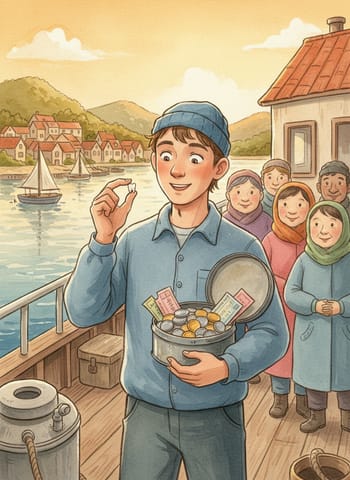
The ferry across the Long River has no engine. It is a flat wooden boat, wide enough for ten people and one cart. A thick rope runs from one bank to the other. To cross, you take the rope in your hands and pull. Rumi does this forty times a day, and her arms are as hard as fence posts.
She is twenty-three, and this is her second summer on the ferry. She likes the work. The river is slow and brown, and the boat moves with a soft creak, hand over hand. The only part she dislikes is the fare tin. It is an old biscuit tin that sits by the rope. It is always nearly empty.
The fare is two small coins. Rumi does not ask for it. People drop the coins in the tin when they board, and most of them do. A few forget. A few have no change. She never chases anyone. But she counts the tin each night, and she knows when something is wrong.
On this particular morning, she opens the lid and finds something unusual. Between three coins lies a small white envelope. It is thin, a little crumpled, and sealed with a piece of tape. On the front, in neat pencil, are two words: FOR FARE.
"That's new," Rumi says to nobody.
She opens it carefully. Inside, wrapped in a tissue, is a tiny tooth. It is a baby tooth, small and white, with a narrow root. She holds it in her palm and looks at it for a long time. Then she puts it back in the tissue and sits down on the bench to think.
"All right," she says. "Who pays a ferry with a tooth?"
It is a question she cannot ignore. She loves a small mystery almost as much as the river. This is the best one she has had all summer. She decides to solve it before the last crossing of the day. She will write down everything she learns, on the back of her ticket book.
The first clue is the envelope itself. Rumi studies the writing. The pencil is soft and careful. It is the writing of someone who wants to be understood. It is not a child's handwriting, and it is not a doctor's. The tape is new, but the paper is soft and old. It spent years in a drawer. Somebody wrote this a long time ago, then put it away, and only recently took it out again.
"A grown-up's writing, old paper," Rumi writes. "A tooth that waited."
The second clue comes at noon. The boat is almost full. A farmer with a basket of onions sits near the front. Two women with bright scarves lean on the side. A boy with a fishing rod keeps asking her if the river is deep. And at the back, standing by himself, is a young man with a very large backpack.
Rumi has not seen him before. He is about nineteen, with a thin face and a short haircut that looks new. He holds the strap of his backpack in both hands, like a child at a station. Every few minutes, he pats the pocket of his jacket and then looks anxiously at the tin.
"Excuse me," he says, when the boat is halfway across. "How much is the fare?"
"Two small coins," Rumi says. She keeps pulling the rope. "Put them in the tin."
"I only have big notes," the young man says. "I just came out of the bank in town. I don't have any coins at all."
"Then you owe me, and you can pay next time."
"There won't be a next time," he says. "I'm going to the city, to start a job. Tomorrow I begin at a shop that fixes bicycles. I may not come back for a year."
He pats his pocket again.
"I wanted to pay properly. I really did."
Rumi looks at him over her shoulder. He is very serious. She likes him already, in the way you like a nervous stranger who is trying hard.
The third clue is small and almost invisible. When the young man speaks, he rubs his jaw, on the left side, with two fingers. He does it without noticing, as people do when they think about something old. Rumi watches the gesture. Then she looks at the tin, and then at his pocket again.
"What's your name?" she asks.
"Takeshi."
"Takeshi," she says. "Do you know what is in the envelope?"
He goes completely still. The boy with the fishing rod looks up. Takeshi takes a long breath and says, in a small voice, "You found it."
"I found it in the tin this morning," says Rumi. "Before you came. So it was there when you boarded. Somebody put it in before sunrise."
"Nobody put it there," says Takeshi. "I did. I came to the landing last night and left it. I wanted to cross without coins. I thought it would be fine."
He looks at his shoes.
"My mother wrote on it. She wrote it when I was six."
"Why a tooth?" asks Rumi.
"It's a joke. It's an old joke, from the village." He laughs. "When I was small, I was afraid of the river. Every time we crossed, I cried. So my mother told me that the ferry takes a tooth as payment if you have no coins. She said it wasn't a lie, because a tooth was a very good thing to give. Then I lost my first tooth. She put it in an envelope and wrote FOR FARE on the front. I could pay the river and feel brave."
"And you kept it for thirteen years," Rumi says.
"She kept it, actually. In the kitchen drawer. When I packed this week, she put it in my jacket pocket without saying anything. She said I should have the fare ready." He shakes his head. "I forgot the coins, but I remembered the joke. So I left the tooth in the tin last night, and then I felt terrible. I thought I'd given away something important. But I don't want to take it back now, because you might think I lied."
For a moment, nobody speaks. The women with scarves stop talking. The farmer turns around on his basket, holding an onion in one hand. The boy with the fishing rod stares at Takeshi with great respect.
Then Rumi starts to laugh. She laughs so hard that her hands slip on the rope, and the boat slows down. The whole boat laughs with her. Takeshi hides his face in both hands.
"It's not funny," he says through his fingers.
"It's very funny," Rumi says. "I thought I had a crime to solve. I thought a thief left his teeth in my tin. And it's just a boy who forgot his small coins."
She wipes her eyes.
"Here. Take it back."
She puts the little tissue in his open hand. He looks at it. Then he folds his fingers around it, carefully.
"Thank you," he says. "But the fare—"
"The fare for a tooth is a very serious matter," Rumi says. "I must think about it."
She nods toward the thick, wet rope, which hangs between her hands.
"Come here, Takeshi. Take the other side of the rope. Teeth don't pay on this boat, but arms do."