The Tooth in the Fare Tin
Uma história gratuita em inglês de nível B1 para estudantes, para ler online em 7 idiomas, com opção de ouvir no app gratuito Storyteller.
A ferry worker finds a baby tooth in the fare tin and follows three clues to its owner.
Essa foi a prévia! Ouça a história completa no app gratuito Storyteller. Baixar o app
O áudio não está disponível no momento.
The ferry across the Long River has no engine. It is a flat wooden boat, wide enough for ten people and one cart. A thick rope runs from one bank to the other. To cross, you take the rope in your hands and pull. Rumi does this forty times a day, and her arms are as hard as fence posts.
A balsa que cruza o Rio Longo não tem motor. É um barco de madeira plano, largo o bastante para dez pessoas e uma carroça. Uma corda grossa vai de uma margem à outra. Para atravessar, você pega a corda com as mãos e puxa. Rumi faz isso quarenta vezes por dia, e seus braços são duros como mourões de cerca.
She is twenty-three, and this is her second summer on the ferry. She likes the work. The river is slow and brown, and the boat moves with a soft creak, hand over hand. The only part she dislikes is the fare tin. It is an old biscuit tin that sits by the rope. It is always nearly empty.
Ela tem vinte e três anos, e este é seu segundo verão na balsa. Gosta do trabalho. O rio é lento e marrom, e o barco se move com um rangido suave, mão sobre mão. A única parte de que não gosta é a lata da passagem. É uma velha lata de biscoitos que fica junto à corda. Está sempre quase vazia.
The fare is two small coins. Rumi does not ask for it. People drop the coins in the tin when they board, and most of them do. A few forget. A few have no change. She never chases anyone. But she counts the tin each night, and she knows when something is wrong.
A passagem custa duas moedinhas. Rumi não a cobra. As pessoas jogam as moedas na lata ao embarcar, e a maioria joga. Alguns esquecem. Alguns não têm trocado. Ela nunca corre atrás de ninguém. Mas conta a lata toda noite, e sabe quando algo está errado.
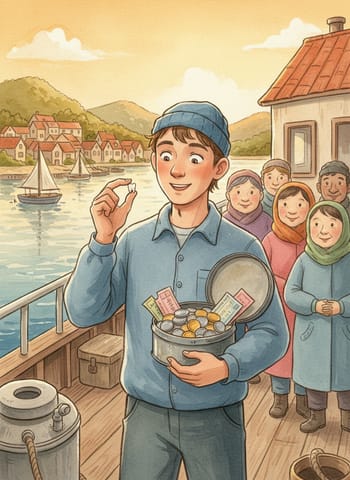
On this particular morning, she opens the lid and finds something unusual. Between three coins lies a small white envelope. It is thin, a little crumpled, and sealed with a piece of tape. On the front, in neat pencil, are two words: FOR FARE.
Nesta manhã em particular, ela abre a tampa e encontra algo incomum. Entre três moedas há um pequeno envelope branco. É fino, um pouco amassado e selado com um pedaço de fita adesiva. Na frente, a lápis, em letra clara, há duas palavras: PARA A PASSAGEM.
"That's new," Rumi says to nobody.
"Isso é novo", diz Rumi a ninguém.
She opens it carefully. Inside, wrapped in a tissue, is a tiny tooth. It is a baby tooth, small and white, with a narrow root. She holds it in her palm and looks at it for a long time. Then she puts it back in the tissue and sits down on the bench to think.
Ela o abre com cuidado. Dentro, embrulhado num lenço de papel, está um dentinho. É um dente de leite, pequeno e branco, com uma raiz estreita. Ela o segura na palma da mão e olha para ele por um bom tempo. Depois o põe de volta no lenço e se senta no banco para pensar.
"All right," she says. "Who pays a ferry with a tooth?"
"Muito bem", diz. "Quem paga uma balsa com um dente?"
It is a question she cannot ignore. She loves a small mystery almost as much as the river. This is the best one she has had all summer. She decides to solve it before the last crossing of the day. She will write down everything she learns, on the back of her ticket book.
É uma pergunta que ela não consegue ignorar. Ela ama um pequeno mistério quase tanto quanto ama o rio. Este é o melhor que teve em todo o verão. Decide resolvê-lo antes da última travessia do dia. Vai anotar tudo o que descobrir, no verso do talão de passagens.
The first clue is the envelope itself. Rumi studies the writing. The pencil is soft and careful. It is the writing of someone who wants to be understood. It is not a child's handwriting, and it is not a doctor's. The tape is new, but the paper is soft and old. It spent years in a drawer. Somebody wrote this a long time ago, then put it away, and only recently took it out again.
A primeira pista é o próprio envelope. Rumi estuda a escrita. O lápis é macio e cuidadoso. É a escrita de alguém que quer ser compreendido. Não é letra de criança, e não é letra de médico. A fita é nova, mas o papel é macio e velho. Passou anos numa gaveta. Alguém escreveu isto há muito tempo, guardou, e só recentemente o tirou de novo.
"A grown-up's writing, old paper," Rumi writes. "A tooth that waited."
"Letra de adulto, papel velho", Rumi escreve. "Um dente que esperou."
The second clue comes at noon. The boat is almost full. A farmer with a basket of onions sits near the front. Two women with bright scarves lean on the side. A boy with a fishing rod keeps asking her if the river is deep. And at the back, standing by himself, is a young man with a very large backpack.
A segunda pista vem ao meio-dia. O barco está quase cheio. Um fazendeiro com um cesto de cebolas senta perto da frente. Duas mulheres de lenços coloridos se apoiam na lateral. Um menino com uma vara de pescar fica perguntando a ela se o rio é fundo. E lá atrás, em pé sozinho, está um rapaz com uma mochila enorme.
Rumi has not seen him before. He is about nineteen, with a thin face and a short haircut that looks new. He holds the strap of his backpack in both hands, like a child at a station. Every few minutes, he pats the pocket of his jacket and then looks anxiously at the tin.
Rumi nunca o viu antes. Ele tem uns dezenove anos, rosto magro e um corte de cabelo curto que parece novo. Segura a alça da mochila com as duas mãos, como uma criança numa estação. A cada poucos minutos, dá tapinhas no bolso do casaco e depois olha ansioso para a lata.
"Excuse me," he says, when the boat is halfway across. "How much is the fare?"
"Com licença", diz ele, quando o barco está na metade da travessia. "Quanto é a passagem?"
"Two small coins," Rumi says. She keeps pulling the rope. "Put them in the tin."
"Duas moedinhas", diz Rumi. Continua puxando a corda. "Ponha na lata."
"I only have big notes," the young man says. "I just came out of the bank in town. I don't have any coins at all."
"Só tenho notas grandes", diz o rapaz. "Acabei de sair do banco na cidade. Não tenho moeda nenhuma."
"Then you owe me, and you can pay next time."
"Então você me deve, e pode pagar da próxima vez."
"There won't be a next time," he says. "I'm going to the city, to start a job. Tomorrow I begin at a shop that fixes bicycles. I may not come back for a year."
"Não vai haver próxima vez", diz ele. "Estou indo para a cidade grande, começar um emprego. Amanhã começo numa loja que conserta bicicletas. Talvez eu não volte por um ano."
He pats his pocket again.
Ele dá tapinhas no bolso de novo.
"I wanted to pay properly. I really did."
"Eu queria pagar direito. Queria mesmo."
Rumi looks at him over her shoulder. He is very serious. She likes him already, in the way you like a nervous stranger who is trying hard.
Rumi olha para ele por cima do ombro. Ele está muito sério. Ela já gosta dele, do jeito como se gosta de um desconhecido nervoso que está se esforçando.
The third clue is small and almost invisible. When the young man speaks, he rubs his jaw, on the left side, with two fingers. He does it without noticing, as people do when they think about something old. Rumi watches the gesture. Then she looks at the tin, and then at his pocket again.
A terceira pista é pequena e quase invisível. Quando o rapaz fala, esfrega o maxilar, do lado esquerdo, com dois dedos. Faz isso sem perceber, como as pessoas fazem quando pensam em algo antigo. Rumi observa o gesto. Depois olha para a lata, e de novo para o bolso dele.
"What's your name?" she asks.
"Como você se chama?", pergunta.
"Takeshi."
"Takeshi."
"Takeshi," she says. "Do you know what is in the envelope?"
"Takeshi", diz ela. "Você sabe o que tem no envelope?"
He goes completely still. The boy with the fishing rod looks up. Takeshi takes a long breath and says, in a small voice, "You found it."
Ele fica completamente imóvel. O menino da vara de pescar levanta os olhos. Takeshi respira fundo e diz, com uma voz pequena: "Você encontrou."
"I found it in the tin this morning," says Rumi. "Before you came. So it was there when you boarded. Somebody put it in before sunrise."
"Encontrei na lata hoje de manhã", diz Rumi. "Antes de você chegar. Então estava lá quando você embarcou. Alguém colocou antes do amanhecer."
"Nobody put it there," says Takeshi. "I did. I came to the landing last night and left it. I wanted to cross without coins. I thought it would be fine."
"Ninguém colocou lá", diz Takeshi. "Fui eu. Vim ao cais ontem à noite e deixei. Queria atravessar sem moedas. Achei que ficaria tudo bem."
He looks at his shoes.
Ele olha para os sapatos.
"My mother wrote on it. She wrote it when I was six."
"Minha mãe escreveu nele. Escreveu quando eu tinha seis anos."
"Why a tooth?" asks Rumi.
"Por que um dente?", pergunta Rumi.
"It's a joke. It's an old joke, from the village." He laughs. "When I was small, I was afraid of the river. Every time we crossed, I cried. So my mother told me that the ferry takes a tooth as payment if you have no coins. She said it wasn't a lie, because a tooth was a very good thing to give. Then I lost my first tooth. She put it in an envelope and wrote FOR FARE on the front. I could pay the river and feel brave."
"É uma brincadeira. Uma brincadeira antiga, da vila." Ele ri. "Quando eu era pequeno, tinha medo do rio. Toda vez que atravessávamos, eu chorava. Então minha mãe me disse que a balsa aceita um dente como pagamento se você não tem moedas. Ela disse que não era mentira, porque um dente era uma coisa muito boa de dar. Aí perdi meu primeiro dente. Ela o pôs num envelope e escreveu PARA A PASSAGEM na frente. Eu podia pagar o rio e me sentir corajoso."
"And you kept it for thirteen years," Rumi says.
"E você o guardou por treze anos", diz Rumi.
"She kept it, actually. In the kitchen drawer. When I packed this week, she put it in my jacket pocket without saying anything. She said I should have the fare ready." He shakes his head. "I forgot the coins, but I remembered the joke. So I left the tooth in the tin last night, and then I felt terrible. I thought I'd given away something important. But I don't want to take it back now, because you might think I lied."
"Na verdade, ela guardou. Na gaveta da cozinha. Quando fiz as malas esta semana, ela o colocou no bolso do meu casaco sem dizer nada. Disse que eu deveria ter a passagem pronta." Ele balança a cabeça. "Esqueci as moedas, mas lembrei da brincadeira. Então deixei o dente na lata ontem à noite, e depois me senti péssimo. Achei que tinha dado algo importante. Mas agora não quero pegar de volta, porque você pode achar que eu menti."
For a moment, nobody speaks. The women with scarves stop talking. The farmer turns around on his basket, holding an onion in one hand. The boy with the fishing rod stares at Takeshi with great respect.
Por um momento, ninguém fala. As mulheres de lenço param de conversar. O fazendeiro se vira sobre o cesto, com uma cebola na mão. O menino da vara de pescar encara Takeshi com grande respeito.
Then Rumi starts to laugh. She laughs so hard that her hands slip on the rope, and the boat slows down. The whole boat laughs with her. Takeshi hides his face in both hands.
Então Rumi começa a rir. Ri tanto que as mãos escorregam na corda, e o barco diminui a velocidade. O barco inteiro ri com ela. Takeshi esconde o rosto nas duas mãos.
"It's not funny," he says through his fingers.
"Não tem graça", diz ele por entre os dedos.
"It's very funny," Rumi says. "I thought I had a crime to solve. I thought a thief left his teeth in my tin. And it's just a boy who forgot his small coins."
"Tem muita graça", diz Rumi. "Achei que tinha um crime para resolver. Achei que um ladrão tinha deixado os dentes dele na minha lata. E é só um rapaz que esqueceu as moedinhas."
She wipes her eyes.
Ela enxuga os olhos.
"Here. Take it back."
"Tome. Pegue de volta."
She puts the little tissue in his open hand. He looks at it. Then he folds his fingers around it, carefully.
Ela põe o lencinho na mão aberta dele. Ele olha para ele. Depois fecha os dedos em volta, com cuidado.
"Thank you," he says. "But the fare—"
"Obrigado", diz. "Mas a passagem…"
"The fare for a tooth is a very serious matter," Rumi says. "I must think about it."
"A passagem por um dente é um assunto muito sério", diz Rumi. "Preciso pensar nisso."
She nods toward the thick, wet rope, which hangs between her hands.
Ela acena com a cabeça para a corda grossa e molhada que pende entre suas mãos.
"Come here, Takeshi. Take the other side of the rope. Teeth don't pay on this boat, but arms do."
"Venha cá, Takeshi. Pegue o outro lado da corda. Dentes não pagam nesta balsa, mas braços pagam."