The Half Page in the Map Room
A free B1-level English story for language learners, readable online in 7 languages, with an option to listen via the free Storyteller app.
An assistant in a library basement tracks down the missing half of a torn diary page and learns to trust her own choices.
That was the preview! Hear the full story in the free Storyteller app. Get the app
Audio isn't available right now.
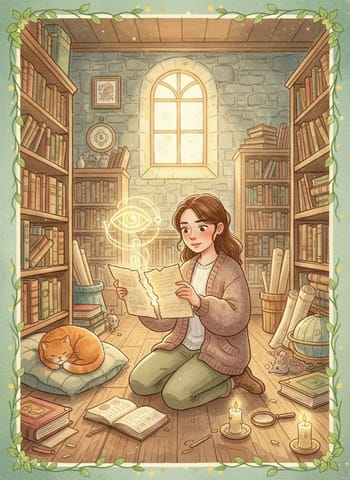
Madu starts every morning in the library basement, where the old maps sleep in flat steel drawers. The air smells of dust and cold metal. A long lamp hangs over the work table and hums.
She has worked here for five weeks. Her job is simple on paper. She opens a drawer, checks each map against a long list, and writes the answer on a card. In practice, the job is full of small choices, and Madu hates choices that nobody has approved.
Today the list says that drawer twelve should hold forty maps. Madu counts thirty-nine.
"One is missing," she says to herself. "Of course it is."
She counts again. Then she checks the tubes on the shelf above the drawer, because maps sometimes hide in them. The third tube is stuffed with brown paper. Inside the paper, she finds something that is not a map. It is half of a page from a diary, torn straight down the middle.
The handwriting is small and slanted. Madu holds the page under the lamp and reads the first line.
"Day nine. The survey crew reached the river road. I drew the ford in pencil, and it must go in the big sheet before the ink dries."
She stops reading. Half of every sentence has disappeared along the torn edge. Without the other half, the words are only a puzzle.
Nami comes down the stairs with a mug and a stack of folders. She is the senior conservator, and she walks like someone who has never been late in her life.
"You look like you found a ghost," Nami says.
"I found half a diary page." Madu holds it out. "It was in a tube in drawer twelve. I think it belongs to the missing map."
Nami puts down her mug and reads the page slowly. She tilts it toward the lamp. "This writer is a mapmaker's assistant. The ink is from the nineteen thirties, I would guess. Where is the other half?"
"I have no idea."
"Then we should find it," Nami says. "What would you do first?"
Madu feels the old familiar pressure in her chest. She wants to say, "Whatever you think is best." That is her habit. In every job she has had, she waits for somebody to hand her the next step.
This time she takes a breath and thinks. A torn page does not travel far. If someone tore it, they used the halves for something. If the maps in drawer twelve share a survey, the other half might sit with that survey.
"I would check the other drawers from the same survey," Madu says. "The list gives a survey code for each map. Drawers twelve and thirteen share the code."
"Good. Go on."
"And if that fails, I would look in the atlases upstairs. People use scraps as bookmarks."
Nami smiles into her mug. "You see? You are not as helpless as you pretend."
They spend the next hour with the drawers. Madu opens drawer thirteen first. She lifts each map with both hands, the way Nami taught her. She slides it onto a clean sheet. There are thirty-six maps, a river chart, and a folded coastline. There is no loose page anywhere.
Nami checks drawers fourteen and fifteen.
"Nothing," she says finally. "It was a clever idea, but the page is somewhere else."
"The atlases, then."
"The atlases are on the third floor, and the reading room opens in twenty minutes." Nami looks at the clock. "We cannot bring a damaged page into a public room without a folder. Do you know how to make one?"
Madu does. Last week, Nami showed her how to fold thin paper into a sleeve. The sleeve holds a fragile page flat. She never expected to use the skill alone.
She cuts the paper, folds it twice, and slides the half page inside. Her hands shake a little, but the folds are straight.
"Perfect," Nami says. "I will stay down here and finish the count. You go upstairs. If you find the other half, do not pull it out of the book. Call me first."
"Why not just pull it out?"
"Because the book might be worth more than the page," Nami says. "Go on."
Madu climbs two flights of stairs with the folder against her chest. The reading room is quiet. A young man sleeps over a newspaper at the nearest table. Madu walks past him to the shelf of old atlases.
There are nineteen of them, some with cracked leather covers. She cannot open all nineteen. She needs a smarter way.
She thinks about the diary again. The writer talked about a river road and a ford. A mapmaker's assistant keeps his diary in the same bag as his instruments. He might use a page to mark a place he plans to draw. So the page belongs near a map of the river road.
Madu runs her finger along the spines. One atlas has a title about regional roads. She pulls it out and lays it on the nearest table.
A thin strip of paper sticks out of the book, just near the middle. She holds her breath.
Carefully, she opens the atlas at the strip. It is the other half of the page. The edge is torn in a jagged line, and the handwriting looks exactly the same.
"Found you," she whispers.
She does not touch it. She takes out her phone and photographs the page where it lies. Then she goes back to the stairs, two steps at a time, and calls Nami from the landing.
Nami arrives eight minutes later, a little out of breath. She reads the strip in place, and her eyebrows rise.
"Look at that torn edge," she says. "The paper fibres are long and fuzzy. If we put the two halves side by side, they will fit like a key and a lock."
"Can we try?"
"We can try right now."
They carry the atlas and the folder to a table by the window. Nami removes the strip with a thin steel tool, slowly, while Madu holds her breath again. The strip comes free without a sound. Madu lays the first half on a clean sheet, and Nami places the second beside it.
The edges meet. Not perfectly, because a little paper is missing, but well enough to read.
"Day nine," Madu reads out loud. "The survey crew reached the river road. I drew the ford in pencil, and it must go in the big sheet before the ink dries. Tell Mr Halloran that sheet twenty-two is in drawer twelve, under the blue cover."
Nami gives a quiet laugh. "Under the blue cover. So the missing map is hiding inside another folder."
They hurry back to the basement. In drawer twelve, Madu lifts a map with a blue cardboard cover. Under it lies a fortieth map, a large sheet with a hand-drawn river and a small, careful ford.
"Sheet twenty-two," she says, smiling. "It was there all along."
Nami helps her fix the torn page with thin tissue and a safe paste. When they finish, the two halves look like one. Madu puts the page into a clear sleeve and writes a new card for the drawer.
She hesitates over the last line, where the card asks for a name.
"Should I write yours?" she asks. "You are the senior conservator."
"You found it, you wrote the card, and you made the folder," Nami says. "I only held the lamp. So put your name on the card, Madu."
Madu looks at the empty line for a moment. Then she picks up the pen and writes her own name, slowly and clearly.