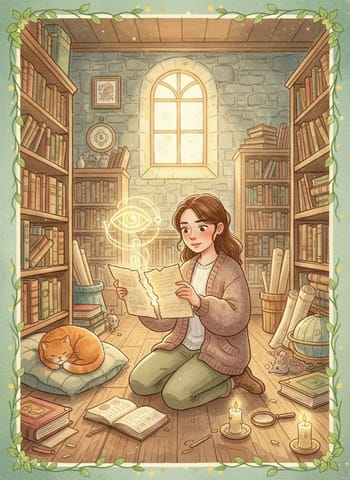
Madu starts every morning in the library basement, where the old maps sleep in flat steel drawers. The air smells of dust and cold metal. A long lamp hangs over the work table and hums.
玛杜每天早晨都从图书馆地下室开始,那里的古地图睡在扁平的钢抽屉里。空气里有灰尘和冷金属的味道。一盏长长的灯悬在工作台上方,嗡嗡作响。
She has worked here for five weeks. Her job is simple on paper. She opens a drawer, checks each map against a long list, and writes the answer on a card. In practice, the job is full of small choices, and Madu hates choices that nobody has approved.
她在这里工作了五个星期。她的工作,写在纸上很简单:打开一个抽屉,对照一份长清单逐张核对地图,再把结果写在卡片上。可实际做起来,这份工作充满了各种小小的抉择,而玛杜最讨厌的,就是没人批准过的抉择。
Today the list says that drawer twelve should hold forty maps. Madu counts thirty-nine.
今天清单上说,十二号抽屉里应该有四十张地图。玛杜数出来是三十九张。
"One is missing," she says to herself. "Of course it is."
“少了一张,”她自言自语,“当然会少。”
She counts again. Then she checks the tubes on the shelf above the drawer, because maps sometimes hide in them. The third tube is stuffed with brown paper. Inside the paper, she finds something that is not a map. It is half of a page from a diary, torn straight down the middle.
她又数了一遍。接着她查看抽屉上方架子上的图筒,因为地图有时会藏在里面。第三个图筒里塞满了牛皮纸。她在纸里发现了一样不是地图的东西。那是半页日记,从正中间直直撕开。
The handwriting is small and slanted. Madu holds the page under the lamp and reads the first line.
字迹细小而倾斜。玛杜把那半页纸举到灯下,读起第一行。
"Day nine. The survey crew reached the river road. I drew the ford in pencil, and it must go in the big sheet before the ink dries."
“第九天。测量队抵达了河边的大路。我用铅笔画下了渡口,必须在墨迹干透之前把它画进那张大图。”
She stops reading. Half of every sentence has disappeared along the torn edge. Without the other half, the words are only a puzzle.
她停了下来。每个句子的一半都随着撕裂的边缘消失了。没有另一半,这些字不过是一道谜题。
Nami comes down the stairs with a mug and a stack of folders. She is the senior conservator, and she walks like someone who has never been late in her life.
娜米端着马克杯、抱着一摞文件夹走下楼梯。她是资深修复师,走起路来像个一辈子没迟到过的人。
"You look like you found a ghost," Nami says.
“你看起来像是撞见了鬼,”娜米说。
"I found half a diary page." Madu holds it out. "It was in a tube in drawer twelve. I think it belongs to the missing map."
“我找到了半页日记。”玛杜把纸递过去。“它在十二号抽屉的一个图筒里。我想它和那张丢失的地图有关。”
Nami puts down her mug and reads the page slowly. She tilts it toward the lamp. "This writer is a mapmaker's assistant. The ink is from the nineteen thirties, I would guess. Where is the other half?"
娜米放下马克杯,慢慢地读着那页纸。她把纸朝灯光倾斜。“写这个的人是制图师的助手。我猜墨水是三十年代的。另一半在哪儿呢?”
"I have no idea."
“我完全不知道。”
"Then we should find it," Nami says. "What would you do first?"
“那我们就该去找,”娜米说。“你会先做什么?”
Madu feels the old familiar pressure in her chest. She wants to say, "Whatever you think is best." That is her habit. In every job she has had, she waits for somebody to hand her the next step.
玛杜感到胸口涌上那种熟悉的压力。她很想说:“您觉得怎么好就怎么办。”这是她的老习惯。在她做过的每一份工作里,她都在等别人把下一步交到她手上。
This time she takes a breath and thinks. A torn page does not travel far. If someone tore it, they used the halves for something. If the maps in drawer twelve share a survey, the other half might sit with that survey.
这一次,她深吸一口气,开始思考。一张撕开的纸不会跑太远。如果有人把它撕开,他们是拿这两半去派了用场。如果十二号抽屉里的地图出自同一次测量,另一半说不定就和那次测量的资料放在一起。
"I would check the other drawers from the same survey," Madu says. "The list gives a survey code for each map. Drawers twelve and thirteen share the code."
“我会去查同一次测量的其他抽屉,”玛杜说。“清单上每张地图都有一个测量编号。十二号和十三号抽屉的编号相同。”
"Good. Go on."
“很好。接着说。”
"And if that fails, I would look in the atlases upstairs. People use scraps as bookmarks."
“如果这样找不到,我会去楼上的地图集里找。人们常拿碎纸片当书签。”
Nami smiles into her mug. "You see? You are not as helpless as you pretend."
娜米对着马克杯笑了。“你看吧?你并不像你假装的那样无能。”
They spend the next hour with the drawers. Madu opens drawer thirteen first. She lifts each map with both hands, the way Nami taught her. She slides it onto a clean sheet. There are thirty-six maps, a river chart, and a folded coastline. There is no loose page anywhere.
接下来的一个小时,她们都在查抽屉。玛杜先打开十三号抽屉。她像娜米教她的那样,用双手托起每一张地图,再把它滑到一张干净的衬纸上。里面有三十六张地图,一幅河流图,还有一幅折起来的海岸线图。哪里都没有散落的纸页。
Nami checks drawers fourteen and fifteen.
娜米查了十四号和十五号抽屉。
"Nothing," she says finally. "It was a clever idea, but the page is somewhere else."
“什么都没有,”她最后说。“这个主意很聪明,可那页纸在别的地方。”
"The atlases, then."
“那就是地图集了。”
"The atlases are on the third floor, and the reading room opens in twenty minutes." Nami looks at the clock. "We cannot bring a damaged page into a public room without a folder. Do you know how to make one?"
“地图集在三楼,而阅览室二十分钟后开门。”娜米看了看钟。“没有文件夹,我们不能把一页受损的纸带进公共场所。你会做吗?”
Madu does. Last week, Nami showed her how to fold thin paper into a sleeve. The sleeve holds a fragile page flat. She never expected to use the skill alone.
玛杜会。上星期,娜米教过她把薄纸折成一个套子。套子能让脆弱的纸页平平整整地躺着。她从没想过会独自用上这门手艺。
She cuts the paper, folds it twice, and slides the half page inside. Her hands shake a little, but the folds are straight.
她裁好纸,对折两次,把半页日记滑进去。她的手有点发抖,可折痕是直的。
"Perfect," Nami says. "I will stay down here and finish the count. You go upstairs. If you find the other half, do not pull it out of the book. Call me first."
“太好了,”娜米说。“我留在这里把清点做完。你上楼去。要是你找到了另一半,别把它从书里抽出来。先给我打电话。”
"Why not just pull it out?"
“为什么不直接抽出来呢?”
"Because the book might be worth more than the page," Nami says. "Go on."
“因为那本书可能比这页纸更值钱,”娜米说。“去吧。”
Madu climbs two flights of stairs with the folder against her chest. The reading room is quiet. A young man sleeps over a newspaper at the nearest table. Madu walks past him to the shelf of old atlases.
玛杜把文件夹贴在胸前,爬了两层楼梯。阅览室里很安静。最近的一张桌子旁,一个年轻男人伏在报纸上睡着了。玛杜从他身边走过,来到摆放旧地图集的书架前。
There are nineteen of them, some with cracked leather covers. She cannot open all nineteen. She needs a smarter way.
一共有十九本,有些皮面封皮已经开裂。她不可能把十九本都翻开。她需要一个更聪明的办法。
She thinks about the diary again. The writer talked about a river road and a ford. A mapmaker's assistant keeps his diary in the same bag as his instruments. He might use a page to mark a place he plans to draw. So the page belongs near a map of the river road.
她又想起了那篇日记。写日记的人提到了河边的大路和一个渡口。制图师的助手会把日记和仪器放在同一个包里。他也许会拿一页纸来标记他打算绘制的地方。所以这页纸应该在靠近河边大路那张地图的地方。
Madu runs her finger along the spines. One atlas has a title about regional roads. She pulls it out and lays it on the nearest table.
玛杜用手指顺着书脊划过去。有一本地图集的书名和地区道路有关。她把它抽出来,放在最近的桌子上。
A thin strip of paper sticks out of the book, just near the middle. She holds her breath.
书的正中间附近,露出一条薄薄的纸边。她屏住了呼吸。
Carefully, she opens the atlas at the strip. It is the other half of the page. The edge is torn in a jagged line, and the handwriting looks exactly the same.
她小心翼翼地在那条纸边处翻开地图集。那正是那页纸的另一半。边缘撕成锯齿状,笔迹看上去一模一样。
"Found you," she whispers.
“找到你了,”她低声说。
She does not touch it. She takes out her phone and photographs the page where it lies. Then she goes back to the stairs, two steps at a time, and calls Nami from the landing.
她没有碰它。她拿出手机,把那页纸原样拍了下来。然后她回到楼梯口,两级两级地往下跑,在楼梯平台上给娜米打了电话。
Nami arrives eight minutes later, a little out of breath. She reads the strip in place, and her eyebrows rise.
八分钟后,娜米到了,有点气喘吁吁。她就地读了那条纸边上的字,眉毛扬了起来。
"Look at that torn edge," she says. "The paper fibres are long and fuzzy. If we put the two halves side by side, they will fit like a key and a lock."
“看看那撕裂的边缘,”她说。“纸纤维又长又毛。如果把两半并排放在一起,它们会像钥匙和锁一样严丝合缝。”
"Can we try?"
“我们能试试吗?”
"We can try right now."
“现在就能试。”
They carry the atlas and the folder to a table by the window. Nami removes the strip with a thin steel tool, slowly, while Madu holds her breath again. The strip comes free without a sound. Madu lays the first half on a clean sheet, and Nami places the second beside it.
她们把地图集和文件夹端到窗边的桌子上。娜米用一把细细的钢工具取下那条纸边,动作很慢,玛杜又一次屏住了呼吸。纸条悄无声息地脱离了书页。玛杜把前半页放在一张干净的衬纸上,娜米把后半页放在它旁边。
The edges meet. Not perfectly, because a little paper is missing, but well enough to read.
两条边缘对上了。不是完美无缺,因为缺了一点点纸,但已经足够读了。
"Day nine," Madu reads out loud. "The survey crew reached the river road. I drew the ford in pencil, and it must go in the big sheet before the ink dries. Tell Mr Halloran that sheet twenty-two is in drawer twelve, under the blue cover."
“第九天,”玛杜大声读道。“测量队抵达了河边的大路。我用铅笔画下了渡口,必须在墨迹干透之前把它画进那张大图。告诉哈洛兰先生,第二十二号图幅在十二号抽屉里,蓝色封套下面。”
Nami gives a quiet laugh. "Under the blue cover. So the missing map is hiding inside another folder."
娜米轻轻笑了一声。“蓝色封套下面。原来丢失的那张地图藏在另一个文件夹里面。”
They hurry back to the basement. In drawer twelve, Madu lifts a map with a blue cardboard cover. Under it lies a fortieth map, a large sheet with a hand-drawn river and a small, careful ford.
她们匆匆赶回地下室。在十二号抽屉里,玛杜拿起一张带蓝色纸板封套的地图。封套下面躺着第四十张地图,一张大图幅,上面有一条手绘的河,和一个小小的、画得一丝不苟的渡口。
"Sheet twenty-two," she says, smiling. "It was there all along."
“第二十二号图幅,”她笑着说。“它一直都在这儿。”
Nami helps her fix the torn page with thin tissue and a safe paste. When they finish, the two halves look like one. Madu puts the page into a clear sleeve and writes a new card for the drawer.
娜米帮她用薄棉纸和安全的糨糊粘好了那页撕开的日记。完成时,两半看上去像是一整页。玛杜把纸页放进一个透明的套子里,为这个抽屉写了一张新卡片。
She hesitates over the last line, where the card asks for a name.
她在最后一行犹豫了,那里要求填一个名字。
"Should I write yours?" she asks. "You are the senior conservator."
“我该写您的名字吗?”她问。“您是资深修复师。”
"You found it, you wrote the card, and you made the folder," Nami says. "I only held the lamp. So put your name on the card, Madu."
“是你找到的,卡片是你写的,文件夹也是你做的,”娜米说。“我只是举了举灯。所以,把你的名字写在卡片上吧,玛杜。”
Madu looks at the empty line for a moment. Then she picks up the pen and writes her own name, slowly and clearly.
玛杜看着那条空白的横线,看了片刻。然后她拿起笔,缓慢而清晰地写下了自己的名字。