The Peaches That Would Not Ripen
Una historia gratuita en inglés de nivel B1 para estudiantes, para leer en línea en 7 idiomas, con opción de escucharla en la app gratuita Storyteller.
On a freezing night train, Brina tries to keep a promise about ripe fruit for a hospital party.
¡Ese fue el avance! Escucha la historia completa en la app gratuita Storyteller. Descargar la app
El audio no está disponible en este momento.
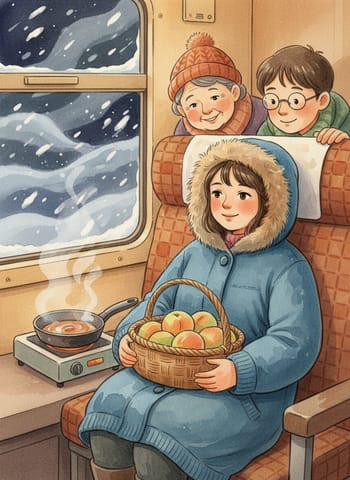
The heater in carriage four died just after the night train left the last big station.
La calefacción del vagón cuatro se averió justo después de que el tren nocturno saliera de la última estación grande.
Brina felt it first in her toes. The warm air stopped blowing from under the seats, and the cold crept up from the floor. She pulled her coat tight and looked down at the basket on her lap.
Brina lo sintió primero en los dedos de los pies. El aire tibio dejó de salir de debajo de los asientos, y el frío subió desde el piso. Se ajustó bien el abrigo y miró la canasta que tenía sobre las rodillas.
It held twenty peaches. They were hard and green, like small apples in early spring. Her boss at the orchard had picked them too soon. A buyer in the city wanted them by noon.
Contenía veinte duraznos. Estaban duros y verdes, como pequeñas manzanas a principios de la primavera. Su jefe en el huerto los había cosechado demasiado pronto. Un comprador de la ciudad los quería para el mediodía.
"They need three more days of sun," she had told him that afternoon.
«Necesitan tres días más de sol», le había dicho esa tarde.
"Then you must make them hurry," he had said, and he had laughed.
«Entonces tendrás que hacer que se apuren», había dicho él, y se había reído.
It was not funny now. Brina had made a promise to the cook at the children's hospital. Tomorrow was the summer party on the ward. The cook had called twice that week, and Brina had said the same words both times.
Ahora no tenía nada de gracioso. Brina le había hecho una promesa a la cocinera del hospital infantil. Mañana era la fiesta de verano en la sala. La cocinera había llamado dos veces esa semana, y Brina había dicho las mismas palabras las dos veces.
"I promise you will have ripe peaches. Soft, sweet and ready to eat."
«Le prometo que tendrá duraznos maduros. Suaves, dulces y listos para comer».
She had meant it. She had not known about the heater.
Lo había dicho en serio. No sabía nada de la calefacción.
A tired conductor walked slowly down the aisle. He wore a thick scarf, and his breath made small clouds. His badge said Lazlo. He stopped beside her seat and looked at the basket.
Un conductor cansado caminaba despacio por el pasillo. Llevaba una bufanda gruesa, y su aliento formaba pequeñas nubes. Su insignia decía Lazlo. Se detuvo junto a su asiento y miró la canasta.
"Those are very green peaches," he said.
«Son duraznos muy verdes», dijo.
"I know," said Brina. "They are supposed to be soft by morning."
«Lo sé», dijo Brina. «Se supone que estarán blandos para la mañana».
Lazlo gave a short, kind laugh. "Not in this carriage. Even the ticket machine is freezing."
Lazlo soltó una risa corta y amable. «No en este vagón. Hasta la máquina de boletos se está congelando».
"Can you fix the heater?"
«¿Puede arreglar la calefacción?».
"I have tried three times. The part is broken, and the next station with a workshop is four hours away." He rubbed his hands together. "I am sorry. I wish I had better news."
«Lo he intentado tres veces. La pieza está rota, y la próxima estación con taller queda a cuatro horas». Se frotó las manos. «Lo siento. Ojalá tuviera mejores noticias».
Brina stared at the dark window. Her own face looked back at her, small and worried. She thought about the children on the ward. Some of them had been in bed for weeks. A basket of fruit would not cure anyone, but the cook had said it would mean a lot.
Brina miró fijamente la ventana oscura. Su propio rostro le devolvía la mirada, pequeño y preocupado. Pensó en los niños de la sala. Algunos llevaban semanas en cama. Una canasta de fruta no curaría a nadie, pero la cocinera había dicho que significaría mucho.
Across the aisle, a young man in a blue jacket was studying a tin of soup. A woman near the door held a sleeping baby inside her coat. Four students sat at the back with their bags in a pile. They were pretending not to be cold.
Al otro lado del pasillo, un joven de chaqueta azul estudiaba una lata de sopa. Una mujer cerca de la puerta sostenía a un bebé dormido dentro de su abrigo. Cuatro estudiantes estaban sentados al fondo con sus mochilas en un montón. Fingían no tener frío.
Brina took out her phone and searched for advice. She found one idea quickly. Peaches ripen faster in a paper bag with a banana or an apple. Ripe fruit gives off a gas that helps the others.
Brina sacó su teléfono y buscó consejos. Encontró una idea enseguida. Los duraznos maduran más rápido en una bolsa de papel con un plátano o una manzana. La fruta madura desprende un gas que ayuda a las demás.
She also read the second part. They still need warmth, and they still need time.
También leyó la segunda parte. Todavía necesitan calor, y todavía necesitan tiempo.
"Do you have a ripe apple?" she asked the young man across the aisle.
«¿Tienes una manzana madura?», le preguntó al joven del otro lado del pasillo.
He looked up, surprised. "I have two. Why?"
Él levantó la vista, sorprendido. «Tengo dos. ¿Por qué?».
"It is a long story."
«Es una historia larga».
"We have all night," he said, and he handed her both apples.
«Tenemos toda la noche», dijo él, y le entregó las dos manzanas.
That was how it began. Brina found a paper bag in her handbag and put six peaches inside with the apples. The students heard her explain, and one of them gave her a banana. The woman with the baby had a pear in her bag. Soon the whole carriage was looking for ripe fruit.
Así fue como empezó. Brina encontró una bolsa de papel en su bolso y puso seis duraznos adentro con las manzanas. Los estudiantes oyeron su explicación, y uno de ellos le dio un plátano. La mujer del bebé tenía una pera en su bolsa. Pronto todo el vagón estaba buscando fruta madura.
Lazlo watched this with his arms crossed. At last he sat down on the seat in front of Brina.
Lazlo observaba esto con los brazos cruzados. Por fin se sentó en el asiento de enfrente de Brina.
"It will not work," he said gently. "I have worked on this line for nine years. Cold is cold."
«No va a funcionar», dijo con suavidad. «Llevo nueve años trabajando en esta línea. Frío es frío».
"I know," Brina said. Her voice shook a little. "But I promised."
«Lo sé», dijo Brina. Le tembló un poco la voz. «Pero lo prometí».
Lazlo said nothing for a moment. Then he stood up and looked at the end of the carriage, where the luggage rack was.
Lazlo no dijo nada por un momento. Luego se levantó y miró hacia el final del vagón, donde estaba el portaequipajes.
"Wait here," he said.
«Espere aquí», dijo.
He came back ten minutes later with a small electric hotplate and a heavy metal pot. He put them on the empty seat across from her.
Volvió diez minutos después con una pequeña hornilla eléctrica y una olla de metal pesada. Las puso en el asiento vacío frente a ella.
"This belongs to a night guard in the next carriage," he said. "He uses it on his breaks. He says I can borrow it if I tell nobody."
«Esto es de un guardia nocturno del vagón de al lado», dijo. «La usa en sus descansos. Dice que puedo pedírsela prestada si no se lo digo a nadie».
Brina looked at the hotplate and then at him. "Rules say no cooking on the train."
Brina miró la hornilla y luego a él. «Las reglas dicen que no se puede cocinar en el tren».
"Rules say a lot of things," said Lazlo. "They also say passengers must be warm. Nobody follows that one tonight."
«Las reglas dicen muchas cosas», dijo Lazlo. «También dicen que los pasajeros deben estar abrigados. Esta noche nadie cumple esa».
He plugged the hotplate into the socket by the door. A small red light came on, and the plate began to tick as it warmed. The students gasped. The baby woke and made a happy noise.
Conectó la hornilla al enchufe junto a la puerta. Se encendió una lucecita roja, y la placa empezó a chasquear al calentarse. Los estudiantes soltaron un grito ahogado. El bebé despertó y emitió un sonido alegre.
"Now," said Lazlo. "You said you promised soft, sweet peaches."
«Ahora», dijo Lazlo. «Usted dijo que prometió duraznos suaves y dulces».
"Yes."
«Sí».
"Then we cannot wait for the sun. We must cook them."
«Entonces no podemos esperar al sol. Tenemos que cocinarlos».
Brina's mouth fell open, and then she began to laugh. It was the first time that night. She cut the green peaches in half with the young man's pocket knife. She dropped them into the pot. The woman with the baby gave her a small bag of sugar from her lunch. One of the students had a stick of cinnamon in her coat. She could not explain why.
A Brina se le abrió la boca, y luego empezó a reír. Era la primera vez esa noche. Cortó los duraznos verdes por la mitad con la navaja del joven. Los echó en la olla. La mujer del bebé le dio una bolsita de azúcar de su almuerzo. Una de las estudiantes tenía una rama de canela en el abrigo. No supo explicar por qué.
Water came from a bottle. The pot began to bubble slowly, and a warm smell filled the carriage. It smelled like summer, even though the peaches had never seen enough of it.
El agua salió de una botella. La olla empezó a burbujear lentamente, y un olor cálido llenó el vagón. Olía a verano, aunque los duraznos nunca habían visto suficiente de él.
People moved closer. First the students came, then the man with the soup, then the woman and her baby. They sat with their hands near the pot and their faces in the soft steam. Someone started to tell a joke about a goat on a bus. Someone else told a worse one.
La gente se acercó más. Primero vinieron los estudiantes, luego el hombre de la sopa, luego la mujer y su bebé. Se sentaron con las manos cerca de la olla y la cara en el vapor suave. Alguien empezó a contar un chiste sobre una cabra en un autobús. Alguien más contó uno peor.
Lazlo stirred the pot with a wooden spoon. He did it carefully, like a man who had cooked for crowds before.
Lazlo revolvía la olla con una cuchara de madera. Lo hacía con cuidado, como un hombre que ya había cocinado para multitudes.
"Where did you learn this?" Brina asked.
«¿Dónde aprendió esto?», preguntó Brina.
"My cousin ran a roadside kitchen," he said. "I was twelve, and I washed pots. I learned to stir before I learned to read."
«Mi primo tenía una cocina junto al camino», dijo. «Yo tenía doce años y lavaba ollas. Aprendí a revolver antes de aprender a leer».
Around two in the morning, the peaches turned soft and golden. They were not the fruit she had promised. They were a sweet, warm stew with cinnamon, and the smell alone made her eyes wet.
Hacia las dos de la madrugada, los duraznos se pusieron blandos y dorados. No eran la fruta que había prometido. Eran un guiso dulce y tibio con canela, y solo el olor le humedeció los ojos.
She filled every empty jar and tin she could find. The woman with the baby gave her a clean cup. The students gave her two plastic boxes. Lazlo took a small bottle from his pocket. He poured the last honey into the pot.
Llenó cada frasco y lata vacíos que pudo encontrar. La mujer del bebé le dio una taza limpia. Los estudiantes le dieron dos cajas de plástico. Lazlo sacó una botellita del bolsillo. Vertió la última miel en la olla.
By the time the sky turned pale outside, everyone in the carriage had tasted a spoonful. Nobody was cold any more. The hotplate was unplugged and carried away before the station.
Cuando el cielo se puso pálido afuera, todos en el vagón habían probado una cucharada. Ya nadie tenía frío. La hornilla fue desenchufada y se la llevaron antes de la estación.
The train stopped at the city platform at a quarter to six. Brina carried her basket, now heavy with jars, down the steps. Lazlo stood at the door with his scarf pulled up to his nose.
El tren se detuvo en el andén de la ciudad a las seis menos cuarto. Brina bajó los escalones con su canasta, ahora pesada de frascos. Lazlo estaba en la puerta con la bufanda subida hasta la nariz.
"You kept your promise," he said. "Just not the way you planned."
«Cumplió su promesa», dijo. «Solo que no como lo había planeado».
"I am not sure the cook will agree," said Brina.
«No estoy segura de que la cocinera esté de acuerdo», dijo Brina.
She was right to worry. At the hospital kitchen, the cook looked at the jars and then at her. Her eyebrows rose slowly.
Tenía razón en preocuparse. En la cocina del hospital, la cocinera miró los frascos y luego a ella. Levantó las cejas lentamente.
"These are not what I asked for," the cook said.
«Esto no es lo que pedí», dijo la cocinera.
"No," said Brina. Her stomach felt tight. "They are not. But please try one."
«No», dijo Brina. Sentía el estómago apretado. «No lo es. Pero por favor pruebe uno».
The cook picked up a spoon and tasted the warm peaches. She closed her eyes. Then she opened them again and smiled, and Brina let out her breath.
La cocinera tomó una cuchara y probó los duraznos tibios. Cerró los ojos. Luego los abrió otra vez y sonrió, y Brina soltó el aire.
"Who made this?" the cook asked.
«¿Quién hizo esto?», preguntó la cocinera.
"A whole carriage of strangers," said Brina. "And one conductor who broke the rules."
«Un vagón entero de desconocidos», dijo Brina. «Y un conductor que rompió las reglas».
The cook laughed and reached for another jar. "The children will love it. Can you tell me the recipe, or must I take the train to find out?"
La cocinera se rio y alcanzó otro frasco. «A los niños les va a encantar. ¿Puede decirme la receta, o tendré que tomar el tren para averiguarla?».