The Peaches That Would Not Ripen
A free B1-level English story for language learners, readable online in 7 languages, with an option to listen via the free Storyteller app.
On a freezing night train, Brina tries to keep a promise about ripe fruit for a hospital party.
That was the preview! Hear the full story in the free Storyteller app. Get the app
Audio isn't available right now.
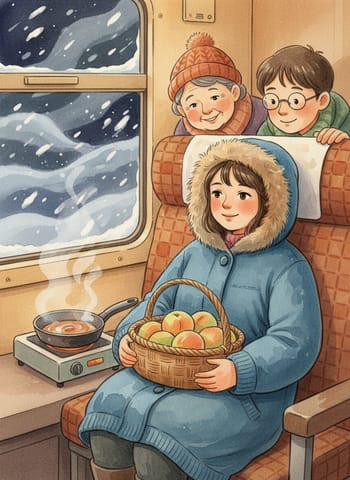
The heater in carriage four died just after the night train left the last big station.
Brina felt it first in her toes. The warm air stopped blowing from under the seats, and the cold crept up from the floor. She pulled her coat tight and looked down at the basket on her lap.
It held twenty peaches. They were hard and green, like small apples in early spring. Her boss at the orchard had picked them too soon. A buyer in the city wanted them by noon.
"They need three more days of sun," she had told him that afternoon.
"Then you must make them hurry," he had said, and he had laughed.
It was not funny now. Brina had made a promise to the cook at the children's hospital. Tomorrow was the summer party on the ward. The cook had called twice that week, and Brina had said the same words both times.
"I promise you will have ripe peaches. Soft, sweet and ready to eat."
She had meant it. She had not known about the heater.
A tired conductor walked slowly down the aisle. He wore a thick scarf, and his breath made small clouds. His badge said Lazlo. He stopped beside her seat and looked at the basket.
"Those are very green peaches," he said.
"I know," said Brina. "They are supposed to be soft by morning."
Lazlo gave a short, kind laugh. "Not in this carriage. Even the ticket machine is freezing."
"Can you fix the heater?"
"I have tried three times. The part is broken, and the next station with a workshop is four hours away." He rubbed his hands together. "I am sorry. I wish I had better news."
Brina stared at the dark window. Her own face looked back at her, small and worried. She thought about the children on the ward. Some of them had been in bed for weeks. A basket of fruit would not cure anyone, but the cook had said it would mean a lot.
Across the aisle, a young man in a blue jacket was studying a tin of soup. A woman near the door held a sleeping baby inside her coat. Four students sat at the back with their bags in a pile. They were pretending not to be cold.
Brina took out her phone and searched for advice. She found one idea quickly. Peaches ripen faster in a paper bag with a banana or an apple. Ripe fruit gives off a gas that helps the others.
She also read the second part. They still need warmth, and they still need time.
"Do you have a ripe apple?" she asked the young man across the aisle.
He looked up, surprised. "I have two. Why?"
"It is a long story."
"We have all night," he said, and he handed her both apples.
That was how it began. Brina found a paper bag in her handbag and put six peaches inside with the apples. The students heard her explain, and one of them gave her a banana. The woman with the baby had a pear in her bag. Soon the whole carriage was looking for ripe fruit.
Lazlo watched this with his arms crossed. At last he sat down on the seat in front of Brina.
"It will not work," he said gently. "I have worked on this line for nine years. Cold is cold."
"I know," Brina said. Her voice shook a little. "But I promised."
Lazlo said nothing for a moment. Then he stood up and looked at the end of the carriage, where the luggage rack was.
"Wait here," he said.
He came back ten minutes later with a small electric hotplate and a heavy metal pot. He put them on the empty seat across from her.
"This belongs to a night guard in the next carriage," he said. "He uses it on his breaks. He says I can borrow it if I tell nobody."
Brina looked at the hotplate and then at him. "Rules say no cooking on the train."
"Rules say a lot of things," said Lazlo. "They also say passengers must be warm. Nobody follows that one tonight."
He plugged the hotplate into the socket by the door. A small red light came on, and the plate began to tick as it warmed. The students gasped. The baby woke and made a happy noise.
"Now," said Lazlo. "You said you promised soft, sweet peaches."
"Yes."
"Then we cannot wait for the sun. We must cook them."
Brina's mouth fell open, and then she began to laugh. It was the first time that night. She cut the green peaches in half with the young man's pocket knife. She dropped them into the pot. The woman with the baby gave her a small bag of sugar from her lunch. One of the students had a stick of cinnamon in her coat. She could not explain why.
Water came from a bottle. The pot began to bubble slowly, and a warm smell filled the carriage. It smelled like summer, even though the peaches had never seen enough of it.
People moved closer. First the students came, then the man with the soup, then the woman and her baby. They sat with their hands near the pot and their faces in the soft steam. Someone started to tell a joke about a goat on a bus. Someone else told a worse one.
Lazlo stirred the pot with a wooden spoon. He did it carefully, like a man who had cooked for crowds before.
"Where did you learn this?" Brina asked.
"My cousin ran a roadside kitchen," he said. "I was twelve, and I washed pots. I learned to stir before I learned to read."
Around two in the morning, the peaches turned soft and golden. They were not the fruit she had promised. They were a sweet, warm stew with cinnamon, and the smell alone made her eyes wet.
She filled every empty jar and tin she could find. The woman with the baby gave her a clean cup. The students gave her two plastic boxes. Lazlo took a small bottle from his pocket. He poured the last honey into the pot.
By the time the sky turned pale outside, everyone in the carriage had tasted a spoonful. Nobody was cold any more. The hotplate was unplugged and carried away before the station.
The train stopped at the city platform at a quarter to six. Brina carried her basket, now heavy with jars, down the steps. Lazlo stood at the door with his scarf pulled up to his nose.
"You kept your promise," he said. "Just not the way you planned."
"I am not sure the cook will agree," said Brina.
She was right to worry. At the hospital kitchen, the cook looked at the jars and then at her. Her eyebrows rose slowly.
"These are not what I asked for," the cook said.
"No," said Brina. Her stomach felt tight. "They are not. But please try one."
The cook picked up a spoon and tasted the warm peaches. She closed her eyes. Then she opened them again and smiled, and Brina let out her breath.
"Who made this?" the cook asked.
"A whole carriage of strangers," said Brina. "And one conductor who broke the rules."
The cook laughed and reached for another jar. "The children will love it. Can you tell me the recipe, or must I take the train to find out?"