The Robot at the Care Home
A free B1-level English story for language learners, readable online in 4 languages, with an option to listen via the free Storyteller app.
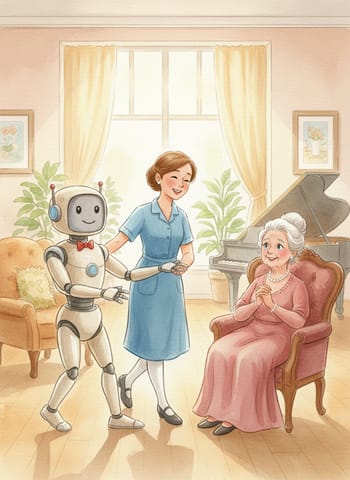
A care worker teaches a new companion robot the waltz that a proud former dancer once loved.
That was the preview! Hear the full story in the free Storyteller app. Get the app
Audio isn't available right now.
The care home where Mahir worked got a new companion robot in March. It was about the size of a ten-year-old child, with a soft round face and a calm voice. The manager hoped it would help residents who felt lonely in the afternoons.
Most of the residents were curious. They asked it questions, and a few of them taught it card games. Only Wilma refused to look at it. When the robot rolled into the lounge, she turned her chair toward the window.
"I don't need a machine," she told Mahir. "I had a whole life before this place."
Mahir didn't argue. He had worked there for six years, and he knew that pushing people usually made things worse. But he kept thinking about her, and he wondered what he was missing.
One evening, he was tidying her shelves when he found an old photo in a frame. In it, a young woman in a bright dress was laughing in the middle of a dance floor. On the back, someone had written "First prize, 1968".
"Is that you?" Mahir asked.
Wilma looked at the photo for a long moment. "That's me," she said. "I danced for thirty years. I haven't heard that music in a very long time."
"What was it like?"
She hummed a few notes of a slow waltz, and her eyes closed for a second.
Mahir searched for the song that night. The next day, he asked the technician how to add music to the robot. It took him an hour to figure out, and he made several mistakes. In the end, the robot learned to play the waltz through its small speaker.
He didn't tell Wilma. He only asked the robot to play it quietly at four o'clock. That was when she usually sat by the window.
For three days, nothing changed. Wilma kept her eyes on the garden. On the fourth day, Mahir noticed that her hands had stopped moving in her lap.
On the fifth day, her right foot began to tap, very softly, in time with the music.
Mahir said nothing. He stood by the door and watched. After a while, Wilma turned her chair a little. It was just enough to see the robot.
"It's not a bad speaker," she said. "But it's a bit slow at the end."
"I'll tell it," Mahir said.