The Last Morning at the Fish Stall
Una historia gratuita en inglés de nivel A1 para estudiantes, para leer en línea en 7 idiomas, con opción de escucharla en la app gratuita Storyteller.
After forty years at a street market, an old fish seller spends her final day with her customers and her young helper.
¡Ese fue el avance! Escucha la historia completa en la app gratuita Storyteller. Descargar la app
El audio no está disponible en este momento.
Bianca woke at four o'clock, as she did every day. It was dark and cold. She made tea and drank it by the window. Today was her last day at the fish stall.
Bianca se despertó a las cuatro, como todos los días. Estaba oscuro y hacía frío. Preparó té y se lo tomó junto a la ventana. Hoy era su último día en el puesto de pescado.
She was sixty-eight years old. For forty years, she sold fish at the street market. She sold cod, trout, and small silver fish for soup. Her back hurt now, and her hands hurt too. Her daughter said, "Mama, it is time."
Tenía sesenta y ocho años. Durante cuarenta años había vendido pescado en el mercado de la calle. Vendía bacalao, trucha y pescaditos plateados para sopa. Ahora le dolía la espalda, y también las manos. Su hija decía: «Mamá, ya es hora».
At five o'clock, she arrived at the market. The street was quiet. The only light came from a lamp over her stall. A young man was already there. His name was Emeka. He was her helper, and he was twenty years old.
A las cinco llegó al mercado. La calle estaba tranquila. La única luz venía de una lámpara sobre su puesto. Un joven ya estaba allí. Se llamaba Emeka. Era su ayudante y tenía veinte años.
"Good morning," Emeka said.
—Buenos días —dijo Emeka.
"I put the ice out."
—Ya puse el hielo.
"Thank you," said Bianca. They laid the fish on the ice, row by row. The fish were bright and shiny. Bianca touched each one with two fingers. She did not think about it. Her hands knew the work.
—Gracias —dijo Bianca. Acomodaron el pescado sobre el hielo, fila por fila. Los pescados estaban brillantes y relucientes. Bianca tocaba cada uno con dos dedos. No lo pensaba. Sus manos conocían el trabajo.
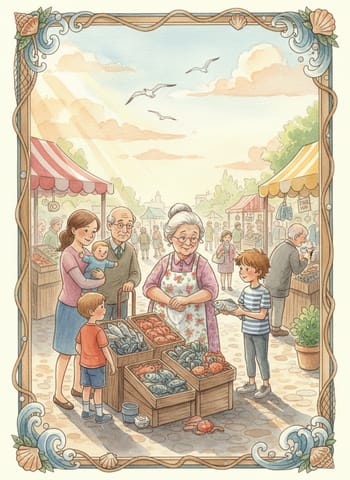
At seven o'clock, the first customers came. A tall man bought two trout. He did not say anything about the day. He just put a few extra coins on the table.
A las siete llegaron los primeros clientes. Un hombre alto compró dos truchas. No dijo nada sobre el día. Solo dejó unas monedas de más sobre la mesa.
"That is too much," Bianca said. "It is for the years," he said. Bianca looked at the coins. She did not answer. She put them in a small tin.
—Es demasiado —dijo Bianca. —Es por los años —dijo él. Bianca miró las monedas. No respondió. Las guardó en una lata pequeña.
A woman came with her little daughter. The girl pointed at a fish. "That one has big eyes," she said.
Una mujer llegó con su hijita. La niña señaló un pescado. —Ese tiene ojos grandes —dijo.
"He is a good fish," said Bianca.
—Es un buen pescado —dijo Bianca.
"He saw a lot of the sea." The girl laughed. Her mother smiled, and they bought him.
—Ha visto mucho mar. —La niña se rio. Su mamá sonrió, y se lo llevaron.
All morning, people came. Some brought flowers. One man brought a small cake in a paper box. A boy gave her a drawing of a fish. Bianca put the drawing on the front of the stall. Emeka said, "It looks like you."
Toda la mañana llegó gente. Algunos traían flores. Un hombre trajo un pastelito en una caja de papel. Un niño le regaló un dibujo de un pescado. Bianca puso el dibujo en el frente del puesto. Emeka dijo: —Se parece a usted.
"The fish?" she asked. "No. The smiling face." She laughed out loud. It was a deep laugh, and it surprised her. At noon, the crowd got smaller. The sun warmed the street. Bianca sat on her old wooden stool. She looked at the scale, the knives, and the apron. She touched them all, many times.
—¿El pescado? —preguntó ella. —No. La cara sonriente. —Se rio a carcajadas. Fue una risa profunda, y la sorprendió. Al mediodía, la multitud disminuyó. El sol calentó la calle. Bianca se sentó en su viejo taburete de madera. Miró la balanza, los cuchillos y el delantal. Los tocó todos, muchas veces.
Emeka sat next to her on a box. "I am a little sad," he said.
Emeka se sentó a su lado sobre una caja. —Estoy un poco triste —dijo.
"Why?" she asked.
—¿Por qué? —preguntó ella.
"You are young. You have the whole market."
—Usted es joven. Tiene todo el mercado.
"I do not have you."
—A usted no lo tengo.
Bianca was quiet. Then she said, "Listen. When the ice melts, pour the water on the street. It keeps the dust down. And never leave the knives wet. And always smile at people who buy one fish."
Bianca se quedó callada. Luego dijo: —Escucha. Cuando se derrita el hielo, echa el agua en la calle. Así se baja el polvo. Y nunca dejes los cuchillos mojados. Y sonríe siempre a la gente que compra un solo pescado.
"Why them?" "Because they come back the most." Emeka wrote it all in his small notebook. He wrote slowly, in big letters.
—¿Por qué a ellos? —Porque son los que más vuelven. —Emeka lo anotó todo en su cuaderno pequeño. Escribía despacio, con letras grandes.
By two o'clock, only five fish remained. Bianca put them in a bag for Emeka. "Take these home," she said.
A las dos solo quedaban cinco pescados. Bianca los puso en una bolsa para Emeka. —Llévatelos a casa —dijo.
"Cook them with butter and lemon."
—Cocínalos con mantequilla y limón.
"But this is your last day."
—Pero es su último día.
"Yes. That is why you cook them."
—Sí. Por eso los cocinas.
They cleaned the stall together. They washed the table and the scale. They folded the umbrella. In the end, only the blue apron was left. Bianca took it off its hook. She held it in her hands for a long time. It was old and soft. It smelled of the sea.
Limpiaron el puesto juntos. Lavaron la mesa y la balanza. Doblaron la sombrilla. Al final, solo quedaba el delantal azul. Bianca lo descolgó de su gancho. Lo sostuvo en las manos mucho tiempo. Era viejo y suave. Olía a mar.
Then she gave it to Emeka. He took it without a word. Bianca picked up her tin of coins. She did not look back. She walked up the street in the afternoon sun. Behind her, a metal hook rang. Emeka hung the apron up again.
Luego se lo dio a Emeka. Él lo recibió sin decir palabra. Bianca tomó su lata de monedas. No miró atrás. Subió por la calle bajo el sol de la tarde. Detrás de ella, un gancho de metal tintineó. Emeka volvió a colgar el delantal.