The Folded Crane on the Roof
Una historia gratuita en inglés de nivel B1 para estudiantes, para leer en línea en 7 idiomas, con opción de escucharla en la app gratuita Storyteller.
Dalila is too shy to speak to Omar, so she sends a paper crane across the roof garden and hopes it finds him.
¡Ese fue el avance! Escucha la historia completa en la app gratuita Storyteller. Descargar la app
El audio no está disponible en este momento.
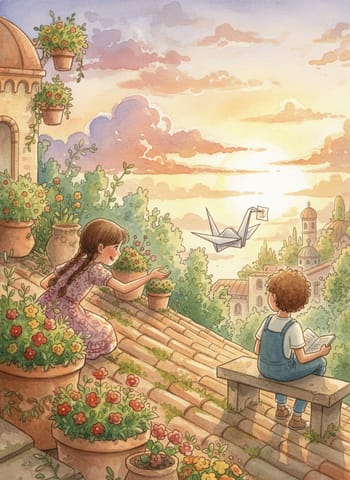
On Saturday mornings, Dalila runs a small plant stall on the roof garden above the shopping centre. The garden club from her school sells seedlings there to raise money for a new greenhouse. Most visitors want basil or sunflowers. Dalila mostly wants to look at the herb beds across the path.
Los sábados por la mañana, Dalila atiende un pequeño puesto de plantas en el jardín de la azotea sobre el centro comercial. El club de jardinería de su escuela vende ahí plantines para reunir dinero para un invernadero nuevo. La mayoría de los visitantes quiere albahaca o girasoles. Dalila, en su mayor parte, quiere mirar los canteros de hierbas al otro lado del sendero.
That is where Omar works. He wears a green apron. He carries a dented watering can that is always a little too full. He knows the name of every plant in the garden. He also knows which ones have been watered and which ones are pretending.
Ahí es donde trabaja Omar. Lleva un delantal verde. Carga una regadera abollada que siempre está un poco demasiado llena. Sabe el nombre de cada planta del jardín. También sabe cuáles han sido regadas y cuáles solo fingen.
Dalila has watched him for three weeks. She has never said more than "Hello" and "Thanks." Every time she plans a longer sentence, it falls apart before it reaches her mouth.
Dalila lo ha observado durante tres semanas. Nunca le ha dicho más que «Hola» y «Gracias». Cada vez que planea una frase más larga, se deshace antes de llegar a su boca.
This morning she sits behind the stall with a page from the seed catalogue. It shows a large photograph of purple lavender. She folds the paper carefully, corner to corner, the way her cousin showed her last summer. Ten minutes later, she is holding a paper crane with long, pointed wings.
Esta mañana se sienta detrás del puesto con una página del catálogo de semillas. Muestra una gran fotografía de lavanda morada. Dobla el papel con cuidado, de esquina a esquina, como le enseñó su prima el verano pasado. Diez minutos después, sostiene una grulla de papel con alas largas y puntiagudas.
Before she closes the last fold, she writes on the inside in tiny letters. Then she lifts the wing and reads it again. It says: "I think the mint likes you more than it likes me."
Antes de cerrar el último doblez, escribe adentro con letras diminutas. Luego levanta el ala y lo lee otra vez. Dice: «Creo que a la menta le gustas más tú que yo».
It is not a great sentence. It is probably the bravest one she has ever written.
No es una gran frase. Probablemente es la más valiente que ha escrito en su vida.
"Okay," she whispers. "Now I only need to give it to him."
«Bueno», susurra. «Ahora solo tengo que dárselo».
She stands up and sits down again. Omar is twenty steps away, bent over the thyme. Twenty steps feels like the length of a football field.
Se levanta y se vuelve a sentar. Omar está a veinte pasos, inclinado sobre el tomillo. Veinte pasos parecen el largo de una cancha de fútbol.
The woman at the next stall looks over. She sells flowers in paper cones, and she misses nothing. "Is that for someone?" she asks.
La mujer del puesto de al lado mira hacia ella. Vende flores en conos de papel, y no se le escapa nada. «¿Es para alguien?», pregunta.
"Maybe," says Dalila. Her voice comes out smaller than she wants. "Could you give it to the boy with the watering can? Please? I have to watch the till."
«Quizás», dice Dalila. Su voz sale más pequeña de lo que quisiera. «¿Podría dárselo al chico de la regadera? ¿Por favor? Tengo que vigilar la caja».
The woman smiles and takes the crane in her palm. "Of course, love. Leave it with me."
La mujer sonríe y toma la grulla en la palma. «Claro, cariño. Déjamelo a mí».
Dalila sits very still and tries to look busy. She straightens a row of pots. She counts the coins in the till twice. Out of the corner of her eye, she watches the flower seller walk down the path.
Dalila se queda muy quieta y trata de parecer ocupada. Endereza una fila de macetas. Cuenta las monedas de la caja dos veces. Por el rabillo del ojo, observa a la florista caminar por el sendero.
Then something goes wrong. A school group arrives. The path fills with children carrying small green watering cans. At least six boys are holding a can. The woman stops, looks around, and chooses the nearest one.
Entonces algo sale mal. Llega un grupo escolar. El sendero se llena de niños con pequeñas regaderas verdes. Al menos seis chicos sostienen una regadera. La mujer se detiene, mira alrededor y elige al más cercano.
"This is for you," she says, and puts the crane in his hands.
«Esto es para ti», dice, y le pone la grulla en las manos.
The boy is about nine years old. He looks at the crane for a long time, as if it might be a trick. Then he decides it is a prize. "Cool!" he says. He holds it above his head and runs off down the path.
El niño tiene unos nueve años. Mira la grulla largo rato, como si pudiera ser una trampa. Luego decide que es un premio. «¡Genial!», dice. La sostiene sobre su cabeza y sale corriendo por el sendero.
Dalila puts her face in her hands. The nine-year-old runs past the herb beds and the fountain. He runs straight into a man in a blue uniform who is checking the lift. The man is a security guard, and he is very serious about his job.
Dalila se tapa la cara con las manos. El niño de nueve años corre más allá de los canteros de hierbas y la fuente. Choca de frente con un hombre de uniforme azul que está revisando el ascensor. El hombre es un guardia de seguridad, y se toma muy en serio su trabajo.
"Where did you get that?" the guard asks.
«¿De dónde sacaste eso?», pregunta el guardia.
"A lady gave it to me," says the boy.
«Una señora me lo dio», dice el niño.
"Then it belongs to somebody," the guard says. He takes the crane gently and turns it around in his large hands. He finds a single letter on one wing, a small neat D. "Hmm. D," he mutters. "Does anyone here have a name that starts with D?"
«Entonces es de alguien», dice el guardia. Toma la grulla con delicadeza y le da vueltas en sus grandes manos. Encuentra una sola letra en un ala, una pequeña D prolija. «Mmm. D», murmura. «¿Alguien aquí tiene un nombre que empiece con D?».
Nobody answers. A few people look up and then look away.
Nadie responde. Algunas personas levantan la vista y luego la desvían.
The guard walks the length of the garden, holding the crane out like a lost glove. At the stall, he asks Dalila. Dalila freezes and cannot say a word, but her neighbour answers for her.
El guardia recorre todo el jardín, sosteniendo la grulla como un guante perdido. En el puesto, le pregunta a Dalila. Dalila se paraliza y no puede decir una palabra, pero su vecina responde por ella.
"Her name starts with D," says the flower seller. "But it isn't hers. It is for the boy with the watering can."
«Su nombre empieza con D», dice la florista. «Pero no es para ella. Es para el chico de la regadera».
"Which boy?" asks the guard. "There are six of them."
«¿Qué chico?», pregunta el guardia. «Son seis».
"The one in the green apron," says the woman.
«El del delantal verde», dice la mujer.
The guard nods slowly. "Ah, the gardener," he says. He gives the crane a little bow, as if it could understand. "That I can do."
El guardia asiente lentamente. «Ah, el jardinero», dice. Le hace a la grulla una pequeña reverencia, como si pudiera entenderla. «Eso sí puedo hacerlo».
He walks to the herb beds and stops beside the thyme. Omar looks up from his work. His hands are muddy, and there is a leaf in his hair.
Camina hasta los canteros de hierbas y se detiene junto al tomillo. Omar levanta la vista de su trabajo. Tiene las manos embarradas y una hoja en el pelo.
"Excuse me," says the guard. "A young lady sent this. I think it might be yours."
«Disculpa», dice el guardia. «Una señorita mandó esto. Creo que podría ser tuyo».
Omar wipes his fingers on his apron and takes the crane as if it were made of glass. He looks at the wings and at the folded point of the beak. He turns it over twice, and then he finds the corner that opens.
Omar se limpia los dedos en el delantal y toma la grulla como si fuera de vidrio. Mira las alas y la punta doblada del pico. La da vuelta dos veces, y entonces encuentra la esquina que se abre.
Dalila cannot see his face from the stall. She can only see his back and the green apron. The guard walks away, whistling softly, and she feels both horrified and strangely proud.
Dalila no puede ver su cara desde el puesto. Solo puede ver su espalda y el delantal verde. El guardia se aleja silbando bajito, y ella se siente a la vez horrorizada y extrañamente orgullosa.
Omar unfolds the first fold. Then the second. He reads the line inside, and she sees his shoulders move. It might be a laugh. It might be something else.
Omar despliega el primer doblez. Luego el segundo. Lee la línea de adentro, y ella ve que sus hombros se mueven. Podría ser una risa. Podría ser otra cosa.
He stands in the middle of the path with the crane open in his hand. He looks across the garden, past the tomato plants and the fountain and the line of waiting customers. He seems to be searching the faces one by one.
Se queda en medio del sendero con la grulla abierta en la mano. Mira a lo largo del jardín, más allá de las plantas de tomate y la fuente y la fila de clientes que esperan. Parece buscar entre las caras una por una.
Dalila ducks behind a tray of sunflower seedlings. Her heart is pounding so loudly that she is sure the customers can hear it.
Dalila se agacha detrás de una bandeja de plantines de girasol. Su corazón late tan fuerte que está segura de que los clientes lo oyen.
"Excuse me," says a woman with a cardboard cup. "How much are the basil plants?"
«Disculpa», dice una mujer con un vaso de cartón. «¿Cuánto cuestan las plantas de albahaca?».
"Two for three," Dalila says, and she hands over a pot without looking at it.
«Dos por tres», dice Dalila, y le entrega una maceta sin mirarla.
When she dares to glance up again, Omar is no longer standing on the path. She spins around. He is walking toward the stall, one slow step at a time. The crane is still in his hand, but now it has been folded back into shape, almost perfectly.
Cuando se atreve a levantar la vista otra vez, Omar ya no está en el sendero. Se da vuelta de golpe. Camina hacia el puesto, un paso lento a la vez. La grulla sigue en su mano, pero ahora la ha vuelto a doblar en su forma, casi a la perfección.
He stops in front of her table. Up close, he is taller than she remembered, and there is mud on his cheek.
Se detiene frente a su mesa. De cerca, es más alto de lo que ella recordaba, y tiene barro en la mejilla.
"That is a very good crane," he says.
«Es una grulla muy buena», dice.
"Thanks," says Dalila. It is the same word she always says. She hates it.
«Gracias», dice Dalila. Es la misma palabra que siempre dice. La odia.
Omar looks down at the paper and then up at her. "I have a problem with the mint," he says. "It keeps growing into the oregano. I have never found a way to stop it. Maybe you know one."
Omar mira el papel y luego a ella. «Tengo un problema con la menta», dice. «Sigue creciendo hacia el orégano. Nunca he encontrado la forma de detenerla. Quizás tú sepas alguna».
"I might," says Dalila. "I would have to see the bed first."
«Puede que sí», dice Dalila. «Tendría que ver primero el cantero».
"It is just over there," says Omar. He does not point, though. He is looking at the crane again, and his forehead is slightly wrinkled.
«Está justo allá», dice Omar. Aunque no señala. Está mirando otra vez la grulla, y tiene la frente un poco arrugada.
"What is it?" she asks.
«¿Qué pasa?», pregunta ella.
"You wrote something in the corner," he says. "Under the fold. It looks like a phone number, but the last digit is smudged. Is it a three or an eight?"
«Escribiste algo en la esquina», dice. «Debajo del doblez. Parece un número de teléfono, pero el último dígito está borroso. ¿Es un tres o un ocho?».
Dalila opens her mouth and closes it again. She has not written a number. She is sure of it. She takes the crane from his hand, turns it toward the light, and tilts it very slowly.
Dalila abre la boca y la cierra otra vez. Ella no escribió ningún número. Está segura. Toma la grulla de su mano, la gira hacia la luz y la inclina muy despacio.
The ink is faint and grey, and it is printed, not written. It is the order number from the seed catalogue, under the photograph of the lavender. The last digit has rubbed away in the fold.
La tinta es tenue y gris, y está impresa, no escrita. Es el número de pedido del catálogo de semillas, bajo la fotografía de la lavanda. El último dígito se ha borrado en el doblez.
"It is not a phone number," she says. "It is lavender."
«No es un número de teléfono», dice. «Es lavanda».
Omar laughs, and the mud on his cheek cracks a little. "Then show me how to stop the mint," he says. "After that, you can tell me the whole number."
Omar se ríe, y el barro de su mejilla se agrieta un poco. «Entonces enséñame cómo detener la menta», dice. «Después, me puedes decir el número completo».
Dalila steps out from behind the stall and follows him to the herb beds. Across the path, six small boys argue about who owns the prize.
Dalila sale de detrás del puesto y lo sigue hasta los canteros de hierbas. Al otro lado del sendero, seis niños pequeños discuten sobre quién es el dueño del premio.