The Folded Crane on the Roof
A free B1-level English story for language learners, readable online in 7 languages, with an option to listen via the free Storyteller app.
Dalila is too shy to speak to Omar, so she sends a paper crane across the roof garden and hopes it finds him.
That was the preview! Hear the full story in the free Storyteller app. Get the app
Audio isn't available right now.
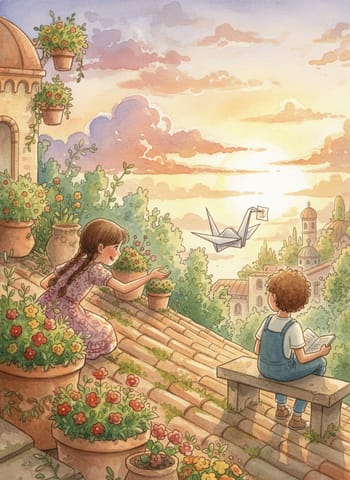
On Saturday mornings, Dalila runs a small plant stall on the roof garden above the shopping centre. The garden club from her school sells seedlings there to raise money for a new greenhouse. Most visitors want basil or sunflowers. Dalila mostly wants to look at the herb beds across the path.
That is where Omar works. He wears a green apron. He carries a dented watering can that is always a little too full. He knows the name of every plant in the garden. He also knows which ones have been watered and which ones are pretending.
Dalila has watched him for three weeks. She has never said more than "Hello" and "Thanks." Every time she plans a longer sentence, it falls apart before it reaches her mouth.
This morning she sits behind the stall with a page from the seed catalogue. It shows a large photograph of purple lavender. She folds the paper carefully, corner to corner, the way her cousin showed her last summer. Ten minutes later, she is holding a paper crane with long, pointed wings.
Before she closes the last fold, she writes on the inside in tiny letters. Then she lifts the wing and reads it again. It says: "I think the mint likes you more than it likes me."
It is not a great sentence. It is probably the bravest one she has ever written.
"Okay," she whispers. "Now I only need to give it to him."
She stands up and sits down again. Omar is twenty steps away, bent over the thyme. Twenty steps feels like the length of a football field.
The woman at the next stall looks over. She sells flowers in paper cones, and she misses nothing. "Is that for someone?" she asks.
"Maybe," says Dalila. Her voice comes out smaller than she wants. "Could you give it to the boy with the watering can? Please? I have to watch the till."
The woman smiles and takes the crane in her palm. "Of course, love. Leave it with me."
Dalila sits very still and tries to look busy. She straightens a row of pots. She counts the coins in the till twice. Out of the corner of her eye, she watches the flower seller walk down the path.
Then something goes wrong. A school group arrives. The path fills with children carrying small green watering cans. At least six boys are holding a can. The woman stops, looks around, and chooses the nearest one.
"This is for you," she says, and puts the crane in his hands.
The boy is about nine years old. He looks at the crane for a long time, as if it might be a trick. Then he decides it is a prize. "Cool!" he says. He holds it above his head and runs off down the path.
Dalila puts her face in her hands. The nine-year-old runs past the herb beds and the fountain. He runs straight into a man in a blue uniform who is checking the lift. The man is a security guard, and he is very serious about his job.
"Where did you get that?" the guard asks.
"A lady gave it to me," says the boy.
"Then it belongs to somebody," the guard says. He takes the crane gently and turns it around in his large hands. He finds a single letter on one wing, a small neat D. "Hmm. D," he mutters. "Does anyone here have a name that starts with D?"
Nobody answers. A few people look up and then look away.
The guard walks the length of the garden, holding the crane out like a lost glove. At the stall, he asks Dalila. Dalila freezes and cannot say a word, but her neighbour answers for her.
"Her name starts with D," says the flower seller. "But it isn't hers. It is for the boy with the watering can."
"Which boy?" asks the guard. "There are six of them."
"The one in the green apron," says the woman.
The guard nods slowly. "Ah, the gardener," he says. He gives the crane a little bow, as if it could understand. "That I can do."
He walks to the herb beds and stops beside the thyme. Omar looks up from his work. His hands are muddy, and there is a leaf in his hair.
"Excuse me," says the guard. "A young lady sent this. I think it might be yours."
Omar wipes his fingers on his apron and takes the crane as if it were made of glass. He looks at the wings and at the folded point of the beak. He turns it over twice, and then he finds the corner that opens.
Dalila cannot see his face from the stall. She can only see his back and the green apron. The guard walks away, whistling softly, and she feels both horrified and strangely proud.
Omar unfolds the first fold. Then the second. He reads the line inside, and she sees his shoulders move. It might be a laugh. It might be something else.
He stands in the middle of the path with the crane open in his hand. He looks across the garden, past the tomato plants and the fountain and the line of waiting customers. He seems to be searching the faces one by one.
Dalila ducks behind a tray of sunflower seedlings. Her heart is pounding so loudly that she is sure the customers can hear it.
"Excuse me," says a woman with a cardboard cup. "How much are the basil plants?"
"Two for three," Dalila says, and she hands over a pot without looking at it.
When she dares to glance up again, Omar is no longer standing on the path. She spins around. He is walking toward the stall, one slow step at a time. The crane is still in his hand, but now it has been folded back into shape, almost perfectly.
He stops in front of her table. Up close, he is taller than she remembered, and there is mud on his cheek.
"That is a very good crane," he says.
"Thanks," says Dalila. It is the same word she always says. She hates it.
Omar looks down at the paper and then up at her. "I have a problem with the mint," he says. "It keeps growing into the oregano. I have never found a way to stop it. Maybe you know one."
"I might," says Dalila. "I would have to see the bed first."
"It is just over there," says Omar. He does not point, though. He is looking at the crane again, and his forehead is slightly wrinkled.
"What is it?" she asks.
"You wrote something in the corner," he says. "Under the fold. It looks like a phone number, but the last digit is smudged. Is it a three or an eight?"
Dalila opens her mouth and closes it again. She has not written a number. She is sure of it. She takes the crane from his hand, turns it toward the light, and tilts it very slowly.
The ink is faint and grey, and it is printed, not written. It is the order number from the seed catalogue, under the photograph of the lavender. The last digit has rubbed away in the fold.
"It is not a phone number," she says. "It is lavender."
Omar laughs, and the mud on his cheek cracks a little. "Then show me how to stop the mint," he says. "After that, you can tell me the whole number."
Dalila steps out from behind the stall and follows him to the herb beds. Across the path, six small boys argue about who owns the prize.