The Folded Crane on the Roof
Uma história gratuita em inglês de nível B1 para estudantes, para ler online em 7 idiomas, com opção de ouvir no app gratuito Storyteller.
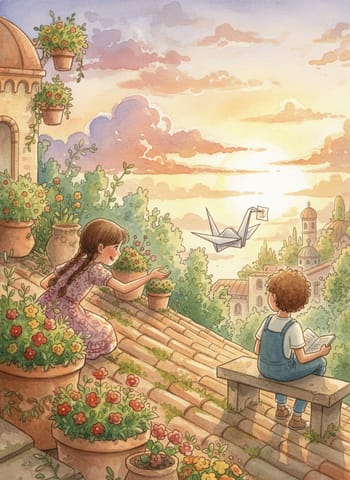
Dalila is too shy to speak to Omar, so she sends a paper crane across the roof garden and hopes it finds him.
Essa foi a prévia! Ouça a história completa no app gratuito Storyteller. Baixar o app
O áudio não está disponível no momento.
On Saturday mornings, Dalila runs a small plant stall on the roof garden above the shopping centre. The garden club from her school sells seedlings there to raise money for a new greenhouse. Most visitors want basil or sunflowers. Dalila mostly wants to look at the herb beds across the path.
Nas manhãs de sábado, Dalila toma conta de uma pequena banca de plantas no jardim do terraço, em cima do shopping. O clube de jardinagem da escola dela vende mudas ali para arrecadar dinheiro para uma estufa nova. A maioria dos visitantes quer manjericão ou girassóis. Dalila, na maior parte do tempo, quer olhar os canteiros de ervas do outro lado do caminho.
That is where Omar works. He wears a green apron. He carries a dented watering can that is always a little too full. He knows the name of every plant in the garden. He also knows which ones have been watered and which ones are pretending.
É ali que Omar trabalha. Ele usa um avental verde. Carrega um regador amassado que está sempre um pouco cheio demais. Sabe o nome de todas as plantas do jardim. Também sabe quais foram regadas e quais estão fingindo.
Dalila has watched him for three weeks. She has never said more than "Hello" and "Thanks." Every time she plans a longer sentence, it falls apart before it reaches her mouth.
Dalila o observa há três semanas. Nunca disse mais que "Oi" e "Obrigada". Toda vez que planeja uma frase mais longa, ela desmorona antes de chegar à boca.
This morning she sits behind the stall with a page from the seed catalogue. It shows a large photograph of purple lavender. She folds the paper carefully, corner to corner, the way her cousin showed her last summer. Ten minutes later, she is holding a paper crane with long, pointed wings.
Nesta manhã ela está sentada atrás da banca com uma página do catálogo de sementes. Nela há uma grande fotografia de lavanda roxa. Dobra o papel com cuidado, de ponta a ponta, do jeito que a prima lhe ensinou no verão passado. Dez minutos depois, segura um tsuru de papel com asas longas e pontudas.
Before she closes the last fold, she writes on the inside in tiny letters. Then she lifts the wing and reads it again. It says: "I think the mint likes you more than it likes me."
Antes de fechar a última dobra, escreve por dentro com letras minúsculas. Depois ergue a asa e lê de novo. Diz: "Acho que a hortelã gosta mais de você do que de mim."
It is not a great sentence. It is probably the bravest one she has ever written.
Não é uma grande frase. Provavelmente é a mais corajosa que ela já escreveu.
"Okay," she whispers. "Now I only need to give it to him."
"Certo", sussurra. "Agora só preciso entregar a ele."
She stands up and sits down again. Omar is twenty steps away, bent over the thyme. Twenty steps feels like the length of a football field.
Ela se levanta e se senta de novo. Omar está a vinte passos de distância, curvado sobre o tomilho. Vinte passos parecem o comprimento de um campo de futebol.
The woman at the next stall looks over. She sells flowers in paper cones, and she misses nothing. "Is that for someone?" she asks.
A mulher da banca ao lado olha para ela. Vende flores em cones de papel e não perde nada. "É para alguém?", pergunta.
"Maybe," says Dalila. Her voice comes out smaller than she wants. "Could you give it to the boy with the watering can? Please? I have to watch the till."
"Talvez", diz Dalila. A voz sai menor do que ela queria. "A senhora poderia entregar ao rapaz do regador? Por favor? Preciso ficar de olho no caixa."
The woman smiles and takes the crane in her palm. "Of course, love. Leave it with me."
A mulher sorri e pega o tsuru na palma da mão. "Claro, querida. Deixe comigo."
Dalila sits very still and tries to look busy. She straightens a row of pots. She counts the coins in the till twice. Out of the corner of her eye, she watches the flower seller walk down the path.
Dalila fica muito quieta e tenta parecer ocupada. Endireita uma fileira de vasos. Conta as moedas do caixa duas vezes. Pelo canto do olho, observa a florista descer pelo caminho.
Then something goes wrong. A school group arrives. The path fills with children carrying small green watering cans. At least six boys are holding a can. The woman stops, looks around, and chooses the nearest one.
Então algo dá errado. Chega um grupo escolar. O caminho se enche de crianças carregando pequenos regadores verdes. Pelo menos seis meninos seguram um regador. A mulher para, olha em volta e escolhe o mais próximo.
"This is for you," she says, and puts the crane in his hands.
"Isto é para você", diz, e põe o tsuru nas mãos dele.
The boy is about nine years old. He looks at the crane for a long time, as if it might be a trick. Then he decides it is a prize. "Cool!" he says. He holds it above his head and runs off down the path.
O menino tem uns nove anos. Olha o tsuru por muito tempo, como se pudesse ser uma pegadinha. Depois decide que é um prêmio. "Legal!", diz. Levanta-o acima da cabeça e sai correndo pelo caminho.
Dalila puts her face in her hands. The nine-year-old runs past the herb beds and the fountain. He runs straight into a man in a blue uniform who is checking the lift. The man is a security guard, and he is very serious about his job.
Dalila esconde o rosto nas mãos. O menino de nove anos passa correndo pelos canteiros de ervas e pela fonte. Corre direto para cima de um homem de uniforme azul que está conferindo o elevador. O homem é um segurança, e leva o trabalho muito a sério.
"Where did you get that?" the guard asks.
"Onde você conseguiu isso?", pergunta o segurança.
"A lady gave it to me," says the boy.
"Uma moça me deu", diz o menino.
"Then it belongs to somebody," the guard says. He takes the crane gently and turns it around in his large hands. He finds a single letter on one wing, a small neat D. "Hmm. D," he mutters. "Does anyone here have a name that starts with D?"
"Então pertence a alguém", diz o segurança. Pega o tsuru com delicadeza e o vira nas grandes mãos. Encontra uma única letra numa das asas, um D pequeno e caprichado. "Hum. D", resmunga. "Alguém aqui tem um nome que começa com D?"
Nobody answers. A few people look up and then look away.
Ninguém responde. Algumas pessoas olham e depois desviam o olhar.
The guard walks the length of the garden, holding the crane out like a lost glove. At the stall, he asks Dalila. Dalila freezes and cannot say a word, but her neighbour answers for her.
O segurança percorre o jardim inteiro, estendendo o tsuru como uma luva perdida. Na banca, pergunta a Dalila. Dalila congela e não consegue dizer uma palavra, mas a vizinha responde por ela.
"Her name starts with D," says the flower seller. "But it isn't hers. It is for the boy with the watering can."
"O nome dela começa com D", diz a florista. "Mas não é para ela. É para o rapaz do regador."
"Which boy?" asks the guard. "There are six of them."
"Qual rapaz?", pergunta o segurança. "Há seis deles."
"The one in the green apron," says the woman.
"O do avental verde", diz a mulher.
The guard nods slowly. "Ah, the gardener," he says. He gives the crane a little bow, as if it could understand. "That I can do."
O segurança assente devagar. "Ah, o jardineiro", diz. Faz uma pequena reverência ao tsuru, como se ele pudesse entender. "Isso eu consigo."
He walks to the herb beds and stops beside the thyme. Omar looks up from his work. His hands are muddy, and there is a leaf in his hair.
Ele caminha até os canteiros de ervas e para ao lado do tomilho. Omar levanta os olhos do trabalho. Tem as mãos sujas de terra e uma folha no cabelo.
"Excuse me," says the guard. "A young lady sent this. I think it might be yours."
"Com licença", diz o segurança. "Uma moça mandou isto. Acho que pode ser seu."
Omar wipes his fingers on his apron and takes the crane as if it were made of glass. He looks at the wings and at the folded point of the beak. He turns it over twice, and then he finds the corner that opens.
Omar limpa os dedos no avental e pega o tsuru como se fosse de vidro. Olha as asas e a ponta dobrada do bico. Vira-o duas vezes e então encontra a ponta que se abre.
Dalila cannot see his face from the stall. She can only see his back and the green apron. The guard walks away, whistling softly, and she feels both horrified and strangely proud.
Dalila não consegue ver o rosto dele da banca. Só vê as costas e o avental verde. O segurança se afasta assobiando baixinho, e ela se sente ao mesmo tempo horrorizada e estranhamente orgulhosa.
Omar unfolds the first fold. Then the second. He reads the line inside, and she sees his shoulders move. It might be a laugh. It might be something else.
Omar desfaz a primeira dobra. Depois a segunda. Lê a linha por dentro, e ela vê os ombros dele se mexerem. Pode ser uma risada. Pode ser outra coisa.
He stands in the middle of the path with the crane open in his hand. He looks across the garden, past the tomato plants and the fountain and the line of waiting customers. He seems to be searching the faces one by one.
Ele fica parado no meio do caminho com o tsuru aberto na mão. Olha para o outro lado do jardim, passando pelos tomateiros, pela fonte e pela fila de clientes à espera. Parece procurar os rostos um por um.
Dalila ducks behind a tray of sunflower seedlings. Her heart is pounding so loudly that she is sure the customers can hear it.
Dalila se abaixa atrás de uma bandeja de mudas de girassol. O coração bate tão forte que ela tem certeza de que os clientes conseguem ouvir.
"Excuse me," says a woman with a cardboard cup. "How much are the basil plants?"
"Com licença", diz uma mulher com um copo de papelão. "Quanto custam as mudas de manjericão?"
"Two for three," Dalila says, and she hands over a pot without looking at it.
"Duas por três", diz Dalila, e entrega um vaso sem olhar para ele.
When she dares to glance up again, Omar is no longer standing on the path. She spins around. He is walking toward the stall, one slow step at a time. The crane is still in his hand, but now it has been folded back into shape, almost perfectly.
Quando ousa olhar para cima de novo, Omar não está mais parado no caminho. Ela se vira de repente. Ele caminha em direção à banca, um passo lento de cada vez. O tsuru ainda está na mão dele, mas agora foi dobrado de volta à forma, quase perfeitamente.
He stops in front of her table. Up close, he is taller than she remembered, and there is mud on his cheek.
Ele para diante da mesa dela. De perto, é mais alto do que ela lembrava, e há terra na bochecha dele.
"That is a very good crane," he says.
"Esse é um tsuru muito bom", diz.
"Thanks," says Dalila. It is the same word she always says. She hates it.
"Obrigada", diz Dalila. É a mesma palavra que ela sempre diz. Ela a odeia.
Omar looks down at the paper and then up at her. "I have a problem with the mint," he says. "It keeps growing into the oregano. I have never found a way to stop it. Maybe you know one."
Omar olha o papel e depois para ela. "Tenho um problema com a hortelã", diz. "Ela não para de crescer em cima do orégano. Nunca achei um jeito de impedir. Talvez você saiba um."
"I might," says Dalila. "I would have to see the bed first."
"Talvez", diz Dalila. "Eu teria que ver o canteiro primeiro."
"It is just over there," says Omar. He does not point, though. He is looking at the crane again, and his forehead is slightly wrinkled.
"É logo ali", diz Omar. Mas não aponta. Está olhando para o tsuru de novo, com a testa levemente franzida.
"What is it?" she asks.
"O que foi?", pergunta ela.
"You wrote something in the corner," he says. "Under the fold. It looks like a phone number, but the last digit is smudged. Is it a three or an eight?"
"Você escreveu uma coisa no canto", diz ele. "Embaixo da dobra. Parece um número de telefone, mas o último dígito está borrado. É um três ou um oito?"
Dalila opens her mouth and closes it again. She has not written a number. She is sure of it. She takes the crane from his hand, turns it toward the light, and tilts it very slowly.
Dalila abre a boca e a fecha de novo. Ela não escreveu número nenhum. Tem certeza. Pega o tsuru da mão dele, vira-o para a luz e o inclina bem devagar.
The ink is faint and grey, and it is printed, not written. It is the order number from the seed catalogue, under the photograph of the lavender. The last digit has rubbed away in the fold.
A tinta é fraca e cinzenta, e é impressa, não escrita. É o número de pedido do catálogo de sementes, embaixo da fotografia da lavanda. O último dígito se apagou na dobra.
"It is not a phone number," she says. "It is lavender."
"Não é um número de telefone", diz ela. "É a lavanda."
Omar laughs, and the mud on his cheek cracks a little. "Then show me how to stop the mint," he says. "After that, you can tell me the whole number."
Omar ri, e a terra na bochecha dele racha um pouco. "Então me mostre como impedir a hortelã", diz. "Depois você me diz o número inteiro."
Dalila steps out from behind the stall and follows him to the herb beds. Across the path, six small boys argue about who owns the prize.
Dalila sai de trás da banca e o segue até os canteiros de ervas. Do outro lado do caminho, seis garotinhos discutem sobre quem é o dono do prêmio.