The Wolf on the Name Tag
Uma história gratuita em inglês de nível B1 para estudantes, para ler online em 7 idiomas, com opção de ouvir no app gratuito Storyteller.
At a riverside camping weekend, a first-time camper with a misprinted name tag helps an experienced camper with a hurt wrist put up her tent.
Essa foi a prévia! Ouça a história completa no app gratuito Storyteller. Baixar o app
O áudio não está disponível no momento.
Wilf stands at the check-in table of the River Weekend and looks at the sticker on his chest. It says WOLF in thick black letters.
Wilf está na mesa de check-in do River Weekend e olha para o adesivo no próprio peito. Nele está escrito WOLF, em letras pretas e grossas.
"That is not my name," he says.
"Esse não é o meu nome", diz ele.
"It's what you wrote on the form," says the girl behind the table.
"É o que você escreveu no formulário", diz a garota atrás da mesa.
"I wrote Wilf. W, I, L, F."
"Eu escrevi Wilf. W, I, L, F."
"Then someone at the printer thought you were a wolf." She shrugs and hands him a map. "It's only for the weekend. Tents are down by the water."
"Então alguém na gráfica achou que você era um lobo." Ela dá de ombros e lhe entrega um mapa. "É só para o fim de semana. As barracas ficam lá embaixo, perto da água."
Wilf wants to ask for a new sticker, but a line is growing behind him. He picks up his bag and walks down the grass slope toward the river. Three small children run past in yellow jackets. One of them points at his chest and howls. The other two join in.
Wilf quer pedir um adesivo novo, mas uma fila está crescendo atrás dele. Ele pega a mochila e desce a encosta de grama em direção ao rio. Três crianças pequenas passam correndo, de jaquetas amarelas. Uma delas aponta para o peito dele e uiva. As outras duas se juntam a ela.
"Great," Wilf mutters. "A pack."
"Ótimo", murmura Wilf. "Uma alcateia."
The campsite is long and quiet. Trees stand on one side, and a slow, shallow river runs on the other. Wilf has never camped before. His office team booked this trip, and then four of them cancelled, so he came alone. This morning he watched three videos about tents. He feels ready, in the way a person feels ready before an exam.
O camping é comprido e silencioso. De um lado há árvores, e do outro corre um rio lento e raso. Wilf nunca acampou antes. A equipe do escritório reservou essa viagem, e depois quatro pessoas cancelaram, então ele veio sozinho. Nesta manhã ele assistiu a três vídeos sobre barracas. Sente-se pronto, do jeito que a pessoa se sente pronta antes de uma prova.
He finds a flat patch of ground under a tall tree and opens the bag. Tent poles spill out onto the grass. They are all the same colour, and there seem to be too many of them.
Ele encontra um pedaço plano de chão debaixo de uma árvore alta e abre a mochila. As hastes da barraca se espalham pela grama. São todas da mesma cor, e parece haver hastes demais.
"Which one goes where?" he says to nobody.
"Qual vai onde?", diz ele para ninguém.
"That depends on what you are building," says a voice nearby.
"Depende do que você está construindo", diz uma voz por perto.
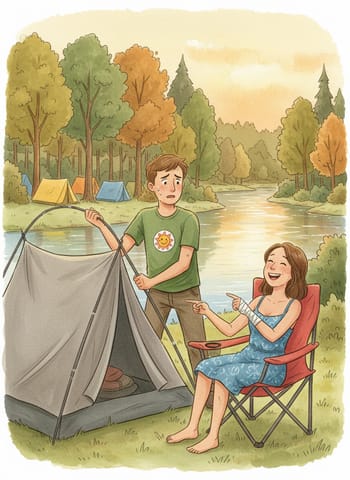
Wilf looks up. A woman sits on a folding chair about ten metres away. A large grey tent lies folded beside her. Her right wrist is wrapped in a white bandage. Her name tag says WANDA, and underneath, in small letters, it says BEGINNER.
Wilf levanta os olhos. Uma mulher está sentada numa cadeira dobrável, a uns dez metros dali. Uma grande barraca cinza está dobrada ao lado dela. O pulso direito dela está enrolado numa atadura branca. Seu crachá diz WANDA e, embaixo, em letras pequenas, diz INICIANTE.
"You're a beginner too?" he asks, with relief.
"Você também é iniciante?", pergunta ele, aliviado.
"No," she says. "That's the printer again. I've camped for twenty years. But I carried a cool box up the hill this morning and my wrist said no."
"Não", diz ela. "É a gráfica de novo. Eu acampo há vinte anos. Mas carreguei uma caixa térmica morro acima hoje cedo e meu pulso disse não."
"Oh. Does it hurt?"
"Ah. Dói?"
"Only when I try to put up a tent." She looks at him and then at his chest. "Hello, Wolf."
"Só quando tento armar uma barraca." Ela olha para ele e depois para o peito dele. "Olá, Wolf."
"It's Wilf. Please."
"É Wilf. Por favor."
"Wilf. I like Wolf better, but I'll try."
"Wilf. Eu gosto mais de Wolf, mas vou tentar."
He sits down on the grass near her, partly out of politeness. Mostly his legs are tired. She tells him that she came with friends. They went to the village for supplies and will be gone for hours. Until then, her tent is a big grey heap on the ground.
Ele se senta na grama perto dela, em parte por educação. Principalmente porque suas pernas estão cansadas. Ela conta que veio com amigos. Eles foram até o vilarejo buscar mantimentos e vão demorar horas. Até lá, a barraca dela é um monte cinza e enorme no chão.
"I can't tighten the pegs," she says. "I can't hold the poles. I can't even open the zip. Which is embarrassing, because I told everyone I'd camp alone this weekend."
"Não consigo apertar as estacas", diz ela. "Não consigo segurar as hastes. Não consigo nem abrir o zíper. O que é constrangedor, porque eu disse a todo mundo que ia acampar sozinha neste fim de semana."
"Is that a good idea with a sore wrist?"
"É uma boa ideia, com o pulso machucado?"
"It's a stubborn idea. I'm known for those."
"É uma ideia teimosa. Sou conhecida por elas."
Wilf looks at her tent. Then he looks at his own poles, which still lie in a messy pile. A strange thought comes to him. He has watched three videos this morning. She has twenty years of experience, but she has only one working hand.
Wilf olha para a barraca dela. Depois olha para as próprias hastes, ainda numa pilha bagunçada. Um pensamento estranho lhe ocorre. Ele assistiu a três vídeos esta manhã. Ela tem vinte anos de experiência, mas só uma mão funcionando.
"I might be able to help you," he says. "I'm not good at much. But I did learn how to put up a tent at breakfast."
"Talvez eu consiga ajudar você", diz ele. "Não sou bom em muita coisa. Mas aprendi a armar uma barraca no café da manhã."
Wanda raises an eyebrow. "From a person?"
Wanda levanta uma sobrancelha. "Com uma pessoa?"
"From a screen."
"Com uma tela."
"Well, that's a start. Show me what you've got."
"Bem, já é um começo. Mostre o que você sabe."
They decide to build her tent first, because it is bigger and she can guide him. Wilf carries the grey heap to a flat spot near the water. Wanda follows with her chair and sits down at the edge of the ground sheet.
Eles decidem montar a barraca dela primeiro, porque é maior e ela pode orientá-lo. Wilf carrega o monte cinza até um local plano perto da água. Wanda o segue com a cadeira e se senta na beira do piso da barraca.
"Lay it flat," she says. "Corners first. Don't pull too hard."
"Estenda tudo no chão", diz ela. "Primeiro os cantos. Não puxe com muita força."
He does as he is told. The fabric flaps open, and he chases it twice. Wanda laughs, and the sound is surprisingly warm. Then she shows him how to thread the long pole through the sleeve. He must push from the middle so the cloth does not catch.
Ele faz o que lhe mandam. O tecido se abre ao vento, e ele corre atrás dele duas vezes. Wanda ri, e o som é surpreendentemente caloroso. Depois ela lhe mostra como passar a haste comprida pela passagem do tecido. Ele precisa empurrar pelo meio para que o pano não prenda.
"Now the second pole," she says. "Cross them at the top. Yes, like that. You've got it."
"Agora a segunda haste", diz ela. "Cruze as duas no alto. Sim, assim. Você pegou o jeito."
"Is it supposed to lean this much?"
"Era para ela ficar tão inclinada?"
"If it leans, we fix it. Tents are very forgiving, if you are patient."
"Se está inclinada, a gente conserta. Barracas perdoam muito, se você tiver paciência."
The tent rises slowly, like a tired animal getting to its feet. Wilf hammers the pegs with a rubber mallet. Wanda points at the places where the ground is soft. When a peg bends, she shows him how to pull it out. He tries again at a sharper angle.
A barraca sobe devagar, como um animal cansado se pondo de pé. Wilf crava as estacas com um martelo de borracha. Wanda aponta os lugares onde o chão está mole. Quando uma estaca entorta, ela lhe mostra como tirá-la. Ele tenta de novo, num ângulo mais fechado.
"My video didn't say that," Wilf admits.
"Meu vídeo não dizia isso", admite Wilf.
"Videos never do. The ground is always a surprise."
"Os vídeos nunca dizem. O chão é sempre uma surpresa."
By the time the grey tent stands straight, the sun is low over the river. The children have gone to eat. Wilf steps back and wipes his hands on his trousers. He feels strangely proud, as if he has built a house.
Quando a barraca cinza enfim está de pé, o sol está baixo sobre o rio. As crianças foram comer. Wilf dá um passo para trás e limpa as mãos na calça. Sente um orgulho estranho, como se tivesse construído uma casa.
"It's a good tent," Wanda says. "Better than I would have done with two hands."
"É uma boa barraca", diz Wanda. "Melhor do que eu teria feito com as duas mãos."
"That's not true."
"Isso não é verdade."
"It's a little true." She smiles. "Now do yours. I'll sit here and shout at you."
"É um pouco verdade." Ela sorri. "Agora a sua. Vou ficar aqui sentada gritando com você."
It takes him half an hour. She tells him to face his tent door toward the trees. She tells him to keep his shoes outside and never, ever to put the stove inside. Then he drops the pole bag into the river. She laughs so hard that she has to hold her wrist.
Leva meia hora. Ela manda que ele vire a porta da barraca para as árvores. Manda que ele deixe os sapatos do lado de fora e que nunca, nunca coloque o fogareiro lá dentro. Então ele derruba a bolsa das hastes no rio. Ela ri tanto que precisa segurar o pulso.
"I'm sorry," she says between breaths. "It's not funny."
"Desculpe", diz ela entre uma respiração e outra. "Não tem graça."
"It's a little funny."
"Tem um pouco de graça."
"It's a lot funny."
"Tem muita graça."
He fishes the bag out with a stick and shakes it dry. She makes a small noise of approval, like a teacher with a good student.
Ele pesca a bolsa com um graveto e a sacode para secar. Ela faz um barulhinho de aprovação, como uma professora com um bom aluno.
When both tents stand side by side, Wanda stays in her chair a moment longer. Then she opens a small tin from her bag and holds it out. Inside are two thick biscuits, wrapped in paper.
Quando as duas barracas estão lado a lado, Wanda fica mais um instante na cadeira. Depois abre uma latinha tirada da bolsa e a estende para ele. Dentro há dois biscoitos grossos, embrulhados em papel.
"My emergency supply," she says. "I only share it with people who rescue me."
"Minha reserva de emergência", diz ela. "Só divido com quem me resgata."
"I didn't rescue you. I lifted some poles."
"Eu não resgatei você. Só levantei umas hastes."
"You gave me back my weekend. That counts."
"Você me devolveu o meu fim de semana. Isso conta."
They eat the biscuits by the water. The river moves slowly past, brown and shining, and a pair of ducks drifts by without a sound. For a while, neither of them says anything, and it feels completely comfortable.
Eles comem os biscoitos perto da água. O rio passa devagar, marrom e brilhante, e um casal de patos desliza sem fazer som. Por um tempo, nenhum dos dois diz nada, e é completamente confortável.
Then Wanda takes a marker from her pocket. She peels the sticker off her shirt and turns it over. On the back, she writes in big letters. WANDA. NOT A BEGINNER. She presses it carefully back onto her chest.
Então Wanda tira um marcador do bolso. Ela descola o adesivo da camisa e o vira do avesso. No verso, escreve em letras grandes: WANDA. NÃO É INICIANTE. Ela o cola de volta no peito com cuidado.
"Give me yours," she says.
"Me dê o seu", diz ela.
Wilf peels off his sticker and hands it to her. She writes under the word WOLF, stops, crosses it out, and writes again. She hands it back.
Wilf descola o adesivo e o entrega a ela. Ela escreve embaixo da palavra WOLF, para, risca e escreve de novo. Devolve a ele.
He reads it aloud. "WILF. NOT A WOLF."
Ele lê em voz alta. "WILF. NÃO É UM WOLF."
"Now everyone will know."
"Agora todo mundo vai saber."
"I think I preferred the old one," he says. "The children seemed to like it."
"Acho que eu preferia o antigo", diz ele. "As crianças pareciam gostar."
As if they heard him, three small voices rise from the hill behind the trees. A long, wobbly howl rolls across the campsite and out over the river.
Como se o tivessem ouvido, três vozinhas se erguem da colina atrás das árvores. Um uivo longo e trêmulo rola pelo camping e se espalha sobre o rio.
Wilf looks at Wanda. Wanda looks at Wilf.
Wilf olha para Wanda. Wanda olha para Wilf.
Then he stands, lifts his chin toward the sky, and howls back.
Então ele se levanta, ergue o queixo para o céu e uiva de volta.