The Wolf on the Name Tag
Una historia gratuita en inglés de nivel B1 para estudiantes, para leer en línea en 7 idiomas, con opción de escucharla en la app gratuita Storyteller.
At a riverside camping weekend, a first-time camper with a misprinted name tag helps an experienced camper with a hurt wrist put up her tent.
¡Ese fue el avance! Escucha la historia completa en la app gratuita Storyteller. Descargar la app
El audio no está disponible en este momento.
Wilf stands at the check-in table of the River Weekend and looks at the sticker on his chest. It says WOLF in thick black letters.
Wilf está de pie frente a la mesa de registro del Fin de Semana del Río y mira la etiqueta que lleva en el pecho. Dice WOLF en gruesas letras negras.
"That is not my name," he says.
«Ese no es mi nombre», dice.
"It's what you wrote on the form," says the girl behind the table.
«Es lo que escribiste en el formulario», dice la chica detrás de la mesa.
"I wrote Wilf. W, I, L, F."
«Escribí Wilf. W, I, L, F».
"Then someone at the printer thought you were a wolf." She shrugs and hands him a map. "It's only for the weekend. Tents are down by the water."
«Entonces alguien en la imprenta pensó que eras un lobo». Se encoge de hombros y le entrega un mapa. «Es solo por el fin de semana. Las tiendas están abajo, junto al agua».
Wilf wants to ask for a new sticker, but a line is growing behind him. He picks up his bag and walks down the grass slope toward the river. Three small children run past in yellow jackets. One of them points at his chest and howls. The other two join in.
Wilf quiere pedir otra etiqueta, pero detrás de él se va formando una fila. Recoge su bolsa y baja por la ladera de césped hacia el río. Tres niños pequeños pasan corriendo con chaquetas amarillas. Uno de ellos le señala el pecho y aúlla. Los otros dos se le unen.
"Great," Wilf mutters. "A pack."
«Genial», murmura Wilf. «Una manada».
The campsite is long and quiet. Trees stand on one side, and a slow, shallow river runs on the other. Wilf has never camped before. His office team booked this trip, and then four of them cancelled, so he came alone. This morning he watched three videos about tents. He feels ready, in the way a person feels ready before an exam.
El campamento es largo y tranquilo. De un lado hay árboles, y del otro corre un río lento y poco profundo. Wilf nunca ha acampado. Su equipo de la oficina reservó este viaje, y luego cuatro de ellos cancelaron, así que vino solo. Esta mañana vio tres videos sobre tiendas de campaña. Se siente listo, como se siente uno antes de un examen.
He finds a flat patch of ground under a tall tree and opens the bag. Tent poles spill out onto the grass. They are all the same colour, and there seem to be too many of them.
Encuentra un trozo de terreno plano bajo un árbol alto y abre la bolsa. Los postes de la tienda se derraman sobre el pasto. Son todos del mismo color, y parece que hay demasiados.
"Which one goes where?" he says to nobody.
«¿Cuál va dónde?», dice a nadie.
"That depends on what you are building," says a voice nearby.
«Eso depende de lo que estés armando», dice una voz cercana.
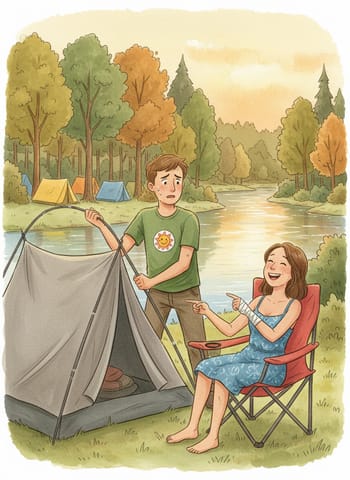
Wilf looks up. A woman sits on a folding chair about ten metres away. A large grey tent lies folded beside her. Her right wrist is wrapped in a white bandage. Her name tag says WANDA, and underneath, in small letters, it says BEGINNER.
Wilf levanta la vista. Una mujer está sentada en una silla plegable a unos diez metros. A su lado hay una gran tienda gris doblada. Tiene la muñeca derecha envuelta en una venda blanca. Su etiqueta dice WANDA, y debajo, en letras pequeñas, dice PRINCIPIANTE.
"You're a beginner too?" he asks, with relief.
«¿Tú también eres principiante?», pregunta él, aliviado.
"No," she says. "That's the printer again. I've camped for twenty years. But I carried a cool box up the hill this morning and my wrist said no."
«No», dice ella. «Es la imprenta otra vez. Llevo veinte años acampando. Pero esta mañana subí una hielera por la colina y mi muñeca dijo que no».
"Oh. Does it hurt?"
«Ah. ¿Te duele?».
"Only when I try to put up a tent." She looks at him and then at his chest. "Hello, Wolf."
«Solo cuando intento armar una tienda». Lo mira a él y luego a su pecho. «Hola, Wolf».
"It's Wilf. Please."
«Es Wilf. Por favor».
"Wilf. I like Wolf better, but I'll try."
«Wilf. Me gusta más Wolf, pero lo intentaré».
He sits down on the grass near her, partly out of politeness. Mostly his legs are tired. She tells him that she came with friends. They went to the village for supplies and will be gone for hours. Until then, her tent is a big grey heap on the ground.
Se sienta en el pasto cerca de ella, en parte por cortesía. Sobre todo porque tiene las piernas cansadas. Ella le cuenta que vino con amigos. Fueron al pueblo por provisiones y tardarán horas. Hasta entonces, su tienda es un gran montón gris en el suelo.
"I can't tighten the pegs," she says. "I can't hold the poles. I can't even open the zip. Which is embarrassing, because I told everyone I'd camp alone this weekend."
«No puedo apretar las estacas», dice. «No puedo sostener los postes. Ni siquiera puedo abrir el cierre. Lo cual es vergonzoso, porque le dije a todos que este fin de semana acamparía sola».
"Is that a good idea with a sore wrist?"
«¿Es buena idea con la muñeca lastimada?».
"It's a stubborn idea. I'm known for those."
«Es una idea terca. Soy conocida por esas».
Wilf looks at her tent. Then he looks at his own poles, which still lie in a messy pile. A strange thought comes to him. He has watched three videos this morning. She has twenty years of experience, but she has only one working hand.
Wilf mira su tienda. Luego mira sus propios postes, que siguen en un montón desordenado. Se le ocurre una idea extraña. Él ha visto tres videos esta mañana. Ella tiene veinte años de experiencia, pero solo una mano que funciona.
"I might be able to help you," he says. "I'm not good at much. But I did learn how to put up a tent at breakfast."
«Quizás pueda ayudarte», dice. «No soy bueno en muchas cosas. Pero sí aprendí a armar una tienda durante el desayuno».
Wanda raises an eyebrow. "From a person?"
Wanda levanta una ceja. «¿De una persona?».
"From a screen."
«De una pantalla».
"Well, that's a start. Show me what you've got."
«Bueno, es un comienzo. Muéstrame lo que tienes».
They decide to build her tent first, because it is bigger and she can guide him. Wilf carries the grey heap to a flat spot near the water. Wanda follows with her chair and sits down at the edge of the ground sheet.
Deciden armar primero la de ella, porque es más grande y ella puede guiarlo. Wilf lleva el montón gris a un lugar plano cerca del agua. Wanda lo sigue con su silla y se sienta en el borde del piso de la tienda.
"Lay it flat," she says. "Corners first. Don't pull too hard."
«Extiéndela plana», dice. «Primero las esquinas. No tires muy fuerte».
He does as he is told. The fabric flaps open, and he chases it twice. Wanda laughs, and the sound is surprisingly warm. Then she shows him how to thread the long pole through the sleeve. He must push from the middle so the cloth does not catch.
Hace lo que le dicen. La tela se abre con un aleteo, y la persigue dos veces. Wanda se ríe, y el sonido es sorprendentemente cálido. Luego le muestra cómo pasar el poste largo por la funda. Debe empujar desde el medio para que la tela no se atore.
"Now the second pole," she says. "Cross them at the top. Yes, like that. You've got it."
«Ahora el segundo poste», dice. «Crúzalos arriba. Sí, así. Ya lo tienes».
"Is it supposed to lean this much?"
«¿Se supone que se incline tanto?».
"If it leans, we fix it. Tents are very forgiving, if you are patient."
«Si se inclina, la arreglamos. Las tiendas perdonan mucho, si tienes paciencia».
The tent rises slowly, like a tired animal getting to its feet. Wilf hammers the pegs with a rubber mallet. Wanda points at the places where the ground is soft. When a peg bends, she shows him how to pull it out. He tries again at a sharper angle.
La tienda se levanta despacio, como un animal cansado poniéndose de pie. Wilf golpea las estacas con un mazo de goma. Wanda señala los lugares donde el suelo está blando. Cuando una estaca se dobla, le enseña cómo sacarla. Él lo intenta de nuevo con un ángulo más cerrado.
"My video didn't say that," Wilf admits.
«Mi video no decía eso», admite Wilf.
"Videos never do. The ground is always a surprise."
«Los videos nunca lo dicen. El suelo siempre es una sorpresa».
By the time the grey tent stands straight, the sun is low over the river. The children have gone to eat. Wilf steps back and wipes his hands on his trousers. He feels strangely proud, as if he has built a house.
Cuando la tienda gris queda derecha, el sol está bajo sobre el río. Los niños se han ido a comer. Wilf da un paso atrás y se limpia las manos en el pantalón. Se siente extrañamente orgulloso, como si hubiera construido una casa.
"It's a good tent," Wanda says. "Better than I would have done with two hands."
«Es una buena tienda», dice Wanda. «Mejor de lo que yo habría hecho con dos manos».
"That's not true."
«Eso no es cierto».
"It's a little true." She smiles. "Now do yours. I'll sit here and shout at you."
«Es un poco cierto». Sonríe. «Ahora arma la tuya. Yo me sentaré aquí a gritarte».
It takes him half an hour. She tells him to face his tent door toward the trees. She tells him to keep his shoes outside and never, ever to put the stove inside. Then he drops the pole bag into the river. She laughs so hard that she has to hold her wrist.
Le toma media hora. Ella le dice que ponga la puerta de su tienda hacia los árboles. Le dice que deje los zapatos afuera y que nunca, jamás, meta la estufa adentro. Luego él deja caer la bolsa de postes al río. Ella se ríe tan fuerte que tiene que sujetarse la muñeca.
"I'm sorry," she says between breaths. "It's not funny."
«Perdón», dice entre bocanadas de aire. «No tiene gracia».
"It's a little funny."
«Tiene un poco de gracia».
"It's a lot funny."
«Tiene muchísima gracia».
He fishes the bag out with a stick and shakes it dry. She makes a small noise of approval, like a teacher with a good student.
Él saca la bolsa con una vara y la sacude para secarla. Ella hace un ruidito de aprobación, como una maestra con un buen alumno.
When both tents stand side by side, Wanda stays in her chair a moment longer. Then she opens a small tin from her bag and holds it out. Inside are two thick biscuits, wrapped in paper.
Cuando las dos tiendas están lado a lado, Wanda se queda un momento más en su silla. Luego abre una latita de su bolsa y se la ofrece. Adentro hay dos galletas gruesas, envueltas en papel.
"My emergency supply," she says. "I only share it with people who rescue me."
«Mi reserva de emergencia», dice. «Solo la comparto con quienes me rescatan».
"I didn't rescue you. I lifted some poles."
«Yo no te rescaté. Levanté unos postes».
"You gave me back my weekend. That counts."
«Me devolviste mi fin de semana. Eso cuenta».
They eat the biscuits by the water. The river moves slowly past, brown and shining, and a pair of ducks drifts by without a sound. For a while, neither of them says anything, and it feels completely comfortable.
Se comen las galletas junto al agua. El río pasa lento, café y brillante, y un par de patos flota sin hacer ruido. Por un rato, ninguno dice nada, y se siente completamente cómodo.
Then Wanda takes a marker from her pocket. She peels the sticker off her shirt and turns it over. On the back, she writes in big letters. WANDA. NOT A BEGINNER. She presses it carefully back onto her chest.
Entonces Wanda saca un marcador de su bolsillo. Se despega la etiqueta de la camisa y le da la vuelta. En el reverso escribe con letras grandes: WANDA. NO ES PRINCIPIANTE. La vuelve a pegar con cuidado en su pecho.
"Give me yours," she says.
«Dame la tuya», dice.
Wilf peels off his sticker and hands it to her. She writes under the word WOLF, stops, crosses it out, and writes again. She hands it back.
Wilf se despega la etiqueta y se la entrega. Ella escribe debajo de la palabra WOLF, se detiene, lo tacha y escribe de nuevo. Se la devuelve.
He reads it aloud. "WILF. NOT A WOLF."
La lee en voz alta. «WILF. NO ES UN LOBO».
"Now everyone will know."
«Ahora todos lo sabrán».
"I think I preferred the old one," he says. "The children seemed to like it."
«Creo que prefería la anterior», dice él. «A los niños parecía gustarles».
As if they heard him, three small voices rise from the hill behind the trees. A long, wobbly howl rolls across the campsite and out over the river.
Como si lo hubieran oído, tres vocecitas se alzan desde la colina detrás de los árboles. Un largo y tembloroso aullido rueda por el campamento y se extiende sobre el río.
Wilf looks at Wanda. Wanda looks at Wilf.
Wilf mira a Wanda. Wanda mira a Wilf.
Then he stands, lifts his chin toward the sky, and howls back.
Entonces él se pone de pie, levanta la barbilla hacia el cielo y aúlla de vuelta.