The First Day Badge on Day Thirty
Una historia gratuita en inglés de nivel B2 para estudiantes, para leer en línea en 7 idiomas, con opción de escucharla en la app gratuita Storyteller.
A new site clerk follows three small clues to find out why one man keeps wearing a badge meant for newcomers.
¡Ese fue el avance! Escucha la historia completa en la app gratuita Storyteller. Descargar la app
El audio no está disponible en este momento.
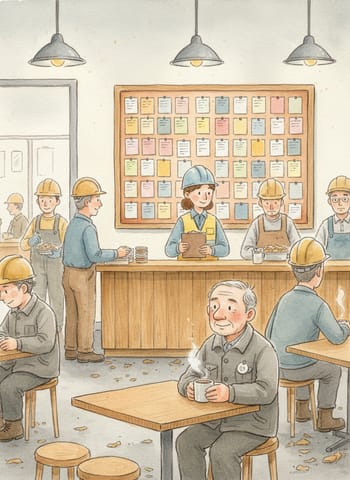
The canteen on the building site is a long metal box with a steel counter at one end and forty plastic chairs at the other. Neil starts work there at half past six on a Monday, wearing boots that are still too clean. He is the new site clerk, and his first job, according to the manager, is to learn how the place breathes.
La cantina de la obra es una larga caja de metal con un mostrador de acero en un extremo y cuarenta sillas de plástico en el otro. Neil empieza a trabajar ahí a las seis y media de un lunes, con unas botas que todavía están demasiado limpias. Es el nuevo auxiliar administrativo de la obra, y su primera tarea, según el gerente, es aprender cómo respira el lugar.
"Start with the canteen," the manager says. "If you understand the canteen, you understand the site."
«Empieza por la cantina», dice el gerente. «Si entiendes la cantina, entiendes la obra».
Adel, who runs the counter, hands him a mug of black coffee before he has even asked. She is small and quick, with a pencil behind one ear and a laminated menu she has not changed in years. She watches Neil look around the room, and then she points at the wall.
Adel, que atiende el mostrador, le pasa una taza de café negro antes de que él siquiera lo haya pedido. Es pequeña y rápida, con un lápiz detrás de una oreja y un menú plastificado que no ha cambiado en años. Lo observa mirar alrededor del salón y luego señala la pared.
"Tell me what you see," she says.
«Dime qué ves», dice.
Neil sees a notice about hard hats, a calendar from a concrete supplier, and a pinboard full of paper. On the pinboard hangs a small plastic badge on a string. It says FIRST DAY in capital letters, with a blank space where a name should be.
Neil ve un aviso sobre los cascos, un calendario de un proveedor de concreto y un tablero lleno de papeles. En el tablero cuelga una pequeña credencial de plástico en un cordón. Dice PRIMER DÍA en letras mayúsculas, con un espacio en blanco donde debería ir un nombre.
"It's a badge for new workers," he says. "They give them out on the first day, so everyone knows to be patient."
«Es una credencial para trabajadores nuevos», dice. «Se las dan el primer día, para que todos sepan que hay que tener paciencia».
"Correct," Adel says. "Now count how many new workers have started here this month."
«Correcto», dice Adel. «Ahora cuenta cuántos trabajadores nuevos han empezado aquí este mes».
He asks the manager's assistant, who checks a spreadsheet. The answer comes back in ten minutes. No one has joined the site since the start of the month, and the last new face arrived seven weeks ago. Neil returns to the counter with a puzzled expression.
Le pregunta al asistente del gerente, que revisa una hoja de cálculo. La respuesta llega en diez minutos. Nadie se ha incorporado a la obra desde principios de mes, y la última cara nueva llegó hace siete semanas. Neil vuelve al mostrador con expresión desconcertada.
"So why does the badge leave its hook every single day?" Adel asks, pleased. "Look at it at lunchtime. Look at it at the end of the day. You will see."
«Entonces, ¿por qué la credencial sale de su gancho todos los días?», pregunta Adel, encantada. «Míralo a la hora del almuerzo. Míralo al final del día. Ya verás».
That is the puzzle. Adel has been watching it for a month, and she has failed to solve it. She is always behind the counter when the interesting part happens. Neil, who spends his days between the office and the canteen, is the first person with the freedom to follow it.
Ese es el acertijo. Adel lleva un mes observándolo, y no ha logrado resolverlo. Siempre está detrás del mostrador cuando ocurre la parte interesante. Neil, que pasa sus días entre la oficina y la cantina, es la primera persona con la libertad de seguirlo.
At noon the canteen fills with the noise of boots and cutlery. Neil sits at a corner table with a notebook and writes the first clue. The badge is not on its hook. It was taken at some point during the morning, and it has not come back yet.
Al mediodía la cantina se llena con el ruido de botas y cubiertos. Neil se sienta a una mesa en la esquina con una libreta y escribe la primera pista. La credencial no está en su gancho. Alguien se la llevó en algún momento de la mañana, y todavía no ha vuelto.
At twelve fifteen a tall man in a spotless yellow vest walks to the counter. He wears the badge around his neck, and he does not seem to notice that the men at the next table are smiling at him. He takes his tray, receives a bigger portion of stew than anybody else, and sits alone by the window. Neil writes the second clue. Everyone is being gentle with him.
A las doce y cuarto un hombre alto con un chaleco amarillo impecable camina hacia el mostrador. Lleva la credencial colgada del cuello, y no parece darse cuenta de que los hombres de la mesa de al lado le sonríen. Toma su bandeja, recibe una porción de estofado más grande que la de cualquier otro, y se sienta solo junto a la ventana. Neil escribe la segunda pista. Todos están siendo amables con él.
The cook who ladles the stew does it without a word. A plasterer slides a free piece of cake onto the man's tray as he passes. A crane operator nods at him and says, "Good to have you, mate." It is the voice people use for a nervous child at school.
El cocinero que sirve el estofado lo hace sin decir palabra. Un yesero desliza un trozo de pastel gratis en la bandeja del hombre cuando pasa. Un operador de grúa le hace un gesto con la cabeza y le dice: «Qué bueno tenerte aquí, amigo». Es la voz que se usa con un niño nervioso en la escuela.
The tall man looks embarrassed, but he says thank you and keeps eating. Neil writes the third clue. The man does not just wear the badge. He accepts every kindness it earns, as though he were afraid of insulting the site by refusing.
El hombre alto parece avergonzado, pero da las gracias y sigue comiendo. Neil escribe la tercera pista. El hombre no solo lleva la credencial. Acepta cada amabilidad que esta le gana, como si temiera ofender a la obra al rechazarla.
At one o'clock the man stands, returns his tray, and hangs the badge on its hook. Then he walks out through the door that leads to the scaffolding. Neil closes his notebook and thinks. The man is not new. The cook ladles his stew the same way each day, which means he is a regular. The men tease him in a friendly way, which means they know him. Yet the badge still says first day.
A la una el hombre se levanta, devuelve su bandeja y cuelga la credencial en su gancho. Luego sale por la puerta que da a los andamios. Neil cierra su libreta y piensa. El hombre no es nuevo. El cocinero le sirve el estofado de la misma manera cada día, lo que significa que es un cliente habitual. Los hombres lo molestan con cariño, lo que significa que lo conocen. Sin embargo, la credencial sigue diciendo primer día.
He walks back to the counter, where Adel is wiping a tray.
Vuelve al mostrador, donde Adel está limpiando una bandeja.
"Three clues," he says. "He gets extra food. He gets extra kindness. And he never looks surprised by either. This is not his first day. It might be his thirtieth."
«Tres pistas», dice. «Recibe comida extra. Recibe amabilidad extra. Y nunca parece sorprendido por ninguna de las dos. Este no es su primer día. Podría ser el trigésimo».
"That is what I thought," Adel says, "but it doesn't explain why he wears it."
«Eso pensé yo», dice Adel, «pero no explica por qué la usa».
"No," Neil agrees. "But I think I know who can explain it."
«No», concuerda Neil. «Pero creo que sé quién puede explicarlo».
The next morning Neil waits at the gate at ten to six. The tall man arrives first, as always, carrying a flask and a bag of tools. Neil greets him and shows him his own clerk's badge. Then he asks, as politely as he can, why the man wears a first day badge after a month of work.
A la mañana siguiente Neil espera en la puerta a las seis menos diez. El hombre alto llega primero, como siempre, con un termo y una bolsa de herramientas. Neil lo saluda y le muestra su propia credencial de auxiliar. Luego le pregunta, con la mayor cortesía posible, por qué lleva una credencial de primer día después de un mes de trabajo.
The man stops walking. For a moment he looks like someone who has been caught with his hand in a jar. Then he lets out a long breath.
El hombre deja de caminar. Por un momento parece alguien a quien han sorprendido con la mano en el frasco. Luego suelta un largo suspiro.
"On my first day, the office gave me a temporary badge," he says. "They told me they would print the proper one on Friday. Friday came, and the printer was broken. Then the printer was fixed, and the woman who prints the badges was ill. Then the new vests arrived, and everyone forgot."
«En mi primer día, la oficina me dio una credencial temporal», dice. «Me dijeron que imprimirían la definitiva el viernes. Llegó el viernes, y la impresora estaba descompuesta. Luego arreglaron la impresora, y la mujer que imprime las credenciales estaba enferma. Después llegaron los chalecos nuevos, y todos se olvidaron».
"So you wear the temporary one," Neil says.
«Así que usa la temporal», dice Neil.
"It is the only badge I have. The guard at the gate knows me and checks a list, but the canteen counter serves only people who wear one." The man shrugs, a little sadly. "After the first week I wanted to say something. By then the cook had started giving me extra stew, and the plasterer gave me cake every day. How do you tell people that you have been a fake newcomer for a month?"
«Es la única credencial que tengo. El guardia de la entrada me conoce y revisa una lista, pero el mostrador de la cantina solo sirve a quienes llevan una». El hombre se encoge de hombros, algo triste. «Después de la primera semana quise decir algo. Para entonces el cocinero ya había empezado a darme estofado de más, y el yesero me daba pastel todos los días. ¿Cómo le dices a la gente que llevas un mes siendo un falso recién llegado?».
Neil tries very hard not to laugh, and he nearly manages. "You have been getting special treatment for thirty days because of a broken printer?"
Neil se esfuerza muchísimo por no reírse, y casi lo logra. «¿Lleva treinta días recibiendo trato especial por una impresora descompuesta?».
"The stew is very good," the man says, with dignity.
«El estofado es muy bueno», dice el hombre, con dignidad.
They walk to the office together. The woman who prints the badges is back at her desk, and she goes pale when Neil explains. She apologises three times and spends ten minutes finding the right file. Then the printer, which has apparently worked for weeks, produces a neat plastic card. It shows the man's photograph and his full name in black letters.
Caminan juntos hasta la oficina. La mujer que imprime las credenciales está de vuelta en su escritorio, y se pone pálida cuando Neil le explica. Se disculpa tres veces y pasa diez minutos buscando el archivo correcto. Entonces la impresora, que al parecer funciona desde hace semanas, produce una tarjeta de plástico impecable. Muestra la fotografía del hombre y su nombre completo en letras negras.
At lunchtime Neil sits in his corner again with a mug of coffee. He watches the tall man enter the canteen wearing his new badge, and he sees the room slowly notice the change. The cook looks twice and, with a straight face, gives him a normal portion of stew. The plasterer keeps the cake for himself. The crane operator says only, "Afternoon," as though the man has always been there.
A la hora del almuerzo Neil se sienta otra vez en su rincón con una taza de café. Ve al hombre alto entrar en la cantina con su credencial nueva, y ve cómo el salón va notando poco a poco el cambio. El cocinero mira dos veces y, con cara seria, le sirve una porción normal de estofado. El yesero se queda con el pastel para él. El operador de grúa solo dice: «Buenas tardes», como si el hombre siempre hubiera estado ahí.
The man collects his tray and stands for a moment, looking at the room. Then he walks to the table by the window, and for the first time in a month he sits with other people. The plasterer pulls out a chair for him without being asked.
El hombre recoge su bandeja y se queda un momento mirando el salón. Luego camina hasta la mesa junto a la ventana, y por primera vez en un mes se sienta con otras personas. El yesero le saca una silla sin que se lo pidan.
Adel comes out from behind the counter and stands next to Neil. She holds the old FIRST DAY badge in her hand. She turns it over twice, and then she hangs it back on the pinboard, because someone, someday, will need it.
Adel sale de detrás del mostrador y se para junto a Neil. Tiene en la mano la vieja credencial de PRIMER DÍA. La da vuelta dos veces, y luego la cuelga de nuevo en el tablero, porque alguien, algún día, la va a necesitar.
The sun comes through the dirty window and falls across the tables. The stew steams in forty bowls. At the end of the long room, a man in a yellow vest laughs at something, and nobody turns to look.
El sol entra por la ventana sucia y cae sobre las mesas. El estofado humea en cuarenta platos. Al fondo del largo salón, un hombre con chaleco amarillo se ríe de algo, y nadie se da vuelta a mirar.