The First Day Badge on Day Thirty
Cerita bahasa Inggris gratis level B2 untuk pelajar, bisa dibaca online dalam 7 bahasa, dengan pilihan untuk mendengarkannya di aplikasi Storyteller gratis.
A new site clerk follows three small clues to find out why one man keeps wearing a badge meant for newcomers.
Itu cuplikannya! Dengarkan cerita lengkapnya di aplikasi Storyteller gratis. Unduh aplikasi
Audio belum tersedia saat ini.
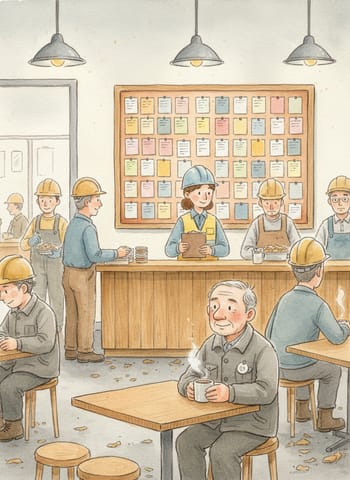
The canteen on the building site is a long metal box with a steel counter at one end and forty plastic chairs at the other. Neil starts work there at half past six on a Monday, wearing boots that are still too clean. He is the new site clerk, and his first job, according to the manager, is to learn how the place breathes.
Kantin di lokasi proyek itu berupa kotak logam panjang dengan meja konter baja di salah satu ujung dan empat puluh kursi plastik di ujung lainnya. Neil mulai bekerja di sana pukul setengah tujuh pada hari Senin, dengan sepatu bot yang masih terlalu bersih. Ia juru tulis baru di lokasi proyek, dan tugas pertamanya, menurut manajer, adalah mempelajari bagaimana tempat itu bernapas.
"Start with the canteen," the manager says. "If you understand the canteen, you understand the site."
"Mulailah dari kantin," kata manajer. "Kalau kamu paham kantin, kamu paham lokasi proyek ini."
Adel, who runs the counter, hands him a mug of black coffee before he has even asked. She is small and quick, with a pencil behind one ear and a laminated menu she has not changed in years. She watches Neil look around the room, and then she points at the wall.
Adel, yang mengurus konter, menyodorkan secangkir kopi hitam kepadanya sebelum ia sempat meminta. Ia bertubuh kecil dan gesit, dengan pensil terselip di belakang telinga dan menu berlaminasi yang tidak ia ganti bertahun-tahun. Ia memperhatikan Neil menengok ke sekeliling ruangan, lalu menunjuk ke dinding.
"Tell me what you see," she says.
"Coba katakan apa yang kamu lihat," katanya.
Neil sees a notice about hard hats, a calendar from a concrete supplier, and a pinboard full of paper. On the pinboard hangs a small plastic badge on a string. It says FIRST DAY in capital letters, with a blank space where a name should be.
Neil melihat pengumuman tentang helm pengaman, kalender dari pemasok beton, dan papan pengumuman penuh kertas. Di papan itu tergantung sebuah lencana plastik kecil pada seutas tali. Tertulis HARI PERTAMA dengan huruf kapital, dengan ruang kosong tempat seharusnya ada nama.
"It's a badge for new workers," he says. "They give them out on the first day, so everyone knows to be patient."
"Itu lencana untuk pekerja baru," katanya. "Mereka dikasih lencana itu di hari pertama, supaya semua orang tahu untuk bersabar."
"Correct," Adel says. "Now count how many new workers have started here this month."
"Benar," kata Adel. "Sekarang hitung berapa pekerja baru yang mulai bekerja di sini bulan ini."
He asks the manager's assistant, who checks a spreadsheet. The answer comes back in ten minutes. No one has joined the site since the start of the month, and the last new face arrived seven weeks ago. Neil returns to the counter with a puzzled expression.
Ia bertanya kepada asisten manajer, yang memeriksa lembar kerja digital. Jawabannya datang sepuluh menit kemudian. Tidak ada yang bergabung dengan lokasi proyek sejak awal bulan, dan wajah baru terakhir datang tujuh minggu lalu. Neil kembali ke konter dengan wajah bingung.
"So why does the badge leave its hook every single day?" Adel asks, pleased. "Look at it at lunchtime. Look at it at the end of the day. You will see."
"Jadi kenapa lencana itu meninggalkan kaitannya setiap hari?" tanya Adel, senang. "Lihat saja waktu makan siang. Lihat lagi di akhir hari. Kamu akan tahu."
That is the puzzle. Adel has been watching it for a month, and she has failed to solve it. She is always behind the counter when the interesting part happens. Neil, who spends his days between the office and the canteen, is the first person with the freedom to follow it.
Itulah teka-tekinya. Adel sudah mengamatinya selama sebulan, dan ia gagal memecahkannya. Ia selalu berada di balik konter saat bagian yang menarik terjadi. Neil, yang menghabiskan harinya di antara kantor dan kantin, adalah orang pertama yang punya keleluasaan untuk mengikutinya.
At noon the canteen fills with the noise of boots and cutlery. Neil sits at a corner table with a notebook and writes the first clue. The badge is not on its hook. It was taken at some point during the morning, and it has not come back yet.
Siang hari kantin dipenuhi bunyi sepatu bot dan alat makan. Neil duduk di meja pojok dengan buku catatan dan menulis petunjuk pertama. Lencana itu tidak ada di kaitannya. Seseorang mengambilnya di suatu saat pagi tadi, dan belum dikembalikan.
At twelve fifteen a tall man in a spotless yellow vest walks to the counter. He wears the badge around his neck, and he does not seem to notice that the men at the next table are smiling at him. He takes his tray, receives a bigger portion of stew than anybody else, and sits alone by the window. Neil writes the second clue. Everyone is being gentle with him.
Pukul dua belas lewat lima belas, seorang pria jangkung berompi kuning tanpa noda berjalan ke konter. Ia mengenakan lencana itu di lehernya, dan ia tampaknya tidak sadar bahwa para pria di meja sebelah tersenyum kepadanya. Ia mengambil nampannya, menerima porsi semur lebih besar daripada siapa pun, dan duduk sendirian di dekat jendela. Neil menulis petunjuk kedua. Semua orang bersikap lembut kepadanya.
The cook who ladles the stew does it without a word. A plasterer slides a free piece of cake onto the man's tray as he passes. A crane operator nods at him and says, "Good to have you, mate." It is the voice people use for a nervous child at school.
Juru masak yang menyendok semur itu melakukannya tanpa sepatah kata pun. Seorang tukang plester menyelipkan sepotong kue gratis ke nampan pria itu saat ia lewat. Seorang operator derek mengangguk kepadanya dan berkata, "Senang kamu bergabung, Kawan." Itu nada suara yang dipakai orang untuk anak yang gugup di sekolah.
The tall man looks embarrassed, but he says thank you and keeps eating. Neil writes the third clue. The man does not just wear the badge. He accepts every kindness it earns, as though he were afraid of insulting the site by refusing.
Pria jangkung itu tampak malu, tetapi ia mengucapkan terima kasih dan terus makan. Neil menulis petunjuk ketiga. Pria itu tidak hanya memakai lencana itu. Ia menerima setiap kebaikan yang didapatnya dari lencana itu, seakan takut menyinggung lokasi proyek ini kalau menolak.
At one o'clock the man stands, returns his tray, and hangs the badge on its hook. Then he walks out through the door that leads to the scaffolding. Neil closes his notebook and thinks. The man is not new. The cook ladles his stew the same way each day, which means he is a regular. The men tease him in a friendly way, which means they know him. Yet the badge still says first day.
Pukul satu pria itu berdiri, mengembalikan nampannya, dan menggantung lencana itu di kaitannya. Lalu ia berjalan keluar lewat pintu yang menuju perancah. Neil menutup buku catatannya dan berpikir. Pria itu bukan orang baru. Juru masak menyendokkan semurnya dengan cara yang sama setiap hari, artinya ia pelanggan tetap. Para pria menggodanya dengan akrab, artinya mereka mengenalnya. Namun lencana itu tetap bertuliskan hari pertama.
He walks back to the counter, where Adel is wiping a tray.
Ia berjalan kembali ke konter, tempat Adel sedang mengelap nampan.
"Three clues," he says. "He gets extra food. He gets extra kindness. And he never looks surprised by either. This is not his first day. It might be his thirtieth."
"Tiga petunjuk," katanya. "Dia dapat makanan ekstra. Dia dapat kebaikan ekstra. Dan dia tidak pernah tampak kaget pada keduanya. Ini bukan hari pertamanya. Mungkin hari ketiga puluhnya."
"That is what I thought," Adel says, "but it doesn't explain why he wears it."
"Itu juga yang kupikirkan," kata Adel, "tapi itu tidak menjelaskan kenapa dia memakainya."
"No," Neil agrees. "But I think I know who can explain it."
"Ya," Neil setuju. "Tapi kurasa aku tahu siapa yang bisa menjelaskannya."
The next morning Neil waits at the gate at ten to six. The tall man arrives first, as always, carrying a flask and a bag of tools. Neil greets him and shows him his own clerk's badge. Then he asks, as politely as he can, why the man wears a first day badge after a month of work.
Keesokan paginya Neil menunggu di gerbang pukul enam kurang sepuluh menit. Pria jangkung itu tiba paling awal, seperti biasa, membawa termos dan tas perkakas. Neil menyapanya dan menunjukkan lencana juru tulisnya sendiri. Lalu ia bertanya, sesopan mungkin, mengapa pria itu memakai lencana hari pertama setelah sebulan bekerja.
The man stops walking. For a moment he looks like someone who has been caught with his hand in a jar. Then he lets out a long breath.
Pria itu berhenti berjalan. Sesaat ia tampak seperti orang yang tertangkap basah. Lalu ia mengembuskan napas panjang.
"On my first day, the office gave me a temporary badge," he says. "They told me they would print the proper one on Friday. Friday came, and the printer was broken. Then the printer was fixed, and the woman who prints the badges was ill. Then the new vests arrived, and everyone forgot."
"Di hari pertamaku, kantor memberiku lencana sementara," katanya. "Mereka bilang lencana yang sebenarnya akan dicetak hari Jumat. Jumat tiba, dan pencetaknya rusak. Lalu pencetaknya diperbaiki, dan perempuan yang mencetak lencana sedang sakit. Lalu rompi-rompi baru datang, dan semua orang lupa."
"So you wear the temporary one," Neil says.
"Jadi Anda memakai yang sementara," kata Neil.
"It is the only badge I have. The guard at the gate knows me and checks a list, but the canteen counter serves only people who wear one." The man shrugs, a little sadly. "After the first week I wanted to say something. By then the cook had started giving me extra stew, and the plasterer gave me cake every day. How do you tell people that you have been a fake newcomer for a month?"
"Itu satu-satunya lencana yang kupunya. Penjaga gerbang mengenalku dan memeriksa daftar, tapi konter kantin hanya melayani orang yang memakai lencana." Pria itu mengangkat bahu, agak sedih. "Setelah minggu pertama aku ingin bilang sesuatu. Tapi saat itu juru masak sudah mulai memberiku semur ekstra, dan si tukang plester memberiku kue setiap hari. Bagaimana caranya bilang kepada orang-orang bahwa aku sudah sebulan menjadi orang baru palsu?"
Neil tries very hard not to laugh, and he nearly manages. "You have been getting special treatment for thirty days because of a broken printer?"
Neil berusaha keras tidak tertawa, dan hampir berhasil. "Anda mendapat perlakuan istimewa selama tiga puluh hari gara-gara pencetak yang rusak?"
"The stew is very good," the man says, with dignity.
"Semurnya enak sekali," kata pria itu, dengan penuh martabat.
They walk to the office together. The woman who prints the badges is back at her desk, and she goes pale when Neil explains. She apologises three times and spends ten minutes finding the right file. Then the printer, which has apparently worked for weeks, produces a neat plastic card. It shows the man's photograph and his full name in black letters.
Mereka berjalan ke kantor bersama-sama. Perempuan yang mencetak lencana sudah kembali di mejanya, dan wajahnya memucat saat Neil menjelaskan. Ia minta maaf tiga kali dan menghabiskan sepuluh menit mencari berkas yang tepat. Lalu pencetak itu, yang ternyata sudah berfungsi selama berminggu-minggu, mengeluarkan kartu plastik yang rapi. Kartu itu menampilkan foto pria itu dan nama lengkapnya dengan huruf hitam.
At lunchtime Neil sits in his corner again with a mug of coffee. He watches the tall man enter the canteen wearing his new badge, and he sees the room slowly notice the change. The cook looks twice and, with a straight face, gives him a normal portion of stew. The plasterer keeps the cake for himself. The crane operator says only, "Afternoon," as though the man has always been there.
Saat makan siang Neil duduk di pojoknya lagi dengan secangkir kopi. Ia melihat pria jangkung itu memasuki kantin dengan lencana barunya, dan ia melihat ruangan itu perlahan menyadari perubahannya. Juru masak melihat dua kali dan, dengan wajah datar, memberinya semur porsi biasa. Tukang plester menyimpan kuenya untuk dirinya sendiri. Operator derek hanya berkata, "Siang," seolah pria itu sudah selalu ada di sana.
The man collects his tray and stands for a moment, looking at the room. Then he walks to the table by the window, and for the first time in a month he sits with other people. The plasterer pulls out a chair for him without being asked.
Pria itu mengambil nampannya dan berdiri sejenak, memandangi ruangan. Lalu ia berjalan ke meja di dekat jendela, dan untuk pertama kalinya dalam sebulan ia duduk bersama orang lain. Tukang plester menarikkan kursi untuknya tanpa diminta.
Adel comes out from behind the counter and stands next to Neil. She holds the old FIRST DAY badge in her hand. She turns it over twice, and then she hangs it back on the pinboard, because someone, someday, will need it.
Adel keluar dari balik konter dan berdiri di samping Neil. Ia memegang lencana HARI PERTAMA yang lama di tangannya. Ia membolak-baliknya dua kali, lalu menggantungnya kembali di papan pengumuman, karena suatu hari nanti seseorang akan membutuhkannya.
The sun comes through the dirty window and falls across the tables. The stew steams in forty bowls. At the end of the long room, a man in a yellow vest laughs at something, and nobody turns to look.
Matahari masuk lewat jendela yang kotor dan jatuh di atas meja-meja. Semur mengepul di empat puluh mangkuk. Di ujung ruangan panjang itu, seorang pria berompi kuning tertawa mendengar sesuatu, dan tak seorang pun menoleh untuk melihat.