The First Day Badge on Day Thirty
Uma história gratuita em inglês de nível B2 para estudantes, para ler online em 7 idiomas, com opção de ouvir no app gratuito Storyteller.
A new site clerk follows three small clues to find out why one man keeps wearing a badge meant for newcomers.
Essa foi a prévia! Ouça a história completa no app gratuito Storyteller. Baixar o app
O áudio não está disponível no momento.
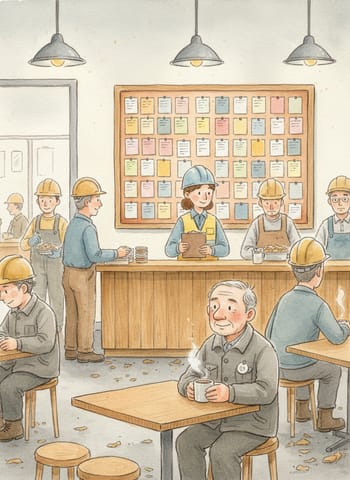
The canteen on the building site is a long metal box with a steel counter at one end and forty plastic chairs at the other. Neil starts work there at half past six on a Monday, wearing boots that are still too clean. He is the new site clerk, and his first job, according to the manager, is to learn how the place breathes.
O refeitório do canteiro de obras é uma longa caixa de metal com um balcão de aço numa ponta e quarenta cadeiras de plástico na outra. Neil começa a trabalhar ali às seis e meia de uma segunda-feira, com botas que ainda estão limpas demais. Ele é o novo auxiliar administrativo da obra, e seu primeiro trabalho, segundo o gerente, é aprender como o lugar respira.
"Start with the canteen," the manager says. "If you understand the canteen, you understand the site."
"Comece pelo refeitório", diz o gerente. "Se você entender o refeitório, entende a obra."
Adel, who runs the counter, hands him a mug of black coffee before he has even asked. She is small and quick, with a pencil behind one ear and a laminated menu she has not changed in years. She watches Neil look around the room, and then she points at the wall.
Adel, que cuida do balcão, entrega a ele uma caneca de café preto antes mesmo de ele pedir. Ela é pequena e rápida, com um lápis atrás da orelha e um cardápio plastificado que não muda há anos. Observa Neil olhar a sala e então aponta para a parede.
"Tell me what you see," she says.
"Diga o que você vê", diz ela.
Neil sees a notice about hard hats, a calendar from a concrete supplier, and a pinboard full of paper. On the pinboard hangs a small plastic badge on a string. It says FIRST DAY in capital letters, with a blank space where a name should be.
Neil vê um aviso sobre capacetes, um calendário de um fornecedor de concreto e um quadro de cortiça cheio de papéis. No quadro pende um pequeno crachá de plástico preso a um cordão. Nele está escrito PRIMEIRO DIA em letras maiúsculas, com um espaço em branco onde deveria haver um nome.
"It's a badge for new workers," he says. "They give them out on the first day, so everyone knows to be patient."
"É um crachá para trabalhadores novos", diz ele. "Dão no primeiro dia, para todo mundo saber que deve ter paciência."
"Correct," Adel says. "Now count how many new workers have started here this month."
"Correto", diz Adel. "Agora conte quantos trabalhadores novos começaram aqui neste mês."
He asks the manager's assistant, who checks a spreadsheet. The answer comes back in ten minutes. No one has joined the site since the start of the month, and the last new face arrived seven weeks ago. Neil returns to the counter with a puzzled expression.
Ele pergunta à assistente do gerente, que consulta uma planilha. A resposta volta em dez minutos. Ninguém entrou na obra desde o início do mês, e o último rosto novo chegou há sete semanas. Neil volta ao balcão com uma expressão intrigada.
"So why does the badge leave its hook every single day?" Adel asks, pleased. "Look at it at lunchtime. Look at it at the end of the day. You will see."
"Então por que o crachá sai do gancho todo santo dia?", pergunta Adel, satisfeita. "Olhe para ele na hora do almoço. Olhe no fim do expediente. Você vai ver."
That is the puzzle. Adel has been watching it for a month, and she has failed to solve it. She is always behind the counter when the interesting part happens. Neil, who spends his days between the office and the canteen, is the first person with the freedom to follow it.
Esse é o enigma. Adel o observa há um mês e não conseguiu resolvê-lo. Ela está sempre atrás do balcão quando a parte interessante acontece. Neil, que passa os dias entre o escritório e o refeitório, é a primeira pessoa com liberdade para segui-lo.
At noon the canteen fills with the noise of boots and cutlery. Neil sits at a corner table with a notebook and writes the first clue. The badge is not on its hook. It was taken at some point during the morning, and it has not come back yet.
Ao meio-dia o refeitório se enche com o barulho de botas e talheres. Neil senta numa mesa do canto com um caderno e escreve a primeira pista. O crachá não está no gancho. Foi levado em algum momento durante a manhã e ainda não voltou.
At twelve fifteen a tall man in a spotless yellow vest walks to the counter. He wears the badge around his neck, and he does not seem to notice that the men at the next table are smiling at him. He takes his tray, receives a bigger portion of stew than anybody else, and sits alone by the window. Neil writes the second clue. Everyone is being gentle with him.
Às doze e quinze um homem alto, de colete amarelo impecável, caminha até o balcão. Usa o crachá no pescoço e parece não perceber que os homens da mesa ao lado estão sorrindo para ele. Pega sua bandeja, recebe uma porção de ensopado maior que a de todos os outros e senta sozinho junto à janela. Neil escreve a segunda pista. Todo mundo está sendo gentil com ele.
The cook who ladles the stew does it without a word. A plasterer slides a free piece of cake onto the man's tray as he passes. A crane operator nods at him and says, "Good to have you, mate." It is the voice people use for a nervous child at school.
O cozinheiro que serve o ensopado faz isso sem dizer uma palavra. Um gesseiro desliza um pedaço de bolo grátis na bandeja do homem quando ele passa. Um operador de guindaste acena com a cabeça e diz: "Que bom ter você aqui, camarada." É a voz que as pessoas usam com uma criança nervosa na escola.
The tall man looks embarrassed, but he says thank you and keeps eating. Neil writes the third clue. The man does not just wear the badge. He accepts every kindness it earns, as though he were afraid of insulting the site by refusing.
O homem alto parece constrangido, mas agradece e continua comendo. Neil escreve a terceira pista. O homem não apenas usa o crachá. Ele aceita todas as gentilezas que o crachá rende, como se tivesse medo de ofender a obra recusando.
At one o'clock the man stands, returns his tray, and hangs the badge on its hook. Then he walks out through the door that leads to the scaffolding. Neil closes his notebook and thinks. The man is not new. The cook ladles his stew the same way each day, which means he is a regular. The men tease him in a friendly way, which means they know him. Yet the badge still says first day.
À uma hora o homem se levanta, devolve a bandeja e pendura o crachá no gancho. Depois sai pela porta que dá para o andaime. Neil fecha o caderno e pensa. O homem não é novo. O cozinheiro serve o ensopado dele do mesmo jeito todos os dias, o que significa que é frequentador. Os homens o provocam de modo amigável, o que significa que o conhecem. Mesmo assim, o crachá continua dizendo primeiro dia.
He walks back to the counter, where Adel is wiping a tray.
Ele volta ao balcão, onde Adel está limpando uma bandeja.
"Three clues," he says. "He gets extra food. He gets extra kindness. And he never looks surprised by either. This is not his first day. It might be his thirtieth."
"Três pistas", diz ele. "Ele ganha comida extra. Ganha gentileza extra. E nunca parece surpreso com nenhuma das duas. Este não é o primeiro dia dele. Pode ser o trigésimo."
"That is what I thought," Adel says, "but it doesn't explain why he wears it."
"Foi o que eu pensei", diz Adel, "mas isso não explica por que ele usa o crachá."
"No," Neil agrees. "But I think I know who can explain it."
"Não", concorda Neil. "Mas acho que sei quem pode explicar."
The next morning Neil waits at the gate at ten to six. The tall man arrives first, as always, carrying a flask and a bag of tools. Neil greets him and shows him his own clerk's badge. Then he asks, as politely as he can, why the man wears a first day badge after a month of work.
Na manhã seguinte, Neil espera no portão às cinco para as seis. O homem alto chega primeiro, como sempre, carregando uma garrafa térmica e uma bolsa de ferramentas. Neil o cumprimenta e mostra o próprio crachá de auxiliar. Depois pergunta, com a maior educação possível, por que o homem usa um crachá de primeiro dia depois de um mês de trabalho.
The man stops walking. For a moment he looks like someone who has been caught with his hand in a jar. Then he lets out a long breath.
O homem para de andar. Por um momento parece alguém flagrado com a mão no pote de biscoitos. Então solta um longo suspiro.
"On my first day, the office gave me a temporary badge," he says. "They told me they would print the proper one on Friday. Friday came, and the printer was broken. Then the printer was fixed, and the woman who prints the badges was ill. Then the new vests arrived, and everyone forgot."
"No meu primeiro dia, o escritório me deu um crachá provisório", diz ele. "Disseram que imprimiriam o definitivo na sexta. A sexta chegou, e a impressora estava quebrada. Depois consertaram a impressora, e a mulher que imprime os crachás ficou doente. Depois chegaram os coletes novos, e todo mundo esqueceu."
"So you wear the temporary one," Neil says.
"Então você usa o provisório", diz Neil.
"It is the only badge I have. The guard at the gate knows me and checks a list, but the canteen counter serves only people who wear one." The man shrugs, a little sadly. "After the first week I wanted to say something. By then the cook had started giving me extra stew, and the plasterer gave me cake every day. How do you tell people that you have been a fake newcomer for a month?"
"É o único crachá que tenho. O guarda do portão me conhece e confere uma lista, mas o balcão do refeitório só serve quem usa um." O homem dá de ombros, um pouco triste. "Depois da primeira semana eu quis falar alguma coisa. Só que a essa altura o cozinheiro já tinha começado a me dar ensopado extra, e o gesseiro me dava bolo todo dia. Como é que se diz às pessoas que você é um falso novato há um mês?"
Neil tries very hard not to laugh, and he nearly manages. "You have been getting special treatment for thirty days because of a broken printer?"
Neil se esforça muito para não rir, e quase consegue. "Você vem recebendo tratamento especial há trinta dias por causa de uma impressora quebrada?"
"The stew is very good," the man says, with dignity.
"O ensopado é muito bom", diz o homem, com dignidade.
They walk to the office together. The woman who prints the badges is back at her desk, and she goes pale when Neil explains. She apologises three times and spends ten minutes finding the right file. Then the printer, which has apparently worked for weeks, produces a neat plastic card. It shows the man's photograph and his full name in black letters.
Eles vão juntos até o escritório. A mulher que imprime os crachás está de volta à mesa e fica pálida quando Neil explica. Pede desculpas três vezes e gasta dez minutos procurando o arquivo certo. Então a impressora, que pelo visto funcionava havia semanas, produz um cartão de plástico bem-feito. Nele estão a fotografia do homem e seu nome completo em letras pretas.
At lunchtime Neil sits in his corner again with a mug of coffee. He watches the tall man enter the canteen wearing his new badge, and he sees the room slowly notice the change. The cook looks twice and, with a straight face, gives him a normal portion of stew. The plasterer keeps the cake for himself. The crane operator says only, "Afternoon," as though the man has always been there.
Na hora do almoço, Neil se senta de novo no seu canto, com uma caneca de café. Observa o homem alto entrar no refeitório com o crachá novo e vê a sala aos poucos notar a mudança. O cozinheiro olha duas vezes e, com cara séria, lhe serve uma porção normal de ensopado. O gesseiro guarda o bolo para si. O operador de guindaste diz apenas "Boa tarde", como se o homem sempre tivesse estado ali.
The man collects his tray and stands for a moment, looking at the room. Then he walks to the table by the window, and for the first time in a month he sits with other people. The plasterer pulls out a chair for him without being asked.
O homem pega a bandeja e fica um momento parado, olhando a sala. Depois caminha até a mesa junto à janela e, pela primeira vez em um mês, senta-se com outras pessoas. O gesseiro puxa uma cadeira para ele sem que ninguém peça.
Adel comes out from behind the counter and stands next to Neil. She holds the old FIRST DAY badge in her hand. She turns it over twice, and then she hangs it back on the pinboard, because someone, someday, will need it.
Adel sai de trás do balcão e para ao lado de Neil. Segura na mão o velho crachá de PRIMEIRO DIA. Vira-o duas vezes e depois o pendura de volta no quadro, porque alguém, algum dia, vai precisar dele.
The sun comes through the dirty window and falls across the tables. The stew steams in forty bowls. At the end of the long room, a man in a yellow vest laughs at something, and nobody turns to look.
O sol atravessa a janela suja e cai sobre as mesas. O ensopado fumega em quarenta tigelas. No fim da longa sala, um homem de colete amarelo ri de alguma coisa, e ninguém se vira para olhar.