The Bakery Under the Sea
Una historia gratuita en inglés de nivel A1 para estudiantes, para leer en línea en 7 idiomas, con opción de escucharla en la app gratuita Storyteller.
The fish that visit a sea-floor bakery every evening suddenly stay away, and Tessa and her helper go to find out why.
¡Ese fue el avance! Escucha la historia completa en la app gratuita Storyteller. Descargar la app
El audio no está disponible en este momento.
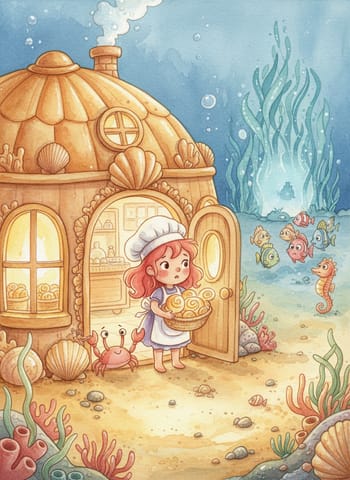
Tessa has a bakery under the sea. It is a round glass room on the sea floor. It is in a small town of glass houses. Every morning, she bakes bread. The smell goes out of a small door. It fills the street.
Tessa tiene una panadería bajo el mar. Es una sala redonda de vidrio en el fondo del mar. Está en un pequeño pueblo de casas de vidrio. Cada mañana, ella hornea pan. El olor sale por una puertecita. Llena la calle.
Her bakery has one big window. Outside it, the water is green and calm. Every evening at six o'clock, something special happens. The fish come.
Su panadería tiene una ventana grande. Afuera, el agua es verde y tranquila. Cada tarde a las seis, ocurre algo especial. Llegan los peces.
They are small and bright, orange and blue and silver. They come in a big group. They look at the warm yellow lights. Tessa gives them one small crumb of bread each. The children in town love to watch.
Son pequeños y brillantes, naranjas, azules y plateados. Llegan en un grupo grande. Miran las cálidas luces amarillas. Tessa le da a cada uno una pequeña miga de pan. A los niños del pueblo les encanta mirar.
Nolan is eleven years old. He helps Tessa after school. His job is to sweep and count the fish. He has a notebook and a pencil.
Nolan tiene once años. Ayuda a Tessa después de la escuela. Su trabajo es barrer y contar los peces. Tiene un cuaderno y un lápiz.
"Yesterday there were forty-two," he says.
«Ayer hubo cuarenta y dos», dice.
"And today?" asks Tessa.
«¿Y hoy?», pregunta Tessa.
"Let us see."
«A ver».
At six o'clock, they stand at the window. Nolan holds his pencil. Tessa holds a bowl of crumbs. They wait.
A las seis, se paran junto a la ventana. Nolan sostiene su lápiz. Tessa sostiene un tazón de migas. Esperan.
The water is empty. Nobody comes.
El agua está vacía. No llega nadie.
"Are they late?" Nolan asks.
«¿Se habrán atrasado?», pregunta Nolan.
"Maybe," says Tessa.
«Quizás», dice Tessa.
They wait ten more minutes. The street lamps come on one by one. Still there are no fish. Nolan puts his pencil down. His face gets long.
Esperan diez minutos más. Los faroles de la calle se encienden uno por uno. Todavía no hay peces. Nolan deja el lápiz. Se le alarga la cara.
"Where are they?" he asks.
«¿Dónde están?», pregunta.
"I do not know," says Tessa. She puts the bowl on the shelf. "But we can find out."
«No lo sé», dice Tessa. Pone el tazón en el estante. «Pero podemos averiguarlo».
She puts on her coat. Nolan puts on his boots. They go out into the street. The water outside is cold and dark. They walk past the school and the post office. The new street lamps shine on every corner.
Se pone el abrigo. Nolan se pone las botas. Salen a la calle. El agua de afuera es fría y oscura. Pasan junto a la escuela y la oficina de correos. Los faroles nuevos brillan en cada esquina.
"Look," says Nolan. "The lamps are different."
«Mira», dice Nolan. «Los faroles son diferentes».
Tessa stops. She looks up. The old lamps were yellow. The new lamps are a hard, bright blue.
Tessa se detiene. Mira hacia arriba. Los faroles viejos eran amarillos. Los nuevos son de un azul fuerte y brillante.
"They put them in last week," says Nolan.
«Los pusieron la semana pasada», dice Nolan.
"The fish like the yellow light," says Tessa. "It is warm. Maybe the blue is too strong."
«A los peces les gusta la luz amarilla», dice Tessa. «Es cálida. Quizás el azul es demasiado fuerte».
She goes to the end of the street. There is a small office with a light on. A man is inside, eating a sandwich. Tessa knocks.
Va hasta el final de la calle. Hay una pequeña oficina con la luz encendida. Dentro hay un hombre comiendo un sándwich. Tessa llama a la puerta.
"Hello," she says. "I have a question about the lamps."
«Hola», dice. «Tengo una pregunta sobre los faroles».
The man listens. He looks at Nolan's notebook. Nolan shows him the numbers for last month. Forty. Forty-two. Thirty-eight.
El hombre escucha. Mira el cuaderno de Nolan. Nolan le muestra los números del mes pasado. Cuarenta. Cuarenta y dos. Treinta y ocho.
"Every night, at six," says Nolan. "Until today."
«Todas las noches, a las seis», dice Nolan. «Hasta hoy».
The man puts down his sandwich. "I did not know," he says. "I changed the lamps for the new building. But I can change them back. I have yellow glass in the back room."
El hombre deja su sándwich. «No lo sabía», dice. «Cambié los faroles por el edificio nuevo. Pero puedo ponerlos como estaban. Tengo vidrio amarillo en el cuarto de atrás».
"Can you do it tonight?" asks Tessa.
«¿Puede hacerlo esta noche?», pregunta Tessa.
"Yes. It is easy," he says.
«Sí. Es fácil», dice él.
He takes a ladder. Tessa and Nolan hold it. One by one, he puts yellow glass on the lamps. The street turns warm and gold.
Toma una escalera. Tessa y Nolan la sostienen. Uno por uno, pone vidrio amarillo en los faroles. La calle se vuelve cálida y dorada.
The next evening at six, Nolan stands at the window. He has his notebook. He does not say anything. The water outside is green. Then a small orange fish comes. Then a blue one. Then twenty more, and then fifty.
A la tarde siguiente, a las seis, Nolan está junto a la ventana. Tiene su cuaderno. No dice nada. El agua de afuera es verde. Entonces llega un pececito naranja. Luego uno azul. Luego veinte más, y después cincuenta.
"Fifty-one!" Nolan shouts.
«¡Cincuenta y uno!», grita Nolan.
Tessa gives out the crumbs. The children come and watch. Nobody talks. She feels light and happy. So does Nolan.
Tessa reparte las migas. Los niños vienen a mirar. Nadie habla. Ella se siente ligera y feliz. Nolan también.