A Second Behind
Una historia gratuita en inglés de nivel A2 para estudiantes, para leer en línea en 7 idiomas, con opción de escucharla en la app gratuita Storyteller.
A young worker on a lonely hill finds out who answers his broken microphone, and a voice helps him say what he really wants.
¡Ese fue el avance! Escucha la historia completa en la app gratuita Storyteller. Descargar la app
El audio no está disponible en este momento.
The microphone repeats everything Lior says.
El micrófono repite todo lo que dice Lior.
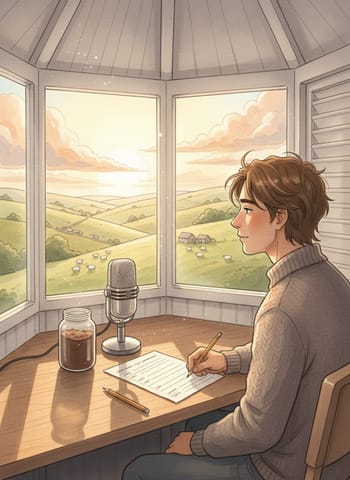
Lior hates it. He is twenty-two, and this is his first real job. He works alone at the weather station on top of a hill. The station is a white hut. It has a metal tower on the roof. Below it, a green valley lies quiet and wide. Inside the hut, there are a desk and a radio. There is also a jar of coffee. There is also the microphone.
Lior lo odia. Tiene veintidós años, y este es su primer trabajo de verdad. Trabaja solo en la estación meteorológica en lo alto de una colina. La estación es una cabaña blanca. Tiene una torre de metal en el techo. Abajo, un valle verde se extiende, tranquilo y ancho. Dentro de la cabaña hay un escritorio y una radio. También hay un frasco de café. Y también está el micrófono.
Lior reads the numbers three times a day. He reads at six in the morning, at noon, and at night. He reads the heat, the wind, and the air pressure. A recorder in the town office saves his voice. That is the whole job.
Lior lee los números tres veces al día. Lee a las seis de la mañana, al mediodía y por la noche. Lee la temperatura, el viento y la presión del aire. Una grabadora en la oficina del pueblo guarda su voz. Ese es todo el trabajo.
The microphone is the problem. Lior says, "Twelve degrees." One second later, a small voice answers, "Twelve degrees." It sounds like a polite parrot that lives inside the cable.
El micrófono es el problema. Lior dice: «Doce grados». Un segundo después, una vocecita responde: «Doce grados». Suena como un loro educado que vive dentro del cable.
He tries to fix it. He changes the cable. He cleans the plug. He moves the desk to the other wall. He even turns the microphone upside down. The parrot still answers.
Intenta arreglarlo. Cambia el cable. Limpia el enchufe. Mueve el escritorio a la otra pared. Incluso pone el micrófono boca abajo. El loro sigue respondiendo.
The manual says, "Echo can happen in tall, empty rooms." The hut is small and full of boxes. Lior laughs, but nobody hears him.
El manual dice: «El eco puede ocurrir en habitaciones altas y vacías». La cabaña es pequeña y está llena de cajas. Lior se ríe, pero nadie lo oye.
After a month, he stops fighting. He reads his numbers, and the parrot repeats them. It becomes part of the day, like the hum of the radio.
Después de un mes, deja de pelear. Lee sus números, y el loro los repite. Se convierte en parte del día, como el zumbido de la radio.
Lior has a second problem, and it is not in the cable. In his desk drawer, there is a form. It is a form for a sound school in the city. His name is at the top. The rest is empty.
Lior tiene un segundo problema, y no está en el cable. En el cajón de su escritorio hay un formulario. Es un formulario para una escuela de sonido en la ciudad. Su nombre está arriba. El resto está vacío.
He tells nobody about it. His mother calls every Sunday. She is proud of his steady job.
No se lo cuenta a nadie. Su madre llama todos los domingos. Está orgullosa de su trabajo estable.
"A safe job is a gift," she says.
«Un trabajo seguro es un regalo», dice ella.
"Yes, Mum," says Lior. He looks at the drawer, and he does not open it.
«Sí, mamá», dice Lior. Mira el cajón y no lo abre.
On Thursday morning, Lior sits down at six o'clock. The valley is silent. He presses the button on the microphone.
El jueves por la mañana, Lior se sienta a las seis en punto. El valle está en silencio. Presiona el botón del micrófono.
"Hill Station. Lior reading. Eleven degrees."
«Estación de la Colina. Lee Lior. Once grados».
"Eleven degrees," says the parrot.
«Once grados», dice el loro.
"Light wind from the north."
«Viento suave del norte».
"Wind from the north," says the parrot.
«Viento del norte», dice el loro.
He looks at the empty hut. Then he says a line that is not a number. "Same as yesterday. Same as always."
Mira la cabaña vacía. Luego dice una frase que no es un número. «Igual que ayer. Igual que siempre».
For a moment, nothing happens. Then the voice says, "Same as always." After another second, it adds, "You sound bored, Lior."
Por un momento no pasa nada. Entonces la voz dice: «Igual que siempre». Después de otro segundo, añade: «Suenas aburrido, Lior».
Lior jumps. His coffee jar falls off the desk and rolls across the floor. He stares at the microphone as if it has teeth.
Lior da un salto. Su frasco de café se cae del escritorio y rueda por el piso. Mira el micrófono como si tuviera dientes.
"Hello?" he says.
«¿Hola?», dice.
"Hello?" says the voice. Then it laughs. "Yes, I am real. I am not a parrot. Sorry for the second. My radio is slow."
«¿Hola?», dice la voz. Luego se ríe. «Sí, soy real. No soy un loro. Perdón por el segundo. Mi radio es lenta».
Lior grabs the edge of the desk. "Who are you?"
Lior se agarra del borde del escritorio. «¿Quién eres?».
He waits for the answer. The second feels very long.
Espera la respuesta. El segundo se siente larguísimo.
"My name is Uzma. I live on a sheep farm at the bottom of your hill. My old radio catches your channel. It can send, too, if I press the big button."
«Me llamo Uzma. Vivo en una granja de ovejas al pie de tu colina. Mi radio vieja capta tu canal. También puede transmitir, si presiono el botón grande».
"You listen to me?"
«¿Me escuchas?».
"Every day for two months. At first it was a game. I repeat your numbers when the sheep wake up. Now I like your voice. It is the first thing I hear."
«Todos los días desde hace dos meses. Al principio era un juego. Repito tus números cuando se despiertan las ovejas. Ahora me gusta tu voz. Es lo primero que oigo».
Lior sits on the floor with the microphone in his hand. He does not know what to say. A second goes by, and then another.
Lior se sienta en el suelo con el micrófono en la mano. No sabe qué decir. Pasa un segundo, y luego otro.
"You sound sad," says Uzma. "Not only today. Every day. Tell me why."
«Suenas triste», dice Uzma. «No solo hoy. Todos los días. Cuéntame por qué».
It is easier to talk to a voice in a wire. Lior says it fast. "I like sound. I like machines that carry voices across a valley. I want to study it in the city. But I have a safe job, and my mother is happy."
Es más fácil hablar con una voz en un cable. Lior lo dice rápido. «Me gusta el sonido. Me gustan las máquinas que llevan voces a través de un valle. Quiero estudiarlo en la ciudad. Pero tengo un trabajo seguro y mi madre está contenta».
"Do you have a form?"
«¿Tienes un formulario?».
"How do you know that?"
«¿Cómo lo sabes?».
"Everybody with a dream has a form in a drawer," says Uzma. "Open it."
«Todo el que tiene un sueño tiene un formulario en un cajón», dice Uzma. «Ábrelo».
Lior opens it. The paper is soft at the corners. He touches it often. He puts it flat on the desk.
Lior lo abre. El papel está suave en las esquinas. Lo toca a menudo. Lo pone plano sobre el escritorio.
"Now read it to me," says Uzma. "Read it like you read the heat and the wind."
«Ahora léemelo», dice Uzma. «Léelo como lees la temperatura y el viento».
He feels silly. Then he reads. "Sound Engineering School. Applications close this month."
Se siente tonto. Luego lee. «Escuela de Ingeniería de Sonido. Las inscripciones cierran este mes».
"Applications close this month," says the echo, one second late.
«Las inscripciones cierran este mes», dice el eco, un segundo tarde.
"Name. Lior."
«Nombre. Lior».
"Name. Lior."
«Nombre. Lior».
"Reason for applying."
«Motivo de la solicitud».
He stops. The pen shakes in his hand. The microphone waits. So does the valley.
Se detiene. El bolígrafo le tiembla en la mano. El micrófono espera. El valle también.
"I don't know what to write," he says.
«No sé qué escribir», dice.
"Don't write," says Uzma. "Say it. I will say it back, so you can hear how it sounds."
«No escribas», dice Uzma. «Dilo. Yo lo repetiré, para que oigas cómo suena».
Lior takes a breath. His voice is small at first. "I want to learn how voices travel."
Lior respira hondo. Al principio su voz es pequeña. «Quiero aprender cómo viajan las voces».
"I want to learn how voices travel," says Uzma, a second behind.
«Quiero aprender cómo viajan las voces», dice Uzma, un segundo atrás.
It sounds strange and wonderful. This is the first time he hears his own wish out loud. It does not sound silly at all. It sounds like a plan.
Suena extraño y maravilloso. Es la primera vez que oye su propio deseo en voz alta. No suena tonto en absoluto. Suena como un plan.
He writes the words on the form. Then he reads the next line, and the next. Uzma echoes each one. The sun climbs over the valley. The two of them fill the page together. Sometimes she makes a joke. Sometimes she waits and says nothing, and he is glad.
Escribe las palabras en el formulario. Luego lee la siguiente línea, y la siguiente. Uzma repite cada una. El sol sube sobre el valle. Los dos llenan la hoja juntos. A veces ella hace una broma. A veces espera y no dice nada, y él lo agradece.
At last, there is only one box left. It says, "Signature."
Por fin queda solo una casilla. Dice: «Firma».
Lior signs his name. The pen makes a tiny sound in the quiet hut. He feels light, for the first time in months.
Lior firma su nombre. El bolígrafo hace un sonidito en la cabaña silenciosa. Se siente ligero, por primera vez en meses.
"Now you need an envelope," says Uzma. "And a stamp. And you must be brave enough to go to the post office."
«Ahora necesitas un sobre», dice Uzma. «Y una estampilla. Y tienes que ser lo bastante valiente para ir al correo».
"The post office is down in the town," says Lior. "Everyone knows my mother there."
«El correo está abajo, en el pueblo», dice Lior. «Allí todos conocen a mi madre».
"Then they will all hear the news from you first." She laughs. "Do not forget your numbers at noon, Lior."
«Entonces todos oirán la noticia primero de ti». Se ríe. «No olvides tus números del mediodía, Lior».
He laughs, too. He picks up the jar and puts it on the desk.
Él también se ríe. Recoge el frasco y lo pone sobre el escritorio.
"Will you still repeat me tomorrow?" he asks.
«¿Me seguirás repitiendo mañana?», pregunta.
"One second late, every day," says Uzma. "But first, say your wish once more, and louder this time. The whole valley can hear you."
«Un segundo tarde, todos los días», dice Uzma. «Pero primero, di tu deseo una vez más, y más fuerte esta vez. Todo el valle puede oírte».