A Second Behind
A free A2-level English story for language learners, readable online in 7 languages, with an option to listen via the free Storyteller app.
A young worker on a lonely hill finds out who answers his broken microphone, and a voice helps him say what he really wants.
That was the preview! Hear the full story in the free Storyteller app. Get the app
Audio isn't available right now.
The microphone repeats everything Lior says.
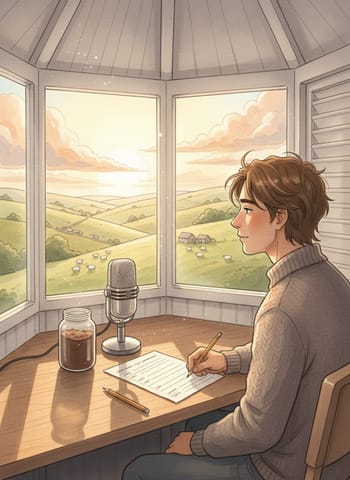
Lior hates it. He is twenty-two, and this is his first real job. He works alone at the weather station on top of a hill. The station is a white hut. It has a metal tower on the roof. Below it, a green valley lies quiet and wide. Inside the hut, there are a desk and a radio. There is also a jar of coffee. There is also the microphone.
Lior reads the numbers three times a day. He reads at six in the morning, at noon, and at night. He reads the heat, the wind, and the air pressure. A recorder in the town office saves his voice. That is the whole job.
The microphone is the problem. Lior says, "Twelve degrees." One second later, a small voice answers, "Twelve degrees." It sounds like a polite parrot that lives inside the cable.
He tries to fix it. He changes the cable. He cleans the plug. He moves the desk to the other wall. He even turns the microphone upside down. The parrot still answers.
The manual says, "Echo can happen in tall, empty rooms." The hut is small and full of boxes. Lior laughs, but nobody hears him.
After a month, he stops fighting. He reads his numbers, and the parrot repeats them. It becomes part of the day, like the hum of the radio.
Lior has a second problem, and it is not in the cable. In his desk drawer, there is a form. It is a form for a sound school in the city. His name is at the top. The rest is empty.
He tells nobody about it. His mother calls every Sunday. She is proud of his steady job.
"A safe job is a gift," she says.
"Yes, Mum," says Lior. He looks at the drawer, and he does not open it.
On Thursday morning, Lior sits down at six o'clock. The valley is silent. He presses the button on the microphone.
"Hill Station. Lior reading. Eleven degrees."
"Eleven degrees," says the parrot.
"Light wind from the north."
"Wind from the north," says the parrot.
He looks at the empty hut. Then he says a line that is not a number. "Same as yesterday. Same as always."
For a moment, nothing happens. Then the voice says, "Same as always." After another second, it adds, "You sound bored, Lior."
Lior jumps. His coffee jar falls off the desk and rolls across the floor. He stares at the microphone as if it has teeth.
"Hello?" he says.
"Hello?" says the voice. Then it laughs. "Yes, I am real. I am not a parrot. Sorry for the second. My radio is slow."
Lior grabs the edge of the desk. "Who are you?"
He waits for the answer. The second feels very long.
"My name is Uzma. I live on a sheep farm at the bottom of your hill. My old radio catches your channel. It can send, too, if I press the big button."
"You listen to me?"
"Every day for two months. At first it was a game. I repeat your numbers when the sheep wake up. Now I like your voice. It is the first thing I hear."
Lior sits on the floor with the microphone in his hand. He does not know what to say. A second goes by, and then another.
"You sound sad," says Uzma. "Not only today. Every day. Tell me why."
It is easier to talk to a voice in a wire. Lior says it fast. "I like sound. I like machines that carry voices across a valley. I want to study it in the city. But I have a safe job, and my mother is happy."
"Do you have a form?"
"How do you know that?"
"Everybody with a dream has a form in a drawer," says Uzma. "Open it."
Lior opens it. The paper is soft at the corners. He touches it often. He puts it flat on the desk.
"Now read it to me," says Uzma. "Read it like you read the heat and the wind."
He feels silly. Then he reads. "Sound Engineering School. Applications close this month."
"Applications close this month," says the echo, one second late.
"Name. Lior."
"Name. Lior."
"Reason for applying."
He stops. The pen shakes in his hand. The microphone waits. So does the valley.
"I don't know what to write," he says.
"Don't write," says Uzma. "Say it. I will say it back, so you can hear how it sounds."
Lior takes a breath. His voice is small at first. "I want to learn how voices travel."
"I want to learn how voices travel," says Uzma, a second behind.
It sounds strange and wonderful. This is the first time he hears his own wish out loud. It does not sound silly at all. It sounds like a plan.
He writes the words on the form. Then he reads the next line, and the next. Uzma echoes each one. The sun climbs over the valley. The two of them fill the page together. Sometimes she makes a joke. Sometimes she waits and says nothing, and he is glad.
At last, there is only one box left. It says, "Signature."
Lior signs his name. The pen makes a tiny sound in the quiet hut. He feels light, for the first time in months.
"Now you need an envelope," says Uzma. "And a stamp. And you must be brave enough to go to the post office."
"The post office is down in the town," says Lior. "Everyone knows my mother there."
"Then they will all hear the news from you first." She laughs. "Do not forget your numbers at noon, Lior."
He laughs, too. He picks up the jar and puts it on the desk.
"Will you still repeat me tomorrow?" he asks.
"One second late, every day," says Uzma. "But first, say your wish once more, and louder this time. The whole valley can hear you."