The Lines on the Field
Uma história gratuita em inglês de nível A1 para estudantes, para ler online em 7 idiomas, com opção de ouvir no app gratuito Storyteller.
A quiet groundskeeper paints the football lines every Friday, until a boy who always watched her makes some lines of his own.
Essa foi a prévia! Ouça a história completa no app gratuito Storyteller. Baixar o app
O áudio não está disponível no momento.
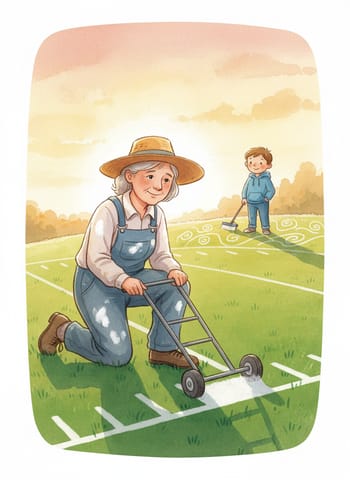
Every Friday evening, Freya paints the football lines. She is fifty-five. She works for the town club. Nobody sees her work. By Saturday morning, the white lines shine in the grass. The players run onto the field. Nobody says thank you.
Toda sexta-feira à tarde, Freya pinta as linhas do campo de futebol. Ela tem cinquenta e cinco anos. Trabalha para o clube da cidade. Ninguém vê o trabalho dela. Na manhã de sábado, as linhas brancas brilham na grama. Os jogadores entram correndo no campo. Ninguém diz obrigado.
Freya does not mind. She likes the quiet. First, she pulls a string from one corner to another. Then she walks slowly behind her little paint machine. The line comes out straight and white. The sun goes down. The air smells of cut grass.
Freya não se importa. Ela gosta do silêncio. Primeiro, estica um barbante de um canto até o outro. Depois, caminha devagar atrás da sua pequena máquina de pintura. A linha sai reta e branca. O sol se põe. O ar tem cheiro de grama cortada.
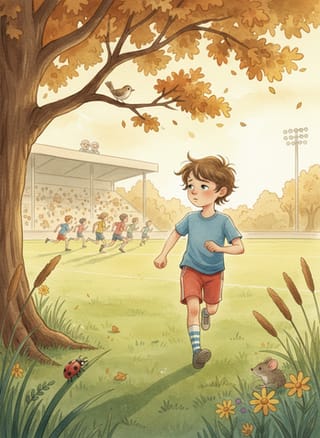
One Friday, a boy sits on the fence. He is about ten years old. He has a big football under his arm. He watches her for a long time. "Why do you do this?" he asks.
Numa sexta-feira, um menino se senta na cerca. Ele tem uns dez anos. Traz uma bola de futebol grande debaixo do braço. Ele a observa por muito tempo. "Por que você faz isso?", ele pergunta.
"Do what?"
"Faço o quê?"
"Paint lines. Nobody looks at them."
"Pintar linhas. Ninguém olha para elas."
Freya stops her machine. She thinks for a moment. "Players look at them," she says.
Freya para a máquina. Pensa por um momento. "Os jogadores olham", diz ela.
"They just do not know it."
"Eles só não sabem disso."
"I do not look at them," the boy says.
"Eu não olho para elas", diz o menino.
"You do. When you play, you know where the goal is. You know when the ball is out. The lines tell you."
"Olha, sim. Quando você joga, você sabe onde fica o gol. Sabe quando a bola saiu. As linhas é que contam isso."
The boy shrugs. "My name is Cyrus. I play on Saturdays."
O menino dá de ombros. "Meu nome é Cyrus. Eu jogo aos sábados."
"I know," says Freya.
"Eu sei", diz Freya.
"You are the small one who never passes the ball." Cyrus goes red.
"Você é o pequeno que nunca passa a bola." Cyrus fica vermelho.
"I pass sometimes."
"Às vezes eu passo."
"Not often," she says. She smiles.
"Não muitas vezes", diz ela. Ela sorri.
"But you run fast."
"Mas você corre rápido."
The next Friday, Cyrus is on the fence again. He brings a bottle of water for her. Freya drinks half of it and gives the rest back. She shows him how to hold the string. Cyrus holds one end at the corner. She walks to the other end and pulls it tight.
Na sexta-feira seguinte, Cyrus está na cerca de novo. Ele traz uma garrafa de água para ela. Freya bebe metade e devolve o resto. Ela mostra a ele como segurar o barbante. Cyrus segura uma ponta no canto. Ela caminha até a outra ponta e o estica bem.
"Do not move," she says.
"Não se mexa", diz ela.
"I will not."
"Não vou me mexer."
"Not even if a bee lands on your nose." He tries hard. A bee does land near his hand. He does not move. The line is done. He looks at the field and says, "Wow."
"Nem se uma abelha pousar no seu nariz." Ele se esforça muito. Uma abelha realmente pousa perto da mão dele. Ele não se mexe. A linha está pronta. Ele olha para o campo e diz: "Uau."
"What?"
"O que foi?"
"It looks different when it is straight."
"Fica diferente quando está reta."
On the third Friday, it rains all afternoon. Freya has a bad cold, so she stays home. The field is wet, and the paint cannot go on. She feels sad. The game is tomorrow, and the field has no lines.
Na terceira sexta-feira, chove a tarde toda. Freya está com um resfriado forte, então fica em casa. O campo está molhado, e a tinta não pega. Ela se sente triste. O jogo é amanhã, e o campo está sem linhas.
On Saturday morning, she goes to the field anyway. She wears a thick coat. She stands behind the fence and looks. The lines are there.
Na manhã de sábado, ela vai ao campo mesmo assim. Veste um casaco grosso. Fica atrás da cerca e olha. As linhas estão lá.
They are not white. They are made of yellow sand and pieces of rope. Someone put them down in the wet grass. They are crooked, and some are too short. The goal box is almost round. At the center, a small circle looks like an egg.
Não são brancas. São feitas de areia amarela e pedaços de corda. Alguém as colocou na grama molhada. Elas são tortas, e algumas são curtas demais. A pequena área do gol é quase redonda. No centro, um pequeno círculo parece um ovo.
Cyrus stands in the middle of the field. He holds a bucket of sand. His shoes are dirty and his hair is wet. "I could not use the machine," he says. "It is too heavy. So I used what I have."
Cyrus está no meio do campo. Ele segura um balde de areia. Os sapatos dele estão sujos e o cabelo está molhado. "Não consegui usar a máquina", diz ele. "É pesada demais. Então usei o que eu tinha."
Freya walks onto the field. She follows the center line with her eyes. It leans to the left. She looks at the egg circle. She looks at the long, crooked side line. She likes it more than a hundred straight lines.
Freya entra no campo. Ela segue a linha do meio com os olhos. Ela se inclina para a esquerda. Olha para o círculo em forma de ovo. Olha para a linha lateral comprida e torta. Gosta mais dela do que de cem linhas retas.
"Is it bad?" Cyrus asks.
"Está ruim?", pergunta Cyrus.
"It is terrible," Freya says.
"Está terrível", diz Freya.
"The goal box is round."
"A área do gol é redonda."
"I can fix it."
"Eu posso consertar."
Freya looks across the field. The players arrive. They stop, one by one, and look at the lines. They start to laugh, but not in a mean way. A few of them kneel down and touch the sand.
Freya olha para o outro lado do campo. Os jogadores chegam. Eles param, um por um, e olham para as linhas. Começam a rir, mas sem maldade. Alguns se ajoelham e tocam a areia.
"Leave it," Freya says. She puts her hand on his wet hair. "Today, we play on these." The whistle blows. Cyrus passes the ball on his first touch.
"Deixe como está", diz Freya. Ela põe a mão no cabelo molhado dele. "Hoje, vamos jogar nestas." O apito soa. Cyrus passa a bola no seu primeiro toque.