The Lines on the Field
Una historia gratuita en inglés de nivel A1 para estudiantes, para leer en línea en 7 idiomas, con opción de escucharla en la app gratuita Storyteller.
A quiet groundskeeper paints the football lines every Friday, until a boy who always watched her makes some lines of his own.
¡Ese fue el avance! Escucha la historia completa en la app gratuita Storyteller. Descargar la app
El audio no está disponible en este momento.
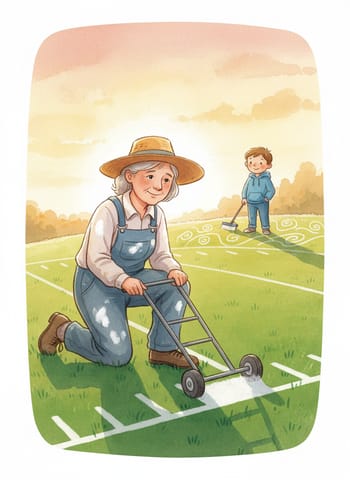
Every Friday evening, Freya paints the football lines. She is fifty-five. She works for the town club. Nobody sees her work. By Saturday morning, the white lines shine in the grass. The players run onto the field. Nobody says thank you.
Todos los viernes por la tarde, Freya pinta las líneas de la cancha de fútbol. Tiene cincuenta y cinco años. Trabaja para el club del pueblo. Nadie ve su trabajo. El sábado por la mañana, las líneas blancas brillan sobre el pasto. Los jugadores salen corriendo a la cancha. Nadie dice gracias.
Freya does not mind. She likes the quiet. First, she pulls a string from one corner to another. Then she walks slowly behind her little paint machine. The line comes out straight and white. The sun goes down. The air smells of cut grass.
A Freya no le importa. Le gusta la tranquilidad. Primero estira un cordel de una esquina a otra. Luego camina despacio detrás de su pequeña máquina de pintura. La línea sale recta y blanca. El sol se pone. El aire huele a pasto recién cortado.
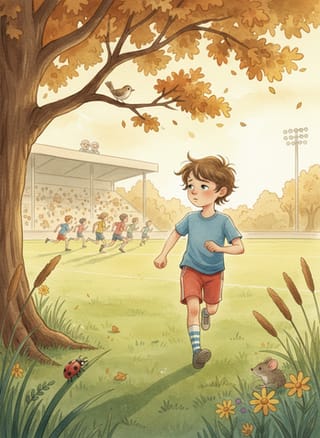
One Friday, a boy sits on the fence. He is about ten years old. He has a big football under his arm. He watches her for a long time. "Why do you do this?" he asks.
Un viernes, un niño está sentado en la cerca. Tiene unos diez años. Lleva un balón grande bajo el brazo. La mira durante mucho rato. «¿Por qué hace esto?», pregunta.
"Do what?"
«¿Hacer qué?»
"Paint lines. Nobody looks at them."
«Pintar líneas. Nadie las mira».
Freya stops her machine. She thinks for a moment. "Players look at them," she says.
Freya detiene su máquina. Piensa un momento. «Los jugadores las miran», dice.
"They just do not know it."
«Solo que no lo saben».
"I do not look at them," the boy says.
«Yo no las miro», dice el niño.
"You do. When you play, you know where the goal is. You know when the ball is out. The lines tell you."
«Sí las miras. Cuando juegas, sabes dónde está el arco. Sabes cuándo la pelota salió. Las líneas te lo dicen».
The boy shrugs. "My name is Cyrus. I play on Saturdays."
El niño se encoge de hombros. «Me llamo Cyrus. Juego los sábados».
"I know," says Freya.
«Lo sé», dice Freya.
"You are the small one who never passes the ball." Cyrus goes red.
«Eres el pequeño que nunca pasa la pelota». Cyrus se pone rojo.
"I pass sometimes."
«A veces paso».
"Not often," she says. She smiles.
«No muy seguido», dice ella. Sonríe.
"But you run fast."
«Pero corres rápido».
The next Friday, Cyrus is on the fence again. He brings a bottle of water for her. Freya drinks half of it and gives the rest back. She shows him how to hold the string. Cyrus holds one end at the corner. She walks to the other end and pulls it tight.
El viernes siguiente, Cyrus está otra vez en la cerca. Le trae una botella de agua. Freya bebe la mitad y le devuelve el resto. Le enseña a sostener el cordel. Cyrus sujeta un extremo en la esquina. Ella camina hasta el otro extremo y lo tensa.
"Do not move," she says.
«No te muevas», dice ella.
"I will not."
«No me moveré».
"Not even if a bee lands on your nose." He tries hard. A bee does land near his hand. He does not move. The line is done. He looks at the field and says, "Wow."
«Ni siquiera si una abeja se te posa en la nariz». Él se esfuerza mucho. Una abeja sí se posa cerca de su mano. Él no se mueve. La línea queda lista. Mira la cancha y dice: «Guau».
"What?"
«¿Qué?»
"It looks different when it is straight."
«Se ve distinta cuando está recta».
On the third Friday, it rains all afternoon. Freya has a bad cold, so she stays home. The field is wet, and the paint cannot go on. She feels sad. The game is tomorrow, and the field has no lines.
El tercer viernes llueve toda la tarde. Freya tiene un resfriado fuerte, así que se queda en casa. La cancha está mojada y la pintura no se puede aplicar. Se siente triste. El partido es mañana y la cancha no tiene líneas.
On Saturday morning, she goes to the field anyway. She wears a thick coat. She stands behind the fence and looks. The lines are there.
El sábado por la mañana, de todos modos va a la cancha. Lleva un abrigo grueso. Se queda detrás de la cerca y mira. Las líneas están ahí.
They are not white. They are made of yellow sand and pieces of rope. Someone put them down in the wet grass. They are crooked, and some are too short. The goal box is almost round. At the center, a small circle looks like an egg.
No son blancas. Están hechas de arena amarilla y pedazos de soga. Alguien las puso sobre el pasto mojado. Están chuecas, y algunas son demasiado cortas. El área del arco es casi redonda. En el centro, un pequeño círculo parece un huevo.
Cyrus stands in the middle of the field. He holds a bucket of sand. His shoes are dirty and his hair is wet. "I could not use the machine," he says. "It is too heavy. So I used what I have."
Cyrus está parado en medio de la cancha. Sostiene un balde de arena. Tiene los zapatos sucios y el pelo mojado. «No pude usar la máquina», dice. «Es muy pesada. Así que usé lo que tengo».
Freya walks onto the field. She follows the center line with her eyes. It leans to the left. She looks at the egg circle. She looks at the long, crooked side line. She likes it more than a hundred straight lines.
Freya camina hacia la cancha. Sigue la línea del centro con la mirada. Se inclina hacia la izquierda. Mira el círculo con forma de huevo. Mira la larga línea lateral, toda chueca. Le gusta más que cien líneas rectas.
"Is it bad?" Cyrus asks.
«¿Está mal?», pregunta Cyrus.
"It is terrible," Freya says.
«Está terrible», dice Freya.
"The goal box is round."
«El área del arco es redonda».
"I can fix it."
«Puedo arreglarlo».
Freya looks across the field. The players arrive. They stop, one by one, and look at the lines. They start to laugh, but not in a mean way. A few of them kneel down and touch the sand.
Freya mira al otro lado de la cancha. Los jugadores llegan. Se detienen, uno por uno, y miran las líneas. Empiezan a reír, pero sin burla. Algunos se agachan y tocan la arena.
"Leave it," Freya says. She puts her hand on his wet hair. "Today, we play on these." The whistle blows. Cyrus passes the ball on his first touch.
«Déjalo así», dice Freya. Le pone la mano sobre el pelo mojado. «Hoy jugamos sobre estas». Suena el silbato. Cyrus pasa el balón en su primer toque.