The Frog Stones on Bo's Map
Uma história gratuita em inglês de nível B2 para estudantes, para ler online em 7 idiomas, com opção de ouvir no app gratuito Storyteller.
A new campsite warden has less than an hour to warn four families on a river island, and an eight-year-old's crayon map shows her a way across.
Essa foi a prévia! Ouça a história completa no app gratuito Storyteller. Baixar o app
O áudio não está disponível no momento.
Gabi checks the clock above the office door for the third time in five minutes. It says ten past four. At five o'clock the water company will open the sluice gate upstream, and the quiet river beside the campsite will rise by almost a metre.
Gabi olha o relógio sobre a porta do escritório pela terceira vez em cinco minutos. Marca quatro e dez. Às cinco horas, a companhia de água vai abrir a comporta rio acima, e o rio tranquilo ao lado do camping vai subir quase um metro.
The warning arrived by email at lunchtime, but nobody read it until now. Gabi has been the warden here for only two weeks, and the previous warden left a handwritten note instead of a proper handover. The note mentions the sluice twice. It never explains what to do when the river rises.
O aviso chegou por e-mail na hora do almoço, mas ninguém o leu até agora. Gabi é a guarda do camping há apenas duas semanas, e o guarda anterior deixou um bilhete escrito à mão em vez de uma passagem de serviço de verdade. O bilhete menciona a comporta duas vezes. Nunca explica o que fazer quando o rio sobe.
Nine tents stand on the flat meadow beside the water, and they are safe enough. Four more are pitched on the small island on the far side. A wooden footbridge at the end of the bank path leads there. The bridge is the problem. When the river rises, it floods first, and the families on the island will be cut off before dark.
Nove barracas estão no gramado plano à beira da água, e elas estão seguras o bastante. Mais quatro estão armadas na pequena ilha do outro lado. Uma passarela de madeira no fim do caminho da margem leva até lá. A passarela é o problema. Quando o rio sobe, ela é a primeira a inundar, e as famílias da ilha ficarão isoladas antes de escurecer.
"I have to reach them before five," Gabi says aloud, to nobody in particular.
"Preciso chegar até elas antes das cinco", diz Gabi em voz alta, para ninguém em particular.
"Reach who?" asks a small voice.
"Chegar até quem?", pergunta uma vozinha.
A boy of about eight stands in the doorway, holding a sheet of paper against his chest. His name is Bo, and he has been staying with his parents in the blue tent since Monday. Gabi has seen him all week on the bank, drawing with a box of wax crayons.
Um menino de uns oito anos está na porta, segurando uma folha de papel junto ao peito. Chama-se Bo e está hospedado com os pais na barraca azul desde segunda-feira. Gabi o viu a semana inteira na margem, desenhando com uma caixa de giz de cera.
"The families on the island," Gabi says. "The river is about to rise, and they need to move their tents. But the bank path is closed today, because tree surgeons are cutting up a broken willow across it. They cannot stop halfway, and they will not finish before ten to five. The long way round, by the road, takes nearly an hour."
"As famílias da ilha", diz Gabi. "O rio vai subir daqui a pouco, e elas precisam mudar as barracas. Mas o caminho da margem está fechado hoje, porque uns podadores estão cortando um salgueiro quebrado que caiu atravessado nele. Eles não podem parar no meio, e só vão terminar às cinco menos dez. O caminho mais longo, pela estrada, leva quase uma hora."
"Then you can't go that way," Bo says reasonably.
"Então a senhora não pode ir por lá", diz Bo, com bom senso.
"No. And I cannot wade across the main channel. It is much deeper than it looks."
"Não. E não posso atravessar o canal principal a vau. É muito mais fundo do que parece."
Bo steps forward and puts his paper on the counter. "Maybe you can use my map."
Bo dá um passo à frente e põe o papel sobre o balcão. "Talvez a senhora possa usar o meu mapa."
Gabi almost says no. The sheet is covered in bright wax. There is a sun with a smiling face, a dragon hiding in the reeds, and the shower block drawn as a castle. Across the middle runs a wavy blue river, and in it there is a row of small grey circles, each with a number. Under them, in careful capital letters, Bo has written FROG STONES.
Gabi quase diz que não. A folha está coberta de giz de cera colorido. Há um sol com cara sorridente, um dragão escondido nos juncos e o bloco dos chuveiros desenhado como um castelo. No meio corre um rio azul ondulado, e nele há uma fileira de pequenos círculos cinza, cada um com um número. Embaixo deles, em letras maiúsculas caprichadas, Bo escreveu PEDRAS-SAPO.
"What are these?" Gabi asks, tapping the circles.
"O que são estes?", pergunta Gabi, batendo o dedo nos círculos.
"Stepping stones. Dad and I found them on Tuesday. You go through the gap in the hedge behind the showers, and then along the old orchard wall. There are seven stones, and they go all the way across to the island. The fifth one wobbles."
"Pedras para atravessar. O papai e eu achamos na terça. A senhora passa pela abertura na cerca viva atrás dos chuveiros e depois segue o muro do antigo pomar. São sete pedras, e vão até a ilha toda. A quinta balança."
Gabi studies the drawing again. Behind the dragon and the smiling sun there is real information here. There is a gate marked with a cross, a tree shaped like a fork and a bin with a crooked lid. Every one of those things exists, because Gabi walked past the same bin that morning. A child who notices a crooked lid has probably noticed everything else too.
Gabi estuda o desenho de novo. Atrás do dragão e do sol sorridente, há informação de verdade aqui. Há um portão marcado com uma cruz, uma árvore em forma de forquilha e uma lixeira com a tampa torta. Todas essas coisas existem, porque Gabi passou pela mesma lixeira naquela manhã. Uma criança que repara numa tampa torta provavelmente reparou em todo o resto também.
It is eighteen minutes past four. Gabi decides.
São quatro e dezoito. Gabi decide.
"Show me the start," she says. "Only the start. Then you go straight back to your parents."
"Mostre-me o começo", diz ela. "Só o começo. Depois você volta direto para seus pais."
They hurry out through the back of the office and past the shower block. The hedge does have a gap exactly where the map says. Bo points at it with the confidence of a tour guide. Beyond the gap, an old stone wall runs down towards the water, half hidden by nettles.
Os dois saem apressados pelos fundos do escritório e passam pelo bloco dos chuveiros. A cerca viva realmente tem uma abertura exatamente onde o mapa diz. Bo aponta para ela com a confiança de um guia de turismo. Depois da abertura, um velho muro de pedra desce em direção à água, meio escondido pelas urtigas.
"Follow the wall until it falls into the river," Bo says. "That is where the stones begin. I drew an arrow."
"Siga o muro até ele cair no rio", diz Bo. "É ali que as pedras começam. Eu desenhei uma seta."
"You did. Now run back to your father and tell him something for me. Every tent on the meadow must stay away from the bank until I return. After that, go to the camp bell and wait beside it."
"Desenhou mesmo. Agora corra de volta para o seu pai e diga uma coisa por mim. Todas as barracas do gramado têm de ficar longe da margem até eu voltar. Depois disso, vá até o sino do camping e espere ao lado dele."
"When do I ring it?"
"Quando eu toco?"
"At five o'clock exactly. Ring it once, as loudly as you can. Then everyone will know the river is about to change."
"Às cinco em ponto. Toque uma vez, o mais forte que puder. Assim todos vão saber que o rio está prestes a mudar."
Bo nods as if he has been given a very important job, which, Gabi realises, he has. He sprints away with his crayon box rattling in his pocket.
Bo assente como quem recebeu uma tarefa importantíssima, o que, Gabi percebe, é exatamente o caso. Ele sai em disparada, com a caixa de giz chacoalhando no bolso.
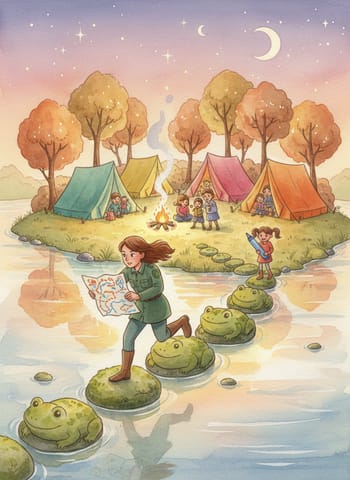
Gabi follows the wall alone. It ends exactly where the arrow says, in a tumble of mossy blocks that disappear into the current. The first stone lies just below the surface, flat and dark and slippery. She steps onto it with both arms out like a child on a balance beam. The second stone is easier. The third is further than the map suggests, so she jumps, and a splash fills her left boot with cold water.
Gabi segue o muro sozinha. Ele termina exatamente onde a seta indica, num amontoado de blocos cobertos de musgo que somem na correnteza. A primeira pedra está logo abaixo da superfície, lisa, escura e escorregadia. Ela pisa nela com os dois braços abertos, como uma criança numa trave de equilíbrio. A segunda pedra é mais fácil. A terceira é mais longe do que o mapa sugere, então ela pula, e um respingo enche sua bota esquerda de água fria.
She does not stop. The river is wider here than it looks from the office, and the current pulls gently at her trousers. Stone four is wide and solid. Stone five has a tiny zigzag drawn beside it on the map, and Gabi remembers the word wobbles a moment too late. She tests the surface with her toe, feels it rock, and moves her weight to the very edge, where the stone rests against the gravel. It holds.
Ela não para. O rio é mais largo aqui do que parece visto do escritório, e a correnteza puxa de leve sua calça. A pedra quatro é larga e firme. Ao lado da pedra cinco o mapa tem um pequeno ziguezague desenhado, e Gabi se lembra da palavra balança um instante tarde demais. Ela testa a superfície com a ponta do pé, sente que oscila, e passa o peso para a beirada, onde a pedra se apoia no cascalho. Aguenta.
Stone six. Stone seven. Then a bank of soft mud, a wall of reeds and, somewhere behind them, the sound of children laughing. Gabi checks her watch. It is 4:36.
Pedra seis. Pedra sete. Depois um trecho de lama mole, uma parede de juncos e, em algum lugar atrás deles, o som de crianças rindo. Gabi olha o relógio. São 4h36.
The first family she finds is cooking supper on a small gas stove. A man in a straw hat looks up with a spoon in his hand and watches a wet, breathless stranger push through the reeds.
A primeira família que ela encontra está preparando o jantar num pequeno fogareiro a gás. Um homem de chapéu de palha levanta os olhos, com uma colher na mão, e vê uma desconhecida molhada e ofegante abrindo caminho pelos juncos.
"I am the warden," Gabi says between breaths. "The water company opens the sluice at five. The river will rise, and the bridge will flood. You must bring everything to the meadow now."
"Sou a guarda do camping", diz Gabi entre uma respiração e outra. "A companhia de água abre a comporta às cinco. O rio vai subir, e a passarela vai inundar. Vocês precisam levar tudo para o gramado agora."
"At five? That gives us twenty minutes," the man says.
"Às cinco? Isso nos dá vinte minutos", diz o homem.
"Twenty-four, if we hurry."
"Vinte e quatro, se nos apressarmos."
He puts the spoon down at once. Within a minute the island is full of voices. Gabi goes from tent to tent, repeating the same few sentences. The families answer her with the quick, practical calm of people who have decided not to panic. A woman pulls pegs from the ground two at a time. At ten to five the last branch of the willow falls. The tree surgeons switch off their saws and wave the families through along the bank path. Two teenagers carry sleeping bags across the planks in great squashed armfuls. A small girl drags a bucket of toys behind her, refusing every offer of help.
Ele larga a colher na hora. Em um minuto, a ilha está cheia de vozes. Gabi vai de barraca em barraca, repetindo as mesmas poucas frases. As famílias respondem com a calma rápida e prática de quem decidiu não entrar em pânico. Uma mulher arranca estacas do chão duas de cada vez. Às cinco menos dez, o último galho do salgueiro cai. Os podadores desligam as serras e acenam para as famílias passarem pelo caminho da margem. Dois adolescentes atravessam as tábuas com sacos de dormir em grandes braçadas amassadas. Uma menina arrasta atrás de si um balde de brinquedos, recusando toda oferta de ajuda.
There are fourteen people in total, four tents and a surprising number of cooking pots. Gabi counts the planks of the bridge as they cross, and she counts the minutes too. At 4:50 the last tent is folded. At 4:54 the bridge is still dry, with only a thin dark line of water creeping towards its lowest board. At 4:57 the last family steps onto the meadow, and the man in the straw hat turns back to shake Gabi's hand.
São catorze pessoas ao todo, quatro barracas e um número surpreendente de panelas. Gabi conta as tábuas da passarela enquanto eles atravessam, e conta os minutos também. Às 4h50, a última barraca está dobrada. Às 4h54, a passarela ainda está seca, com apenas uma fina linha escura de água se arrastando em direção à tábua mais baixa. Às 4h57, a última família pisa no gramado, e o homem de chapéu de palha volta para apertar a mão de Gabi.
She is the last person off the island. She walks the planks slowly, one hand on the rail. A hard knot of worry loosens in her chest as the grass finally appears under her feet.
Ela é a última pessoa a deixar a ilha. Caminha pelas tábuas devagar, com uma mão no corrimão. Um nó duro de preocupação se afrouxa em seu peito quando a grama finalmente aparece sob os pés.
On the meadow, the campers have gathered in a loose crowd. Bo's father stands in the middle with a hand on his son's shoulder. Bo himself stands beside the camp bell, with the rope wrapped carefully around his fist. He looks at Gabi, then at the clock on the office wall, then at Gabi again.
No gramado, os campistas se juntaram numa pequena multidão desordenada. O pai de Bo está no meio, com a mão no ombro do filho. O próprio Bo está ao lado do sino do camping, com a corda enrolada cuidadosamente no punho. Ele olha para Gabi, depois para o relógio na parede do escritório, depois para Gabi de novo.
"Is it time?" he whispers.
"Já está na hora?", sussurra ele.
"Almost."
"Quase."
They all stand in silence and look upstream, where the river still lies flat and silver in the afternoon light. A duck paddles past. Gabi finds that she is smiling, and that her left boot is still full of water, and that she does not mind.
Todos ficam em silêncio e olham rio acima, onde o rio ainda está liso e prateado na luz da tarde. Um pato passa remando. Gabi percebe que está sorrindo, que a bota esquerda ainda está cheia de água e que isso não a incomoda.
"Now," she says.
"Agora", diz ela.
Bo pulls the rope with both hands. The bell sings out over the meadow, and far away, beyond the bend, the first brown water begins to slide down the river.
Bo puxa a corda com as duas mãos. O sino soa por todo o gramado e, lá longe, depois da curva, a primeira água marrom começa a deslizar rio abaixo.