The Frog Stones on Bo's Map
Una historia gratuita en inglés de nivel B2 para estudiantes, para leer en línea en 7 idiomas, con opción de escucharla en la app gratuita Storyteller.
A new campsite warden has less than an hour to warn four families on a river island, and an eight-year-old's crayon map shows her a way across.
¡Ese fue el avance! Escucha la historia completa en la app gratuita Storyteller. Descargar la app
El audio no está disponible en este momento.
Gabi checks the clock above the office door for the third time in five minutes. It says ten past four. At five o'clock the water company will open the sluice gate upstream, and the quiet river beside the campsite will rise by almost a metre.
Gabi mira el reloj sobre la puerta de la oficina por tercera vez en cinco minutos. Marca las cuatro y diez. A las cinco la compañía de agua abrirá la compuerta río arriba, y el tranquilo río junto al campamento subirá casi un metro.
The warning arrived by email at lunchtime, but nobody read it until now. Gabi has been the warden here for only two weeks, and the previous warden left a handwritten note instead of a proper handover. The note mentions the sluice twice. It never explains what to do when the river rises.
El aviso llegó por correo electrónico a la hora del almuerzo, pero nadie lo leyó hasta ahora. Gabi lleva solo dos semanas como guardiana aquí, y el guardián anterior dejó una nota escrita a mano en lugar de una entrega como corresponde. La nota menciona la compuerta dos veces. Nunca explica qué hacer cuando el río sube.
Nine tents stand on the flat meadow beside the water, and they are safe enough. Four more are pitched on the small island on the far side. A wooden footbridge at the end of the bank path leads there. The bridge is the problem. When the river rises, it floods first, and the families on the island will be cut off before dark.
Nueve carpas están en la pradera plana junto al agua, y están bastante seguras. Otras cuatro están armadas en la pequeña isla del otro lado. Una pasarela de madera al final del sendero de la orilla lleva hasta allá. El problema es la pasarela. Cuando el río sube, es lo primero que se inunda, y las familias de la isla quedarán aisladas antes del anochecer.
"I have to reach them before five," Gabi says aloud, to nobody in particular.
«Tengo que llegar hasta ellos antes de las cinco», dice Gabi en voz alta, a nadie en particular.
"Reach who?" asks a small voice.
«¿Hasta quién?», pregunta una vocecita.
A boy of about eight stands in the doorway, holding a sheet of paper against his chest. His name is Bo, and he has been staying with his parents in the blue tent since Monday. Gabi has seen him all week on the bank, drawing with a box of wax crayons.
Un niño de unos ocho años está en la puerta, con una hoja de papel contra el pecho. Se llama Bo, y se aloja con sus padres en la carpa azul desde el lunes. Gabi lo ha visto toda la semana en la orilla, dibujando con una caja de crayones de cera.
"The families on the island," Gabi says. "The river is about to rise, and they need to move their tents. But the bank path is closed today, because tree surgeons are cutting up a broken willow across it. They cannot stop halfway, and they will not finish before ten to five. The long way round, by the road, takes nearly an hour."
«Las familias de la isla», dice Gabi. «El río está a punto de subir, y tienen que mover sus carpas. Pero el sendero de la orilla está cerrado hoy, porque unos podadores de árboles están cortando un sauce caído que lo atraviesa. No pueden parar a mitad de trabajo, y no terminarán antes de las cinco menos diez. El camino largo, por la carretera, toma casi una hora».
"Then you can't go that way," Bo says reasonably.
«Entonces no puedes ir por ahí», dice Bo con razón.
"No. And I cannot wade across the main channel. It is much deeper than it looks."
«No. Y no puedo cruzar el cauce principal a pie. Es mucho más hondo de lo que parece».
Bo steps forward and puts his paper on the counter. "Maybe you can use my map."
Bo da un paso adelante y pone su papel sobre el mostrador. «Quizás puedas usar mi mapa».
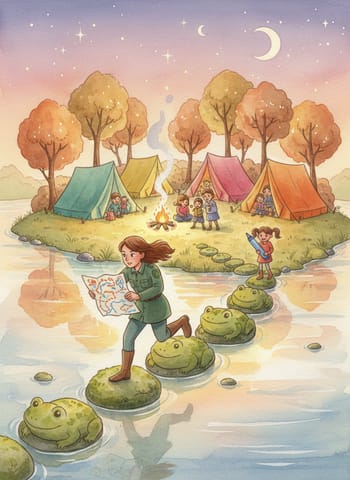
Gabi almost says no. The sheet is covered in bright wax. There is a sun with a smiling face, a dragon hiding in the reeds, and the shower block drawn as a castle. Across the middle runs a wavy blue river, and in it there is a row of small grey circles, each with a number. Under them, in careful capital letters, Bo has written FROG STONES.
Gabi casi dice que no. La hoja está cubierta de cera de colores brillantes. Hay un sol con una cara sonriente, un dragón escondido entre los juncos, y el bloque de duchas dibujado como un castillo. Por el medio corre un río azul ondulado, y en él hay una fila de pequeños círculos grises, cada uno con un número. Debajo, con cuidadosas letras mayúsculas, Bo ha escrito PIEDRAS DE RANA.
"What are these?" Gabi asks, tapping the circles.
«¿Qué son estos?», pregunta Gabi, tocando los círculos.
"Stepping stones. Dad and I found them on Tuesday. You go through the gap in the hedge behind the showers, and then along the old orchard wall. There are seven stones, and they go all the way across to the island. The fifth one wobbles."
«Piedras para cruzar. Mi papá y yo las encontramos el martes. Se pasa por el hueco del seto detrás de las duchas, y luego por el muro del viejo huerto. Hay siete piedras, y llegan hasta la isla. La quinta se mueve».
Gabi studies the drawing again. Behind the dragon and the smiling sun there is real information here. There is a gate marked with a cross, a tree shaped like a fork and a bin with a crooked lid. Every one of those things exists, because Gabi walked past the same bin that morning. A child who notices a crooked lid has probably noticed everything else too.
Gabi estudia el dibujo otra vez. Detrás del dragón y del sol sonriente hay información real. Hay una puerta marcada con una cruz, un árbol con forma de horquilla y un basurero con la tapa torcida. Cada una de esas cosas existe, porque Gabi pasó junto al mismo basurero esa mañana. Un niño que se fija en una tapa torcida probablemente se ha fijado también en todo lo demás.
It is eighteen minutes past four. Gabi decides.
Son las cuatro y dieciocho. Gabi decide.
"Show me the start," she says. "Only the start. Then you go straight back to your parents."
«Muéstrame el comienzo», dice. «Solo el comienzo. Luego vuelves directo con tus padres».
They hurry out through the back of the office and past the shower block. The hedge does have a gap exactly where the map says. Bo points at it with the confidence of a tour guide. Beyond the gap, an old stone wall runs down towards the water, half hidden by nettles.
Salen deprisa por la parte de atrás de la oficina y pasan junto al bloque de duchas. El seto sí tiene un hueco justo donde dice el mapa. Bo lo señala con la seguridad de un guía turístico. Más allá del hueco, un viejo muro de piedra baja hacia el agua, medio escondido entre ortigas.
"Follow the wall until it falls into the river," Bo says. "That is where the stones begin. I drew an arrow."
«Sigue el muro hasta que cae al río», dice Bo. «Ahí empiezan las piedras. Dibujé una flecha».
"You did. Now run back to your father and tell him something for me. Every tent on the meadow must stay away from the bank until I return. After that, go to the camp bell and wait beside it."
«Sí, lo hiciste. Ahora corre de vuelta con tu padre y dile algo de mi parte. Todas las carpas de la pradera deben mantenerse lejos de la orilla hasta que yo regrese. Después, ve a la campana del campamento y espera junto a ella».
"When do I ring it?"
«¿Cuándo la toco?».
"At five o'clock exactly. Ring it once, as loudly as you can. Then everyone will know the river is about to change."
«A las cinco en punto. Tócala una vez, lo más fuerte que puedas. Así todos sabrán que el río está por cambiar».
Bo nods as if he has been given a very important job, which, Gabi realises, he has. He sprints away with his crayon box rattling in his pocket.
Bo asiente como si le hubieran dado un trabajo muy importante, lo cual, se da cuenta Gabi, es cierto. Sale disparado con su caja de crayones sonando en el bolsillo.
Gabi follows the wall alone. It ends exactly where the arrow says, in a tumble of mossy blocks that disappear into the current. The first stone lies just below the surface, flat and dark and slippery. She steps onto it with both arms out like a child on a balance beam. The second stone is easier. The third is further than the map suggests, so she jumps, and a splash fills her left boot with cold water.
Gabi sigue el muro sola. Termina justo donde dice la flecha, en un montón de bloques cubiertos de musgo que desaparecen en la corriente. La primera piedra está justo bajo la superficie, plana, oscura y resbalosa. Se sube a ella con los dos brazos extendidos como una niña en una barra de equilibrio. La segunda piedra es más fácil. La tercera está más lejos de lo que sugiere el mapa, así que salta, y un chapoteo le llena la bota izquierda de agua fría.
She does not stop. The river is wider here than it looks from the office, and the current pulls gently at her trousers. Stone four is wide and solid. Stone five has a tiny zigzag drawn beside it on the map, and Gabi remembers the word wobbles a moment too late. She tests the surface with her toe, feels it rock, and moves her weight to the very edge, where the stone rests against the gravel. It holds.
No se detiene. El río es más ancho aquí de lo que parece desde la oficina, y la corriente le tira suavemente de los pantalones. La piedra cuatro es ancha y sólida. La piedra cinco tiene un pequeño zigzag dibujado al lado en el mapa, y Gabi recuerda la palabra «se mueve» un momento demasiado tarde. Prueba la superficie con la punta del pie, siente que se balancea, y mueve su peso hasta el borde mismo, donde la piedra se apoya contra la grava. Aguanta.
Stone six. Stone seven. Then a bank of soft mud, a wall of reeds and, somewhere behind them, the sound of children laughing. Gabi checks her watch. It is 4:36.
Piedra seis. Piedra siete. Luego un banco de barro blando, un muro de juncos y, en algún lugar detrás de ellos, el sonido de niños riendo. Gabi mira su reloj. Son las 4:36.
The first family she finds is cooking supper on a small gas stove. A man in a straw hat looks up with a spoon in his hand and watches a wet, breathless stranger push through the reeds.
La primera familia que encuentra está cocinando la cena en una pequeña cocinilla de gas. Un hombre con sombrero de paja levanta la vista con una cuchara en la mano y observa a una desconocida mojada y sin aliento abrirse paso entre los juncos.
"I am the warden," Gabi says between breaths. "The water company opens the sluice at five. The river will rise, and the bridge will flood. You must bring everything to the meadow now."
«Soy la guardiana», dice Gabi entre bocanadas. «La compañía de agua abre la compuerta a las cinco. El río subirá y la pasarela se inundará. Deben llevar todo a la pradera ahora».
"At five? That gives us twenty minutes," the man says.
«¿A las cinco? Eso nos da veinte minutos», dice el hombre.
"Twenty-four, if we hurry."
«Veinticuatro, si nos apuramos».
He puts the spoon down at once. Within a minute the island is full of voices. Gabi goes from tent to tent, repeating the same few sentences. The families answer her with the quick, practical calm of people who have decided not to panic. A woman pulls pegs from the ground two at a time. At ten to five the last branch of the willow falls. The tree surgeons switch off their saws and wave the families through along the bank path. Two teenagers carry sleeping bags across the planks in great squashed armfuls. A small girl drags a bucket of toys behind her, refusing every offer of help.
Deja la cuchara de inmediato. En un minuto la isla se llena de voces. Gabi va de carpa en carpa, repitiendo las mismas pocas frases. Las familias le responden con la calma rápida y práctica de gente que ha decidido no entrar en pánico. Una mujer arranca estacas del suelo de dos en dos. A las cinco menos diez cae la última rama del sauce. Los podadores apagan sus sierras y hacen señas a las familias para que pasen por el sendero de la orilla. Dos adolescentes cruzan las tablas con bolsas de dormir en grandes brazadas aplastadas. Una niña pequeña arrastra detrás de sí un balde de juguetes, rechazando toda oferta de ayuda.
There are fourteen people in total, four tents and a surprising number of cooking pots. Gabi counts the planks of the bridge as they cross, and she counts the minutes too. At 4:50 the last tent is folded. At 4:54 the bridge is still dry, with only a thin dark line of water creeping towards its lowest board. At 4:57 the last family steps onto the meadow, and the man in the straw hat turns back to shake Gabi's hand.
Son catorce personas en total, cuatro carpas y una cantidad sorprendente de ollas. Gabi cuenta las tablas de la pasarela mientras cruzan, y también cuenta los minutos. A las 4:50 se pliega la última carpa. A las 4:54 la pasarela sigue seca, con apenas una fina línea oscura de agua arrastrándose hacia su tabla más baja. A las 4:57 la última familia pisa la pradera, y el hombre del sombrero de paja se da la vuelta para estrechar la mano de Gabi.
She is the last person off the island. She walks the planks slowly, one hand on the rail. A hard knot of worry loosens in her chest as the grass finally appears under her feet.
Ella es la última persona en salir de la isla. Camina por las tablas despacio, con una mano en la baranda. Un duro nudo de preocupación se afloja en su pecho cuando por fin aparece el pasto bajo sus pies.
On the meadow, the campers have gathered in a loose crowd. Bo's father stands in the middle with a hand on his son's shoulder. Bo himself stands beside the camp bell, with the rope wrapped carefully around his fist. He looks at Gabi, then at the clock on the office wall, then at Gabi again.
En la pradera, los campistas se han reunido en una multitud desordenada. El padre de Bo está en el medio con una mano en el hombro de su hijo. Bo está junto a la campana del campamento, con la cuerda enrollada con cuidado en el puño. Mira a Gabi, luego el reloj de la pared de la oficina, y luego otra vez a Gabi.
"Is it time?" he whispers.
«¿Es la hora?», susurra.
"Almost."
«Casi».
They all stand in silence and look upstream, where the river still lies flat and silver in the afternoon light. A duck paddles past. Gabi finds that she is smiling, and that her left boot is still full of water, and that she does not mind.
Todos se quedan en silencio y miran río arriba, donde el río todavía yace plano y plateado en la luz de la tarde. Un pato pasa nadando. Gabi se descubre sonriendo, y con la bota izquierda todavía llena de agua, y que no le importa.
"Now," she says.
«Ahora», dice.
Bo pulls the rope with both hands. The bell sings out over the meadow, and far away, beyond the bend, the first brown water begins to slide down the river.
Bo tira de la cuerda con las dos manos. La campana resuena sobre la pradera, y a lo lejos, más allá de la curva, la primera agua marrón empieza a deslizarse río abajo.