The Frog Stones on Bo's Map
A free B2-level English story for language learners, readable online in 7 languages, with an option to listen via the free Storyteller app.
A new campsite warden has less than an hour to warn four families on a river island, and an eight-year-old's crayon map shows her a way across.
That was the preview! Hear the full story in the free Storyteller app. Get the app
Audio isn't available right now.
Gabi checks the clock above the office door for the third time in five minutes. It says ten past four. At five o'clock the water company will open the sluice gate upstream, and the quiet river beside the campsite will rise by almost a metre.
The warning arrived by email at lunchtime, but nobody read it until now. Gabi has been the warden here for only two weeks, and the previous warden left a handwritten note instead of a proper handover. The note mentions the sluice twice. It never explains what to do when the river rises.
Nine tents stand on the flat meadow beside the water, and they are safe enough. Four more are pitched on the small island on the far side. A wooden footbridge at the end of the bank path leads there. The bridge is the problem. When the river rises, it floods first, and the families on the island will be cut off before dark.
"I have to reach them before five," Gabi says aloud, to nobody in particular.
"Reach who?" asks a small voice.
A boy of about eight stands in the doorway, holding a sheet of paper against his chest. His name is Bo, and he has been staying with his parents in the blue tent since Monday. Gabi has seen him all week on the bank, drawing with a box of wax crayons.
"The families on the island," Gabi says. "The river is about to rise, and they need to move their tents. But the bank path is closed today, because tree surgeons are cutting up a broken willow across it. They cannot stop halfway, and they will not finish before ten to five. The long way round, by the road, takes nearly an hour."
"Then you can't go that way," Bo says reasonably.
"No. And I cannot wade across the main channel. It is much deeper than it looks."
Bo steps forward and puts his paper on the counter. "Maybe you can use my map."
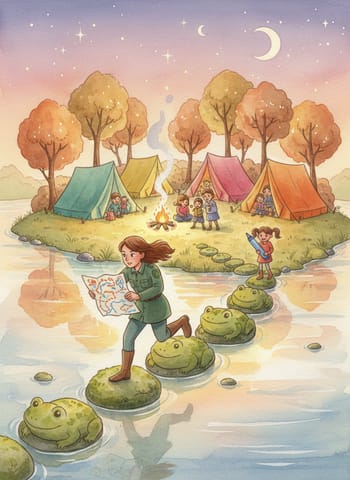
Gabi almost says no. The sheet is covered in bright wax. There is a sun with a smiling face, a dragon hiding in the reeds, and the shower block drawn as a castle. Across the middle runs a wavy blue river, and in it there is a row of small grey circles, each with a number. Under them, in careful capital letters, Bo has written FROG STONES.
"What are these?" Gabi asks, tapping the circles.
"Stepping stones. Dad and I found them on Tuesday. You go through the gap in the hedge behind the showers, and then along the old orchard wall. There are seven stones, and they go all the way across to the island. The fifth one wobbles."
Gabi studies the drawing again. Behind the dragon and the smiling sun there is real information here. There is a gate marked with a cross, a tree shaped like a fork and a bin with a crooked lid. Every one of those things exists, because Gabi walked past the same bin that morning. A child who notices a crooked lid has probably noticed everything else too.
It is eighteen minutes past four. Gabi decides.
"Show me the start," she says. "Only the start. Then you go straight back to your parents."
They hurry out through the back of the office and past the shower block. The hedge does have a gap exactly where the map says. Bo points at it with the confidence of a tour guide. Beyond the gap, an old stone wall runs down towards the water, half hidden by nettles.
"Follow the wall until it falls into the river," Bo says. "That is where the stones begin. I drew an arrow."
"You did. Now run back to your father and tell him something for me. Every tent on the meadow must stay away from the bank until I return. After that, go to the camp bell and wait beside it."
"When do I ring it?"
"At five o'clock exactly. Ring it once, as loudly as you can. Then everyone will know the river is about to change."
Bo nods as if he has been given a very important job, which, Gabi realises, he has. He sprints away with his crayon box rattling in his pocket.
Gabi follows the wall alone. It ends exactly where the arrow says, in a tumble of mossy blocks that disappear into the current. The first stone lies just below the surface, flat and dark and slippery. She steps onto it with both arms out like a child on a balance beam. The second stone is easier. The third is further than the map suggests, so she jumps, and a splash fills her left boot with cold water.
She does not stop. The river is wider here than it looks from the office, and the current pulls gently at her trousers. Stone four is wide and solid. Stone five has a tiny zigzag drawn beside it on the map, and Gabi remembers the word wobbles a moment too late. She tests the surface with her toe, feels it rock, and moves her weight to the very edge, where the stone rests against the gravel. It holds.
Stone six. Stone seven. Then a bank of soft mud, a wall of reeds and, somewhere behind them, the sound of children laughing. Gabi checks her watch. It is 4:36.
The first family she finds is cooking supper on a small gas stove. A man in a straw hat looks up with a spoon in his hand and watches a wet, breathless stranger push through the reeds.
"I am the warden," Gabi says between breaths. "The water company opens the sluice at five. The river will rise, and the bridge will flood. You must bring everything to the meadow now."
"At five? That gives us twenty minutes," the man says.
"Twenty-four, if we hurry."
He puts the spoon down at once. Within a minute the island is full of voices. Gabi goes from tent to tent, repeating the same few sentences. The families answer her with the quick, practical calm of people who have decided not to panic. A woman pulls pegs from the ground two at a time. At ten to five the last branch of the willow falls. The tree surgeons switch off their saws and wave the families through along the bank path. Two teenagers carry sleeping bags across the planks in great squashed armfuls. A small girl drags a bucket of toys behind her, refusing every offer of help.
There are fourteen people in total, four tents and a surprising number of cooking pots. Gabi counts the planks of the bridge as they cross, and she counts the minutes too. At 4:50 the last tent is folded. At 4:54 the bridge is still dry, with only a thin dark line of water creeping towards its lowest board. At 4:57 the last family steps onto the meadow, and the man in the straw hat turns back to shake Gabi's hand.
She is the last person off the island. She walks the planks slowly, one hand on the rail. A hard knot of worry loosens in her chest as the grass finally appears under her feet.
On the meadow, the campers have gathered in a loose crowd. Bo's father stands in the middle with a hand on his son's shoulder. Bo himself stands beside the camp bell, with the rope wrapped carefully around his fist. He looks at Gabi, then at the clock on the office wall, then at Gabi again.
"Is it time?" he whispers.
"Almost."
They all stand in silence and look upstream, where the river still lies flat and silver in the afternoon light. A duck paddles past. Gabi finds that she is smiling, and that her left boot is still full of water, and that she does not mind.
"Now," she says.
Bo pulls the rope with both hands. The bell sings out over the meadow, and far away, beyond the bend, the first brown water begins to slide down the river.