A Lock Built Around a Key
A free B2-level English story for language learners, readable online in 7 languages, with an option to listen via the free Storyteller app.
A Saturday helper in a hardware shop wishes for a space of his own and is handed a puzzling brass key, along with the job of making its door.
That was the preview! Hear the full story in the free Storyteller app. Get the app
Audio isn't available right now.
Madu had worked at Oded's hardware shop for three Saturdays. He still could not tell a wood screw from a machine screw without reading the label. The shop smelled of oil, cut timber and rubber, and every shelf held something he had never needed before.
On the fourth Saturday, Oded handed him a cardboard box and a broom. "The back counter has to be cleared before noon," he said. "Sweep under it, and put anything you find into the box."
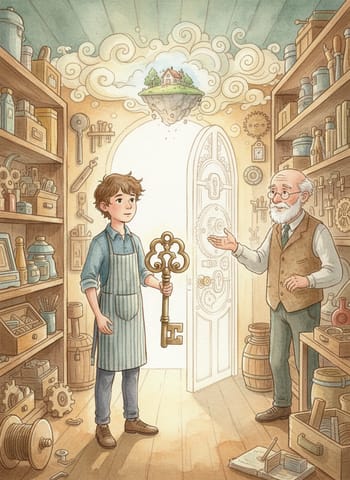
Madu knelt and pushed the broom along the floor. Dust rolled out in grey clumps, together with two washers, a pencil stub and a single brass key. It was heavy for its size, with a round head and teeth cut in a careful, uneven pattern. A paper tag was tied to it with string, but the ink had faded to nothing.
He held it up. "Oded, what does this open?"
Oded looked over the top of his glasses. "Ah. That one. It has been in this shop longer than I have."
"But what is it for?" Madu asked.
"Nobody knows." Oded took the key and turned it over in his fingers. "The man who owned the shop before me left it in a jar of odd keys. I tried it on every lock in the building, and then on every lock I could find in town. It fits nothing. It is a key without a door."
Madu laughed, and then he stopped, because Oded was not smiling. Oded set the key on the counter and went back to sorting hinges.
The morning passed slowly. Madu carried boxes of nails to the front and wiped the glass of the display case. He told a customer, with great confidence and partly by guessing, which paint would suit a garden fence. Whenever the shop went quiet, his eyes drifted back to the brass key.
At noon he took his sandwich out to the loading step behind the shop. The sun was warm on the concrete. He ate slowly, because he did not want to go home yet.
At home, he shared a bedroom with his little brother, who owned four hundred plastic animals and a voice that never seemed to switch off. Madu had been building a model ship for months. It lived in pieces inside a shoebox, because there was nowhere to leave it out where it would not be stepped on.
He turned the key over in his pocket, where he had hidden it without quite meaning to. "I wish I had a door of my own," he said to the empty alley. "Just one. With a lock, and a key that only I carry."
He felt foolish the moment the words were out. But someone had been standing in the open back doorway, holding a coil of wire, and that someone said nothing at all. Madu did not turn around.
The afternoon was busy. Oded sold a ladder, cut three lengths of chain and argued gently with a woman about the price of a drill. At closing time he locked the till and switched off the lights over the shelves.
"Madu, come here a minute," he said.
Madu followed him to the storeroom at the back. It was a long, narrow space stacked with pallets and tins. At the far end there was an empty alcove in the wall, about as wide as a bookcase. Oded pointed at it.
"That corner has been wasted for twenty years," he said. "I have always meant to put a door on it. Behind the door there would be a cupboard, and the cupboard would be used for something that matters."
Madu waited. He had the uneasy feeling that he was being offered something, but he could not tell what.
"Keep the key," Oded said at last. "I have decided that it was never lost. It was waiting for somebody to build its door. If you want the alcove, it is yours, but I will not build anything for you. You will make it with your own hands, and you will make it properly."
"I have never built a door," Madu said.
"Nobody has, before the first one," Oded replied.
The next Saturday, Madu arrived early and found a plank of pale pine, a spirit level and a box of hinges waiting beside the alcove. Oded showed him how to measure twice and cut once. Then he walked away, leaving Madu alone with the saw.
The first attempt was a disaster. Madu had measured the opening carefully, but he had measured it at the bottom only, and the wall leaned slightly. When he lifted the finished frame into place, it stuck at the top and gapped at the base, like a mouth that would not close.
Oded came, looked at it for a long moment, and said nothing kind and nothing unkind. He handed Madu a pencil. "Measure it in three places," he said. "Walls lie. Wood tells the truth, if you ask it the right way."
Madu started again. This time he measured the width at the top, the middle and the bottom. The alcove was almost a centimetre narrower in the middle. He adjusted the frame, planed the edge until the curls of wood fell around his shoes, and tried it again. It slid in with a soft, satisfied sound.
It took three more Saturdays to finish. He hung the door on two brass hinges and screwed on a plain handle. He sanded the surface until it felt like the inside of a shell. Every time he stepped back, he found another small flaw. Every time, Oded walked past and said only, "Good enough to keep going."
There was still a problem, though, and Madu did not discover it until the final afternoon. He had fixed everything he could think of, but the door had no lock. The key fitted nothing, however carefully he looked at it.
"You cannot buy a lock for a key you did not choose," he complained. "It would have to be made to match."
"Exactly," said Oded, and for the first time that month, he grinned. "I wondered how long it would take you to notice. Put your coat on."
They walked two streets to a narrow shop with a handwritten sign in the window. Inside, a locksmith with ink on his thumbs was working at a bench under a lamp. Oded put the brass key on the counter and said that his young friend needed a lock built around it.
The locksmith picked the key up and held it to the light. He hummed to himself. "Somebody cut this by hand," he said at last. "It has not been copied from anything. A lock to fit it would have to be made from scratch, and that takes time."
"How long?" Madu asked.
"A week, if I am not interrupted." The locksmith shrugged. "Come back on Saturday."
Madu returned a week later, and the locksmith set a small brass lock on the counter, wrapped in a cloth. He had filed and fitted every part of it, and the mechanism clicked as softly as a clock. Back at the shop, Madu fixed it in place with four small screws, closed the door, and turned the brass key.
The bolt slid across. For a moment, nobody in the storeroom moved.
Oded cleared his throat and picked up a broom, although the floor was already clean. "I should take that cupboard off my list of wasted corners," he said, without looking up. "Lock the shop when you leave, please. And mind your hands on the way out."
Madu stayed where he was. The alcove was small, only slightly larger than a school locker, and it smelled of fresh pine. He opened the door again and ran his thumb along the empty shelf inside. He thought about the shoebox of ship parts at home.
The shelf was far bigger than a model ship needed. Something else would fit in there as well, if he could only decide what.
He stood in front of the open door with the brass key warm in his hand. What should a person keep behind a door that nobody else could open?