A Lock Built Around a Key
一个面向英语学习者的免费 B2 级英语故事,可用 7 种语言在线阅读,也可以在免费的 Storyteller 应用中收听。
A Saturday helper in a hardware shop wishes for a space of his own and is handed a puzzling brass key, along with the job of making its door.
试听结束!在免费的 Storyteller 应用中收听完整故事。 下载应用
音频暂时无法播放。
Madu had worked at Oded's hardware shop for three Saturdays. He still could not tell a wood screw from a machine screw without reading the label. The shop smelled of oil, cut timber and rubber, and every shelf held something he had never needed before.
马杜在奥代德的五金店里已经干了三个星期六。他仍然分不清木螺丝和机械螺丝,不看标签就不行。店里弥漫着机油、锯好的木料和橡胶的气味,每个货架上都摆着他从没用过的东西。
On the fourth Saturday, Oded handed him a cardboard box and a broom. "The back counter has to be cleared before noon," he said. "Sweep under it, and put anything you find into the box."
第四个星期六,奥代德递给他一个纸箱和一把扫帚。“后面的柜台中午前得清理出来,”他说,“扫扫底下,找到什么都放进箱子里。”
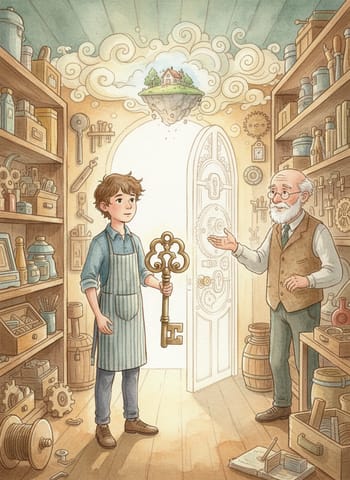
Madu knelt and pushed the broom along the floor. Dust rolled out in grey clumps, together with two washers, a pencil stub and a single brass key. It was heavy for its size, with a round head and teeth cut in a careful, uneven pattern. A paper tag was tied to it with string, but the ink had faded to nothing.
马杜跪下来,把扫帚沿着地面推过去。灰尘一团团滚了出来,还带出两个垫圈、一小截铅笔头和一把黄铜钥匙。这钥匙很沉,圆圆的头,齿纹切得精细而不规则。上面用绳子系着一张纸标签,可是墨迹早已褪得一点也不剩。
He held it up. "Oded, what does this open?"
他举起钥匙。“奥代德,这开什么的?”
Oded looked over the top of his glasses. "Ah. That one. It has been in this shop longer than I have."
奥代德从眼镜上方望过来。“啊,那把钥匙。它待在这家店里的时间比我还长。”
"But what is it for?" Madu asked.
“可它是干什么用的?”马杜问。
"Nobody knows." Oded took the key and turned it over in his fingers. "The man who owned the shop before me left it in a jar of odd keys. I tried it on every lock in the building, and then on every lock I could find in town. It fits nothing. It is a key without a door."
“没人知道。”奥代德接过钥匙,在指间翻了个面。“我前一任店主把它留在一罐杂七杂八的钥匙里。我试过这栋楼里的每一把锁,又试了城里能找到的每一把锁。它什么也配不上。这是一把没有门的钥匙。”
Madu laughed, and then he stopped, because Oded was not smiling. Oded set the key on the counter and went back to sorting hinges.
马杜笑了,随即停住了,因为奥代德没有笑。奥代德把钥匙放在柜台上,又回去整理合页了。
The morning passed slowly. Madu carried boxes of nails to the front and wiped the glass of the display case. He told a customer, with great confidence and partly by guessing, which paint would suit a garden fence. Whenever the shop went quiet, his eyes drifted back to the brass key.
上午过得很慢。马杜把一箱箱钉子搬到前面,擦了展示柜的玻璃。他一边信心十足、一边有点靠猜地告诉一位顾客,哪种油漆适合刷花园的栅栏。每当店里安静下来,他的目光就会飘回那把黄铜钥匙上。
At noon he took his sandwich out to the loading step behind the shop. The sun was warm on the concrete. He ate slowly, because he did not want to go home yet.
中午,他拿着三明治走到店后的装卸台阶上。太阳晒得水泥地暖暖的。他吃得很慢,因为他还不想回家。
At home, he shared a bedroom with his little brother, who owned four hundred plastic animals and a voice that never seemed to switch off. Madu had been building a model ship for months. It lived in pieces inside a shoebox, because there was nowhere to leave it out where it would not be stepped on.
在家里,他和弟弟共住一间卧室,弟弟有四百只塑料动物,嗓门好像永远关不掉。马杜已经做了好几个月的船模,它一直拆散了放在一只鞋盒里,因为没有哪里能摆出来而不被人踩到。
He turned the key over in his pocket, where he had hidden it without quite meaning to. "I wish I had a door of my own," he said to the empty alley. "Just one. With a lock, and a key that only I carry."
他在口袋里翻弄着那把钥匙,他不知不觉把它藏进了那里。“我真希望有一扇属于自己的门,”他对着空荡荡的小巷说,“只要一扇。有一把锁,钥匙只有我带着。”
He felt foolish the moment the words were out. But someone had been standing in the open back doorway, holding a coil of wire, and that someone said nothing at all. Madu did not turn around.
话一出口,他就觉得自己傻。可是有个人一直站在敞开的后门口,手里拿着一卷电线,什么也没说。马杜没有回头。
The afternoon was busy. Oded sold a ladder, cut three lengths of chain and argued gently with a woman about the price of a drill. At closing time he locked the till and switched off the lights over the shelves.
下午很忙。奥代德卖出一架梯子,裁了三段铁链,还和一位女士温和地争论一把电钻的价格。打烊时,他锁好钱柜,关掉货架上方的灯。
"Madu, come here a minute," he said.
“马杜,过来一下,”他说。
Madu followed him to the storeroom at the back. It was a long, narrow space stacked with pallets and tins. At the far end there was an empty alcove in the wall, about as wide as a bookcase. Oded pointed at it.
马杜跟着他走进后面的储藏室。那是一个又长又窄的空间,堆满了托盘和铁罐。最里面,墙上有一个空壁龛,大概有一个书柜那么宽。奥代德指着它。
"That corner has been wasted for twenty years," he said. "I have always meant to put a door on it. Behind the door there would be a cupboard, and the cupboard would be used for something that matters."
“这个角落浪费了二十年,”他说,“我一直想在上面装一扇门。门后做个柜子,柜子里放点重要的东西。”
Madu waited. He had the uneasy feeling that he was being offered something, but he could not tell what.
马杜等着。他有种不安的感觉,觉得有什么东西要给他了,却说不清是什么。
"Keep the key," Oded said at last. "I have decided that it was never lost. It was waiting for somebody to build its door. If you want the alcove, it is yours, but I will not build anything for you. You will make it with your own hands, and you will make it properly."
“钥匙你留着吧,”奥代德终于说,“我决定了,它从来没有丢。它是在等人为它造一扇门。你要是想要这个壁龛,它就是你的,但我不会替你造任何东西。你得亲手做,而且得做好。”
"I have never built a door," Madu said.
“我从来没做过门,”马杜说。
"Nobody has, before the first one," Oded replied.
“第一扇之前,谁都没做过,”奥代德回答。
The next Saturday, Madu arrived early and found a plank of pale pine, a spirit level and a box of hinges waiting beside the alcove. Oded showed him how to measure twice and cut once. Then he walked away, leaving Madu alone with the saw.
下个星期六,马杜早早赶到,发现壁龛旁已经摆好了一块浅色松木板、一把水平尺和一盒合页。奥代德教他怎样量两次、锯一次,然后走开,留下马杜独自面对那把锯子。
The first attempt was a disaster. Madu had measured the opening carefully, but he had measured it at the bottom only, and the wall leaned slightly. When he lifted the finished frame into place, it stuck at the top and gapped at the base, like a mouth that would not close.
第一次尝试一败涂地。马杜仔细量了门洞,但他只量了底部,而墙是微微倾斜的。他把做好的门框抬进去时,门框顶部卡住,底部又留着缝,像一张合不拢的嘴。
Oded came, looked at it for a long moment, and said nothing kind and nothing unkind. He handed Madu a pencil. "Measure it in three places," he said. "Walls lie. Wood tells the truth, if you ask it the right way."
奥代德走过来,看了很久,没说好话,也没说坏话。他递给马杜一支铅笔。“量三个地方,”他说,“墙会说谎,木头说真话,只要你问对了方法。”
Madu started again. This time he measured the width at the top, the middle and the bottom. The alcove was almost a centimetre narrower in the middle. He adjusted the frame, planed the edge until the curls of wood fell around his shoes, and tried it again. It slid in with a soft, satisfied sound.
马杜重新开始。这次他量了顶部、中部和底部的宽度。壁龛中间窄了将近一厘米。他调整了门框,把边缘刨到木屑卷落在鞋边,再试了一次。这回它轻轻滑了进去,发出一声满意的轻响。
It took three more Saturdays to finish. He hung the door on two brass hinges and screwed on a plain handle. He sanded the surface until it felt like the inside of a shell. Every time he stepped back, he found another small flaw. Every time, Oded walked past and said only, "Good enough to keep going."
又花了三个星期六才完工。他用两个黄铜合页挂好门,装上一个朴素的把手,把表面打磨得像贝壳内壁一样光滑。每次退后一步看,他都会发现另一处小瑕疵。每一次,奥代德走过,都只说一句:“够好了,接着干。”
There was still a problem, though, and Madu did not discover it until the final afternoon. He had fixed everything he could think of, but the door had no lock. The key fitted nothing, however carefully he looked at it.
不过还有一个问题,马杜直到最后一天下午才发现。他把能想到的都修好了,可是门上没有锁。无论他多仔细看,那把钥匙都配不上任何锁。
"You cannot buy a lock for a key you did not choose," he complained. "It would have to be made to match."
“你不可能给一把不是你挑的钥匙买到锁,”他抱怨道,“只能照着它定做。”
"Exactly," said Oded, and for the first time that month, he grinned. "I wondered how long it would take you to notice. Put your coat on."
“没错,”奥代德说,这个月里他第一次咧嘴笑了。“我还在想你要多久才会发现呢。穿上外套。”
They walked two streets to a narrow shop with a handwritten sign in the window. Inside, a locksmith with ink on his thumbs was working at a bench under a lamp. Oded put the brass key on the counter and said that his young friend needed a lock built around it.
他们走过两条街,来到一家窄窄的店铺,橱窗里有一块手写的招牌。里面,一位拇指上沾着墨水的锁匠正在灯下的工作台前忙活。奥代德把黄铜钥匙放在柜台上,说他这位年轻的朋友需要围着它做一把锁。
The locksmith picked the key up and held it to the light. He hummed to himself. "Somebody cut this by hand," he said at last. "It has not been copied from anything. A lock to fit it would have to be made from scratch, and that takes time."
锁匠拿起钥匙,对着光看,哼着小调。“有人手工切出来的,”他终于说,“它不是照着什么复制的。要配锁,就得从头做起,这要花时间。”
"How long?" Madu asked.
“要多久?”马杜问。
"A week, if I am not interrupted." The locksmith shrugged. "Come back on Saturday."
“一个星期,只要没人打扰,”锁匠耸耸肩,“星期六再来。”
Madu returned a week later, and the locksmith set a small brass lock on the counter, wrapped in a cloth. He had filed and fitted every part of it, and the mechanism clicked as softly as a clock. Back at the shop, Madu fixed it in place with four small screws, closed the door, and turned the brass key.
一周后,马杜回来了,锁匠把一把用布包着的小黄铜锁放在柜台上。每个零件都是他亲手锉出来、装配好的,机芯咔哒作响,轻得像钟表。回到店里,马杜用四颗小螺丝把锁固定好,关上门,转动了那把黄铜钥匙。
The bolt slid across. For a moment, nobody in the storeroom moved.
锁舌滑了过去。一时间,储藏室里没有人动。
Oded cleared his throat and picked up a broom, although the floor was already clean. "I should take that cupboard off my list of wasted corners," he said, without looking up. "Lock the shop when you leave, please. And mind your hands on the way out."
奥代德清了清嗓子,拿起一把扫帚,尽管地板早已干净。“我该把那个柜子从浪费的角落清单上划掉了,”他头也不抬地说,“走时请锁好店门。出去时当心手。”
Madu stayed where he was. The alcove was small, only slightly larger than a school locker, and it smelled of fresh pine. He opened the door again and ran his thumb along the empty shelf inside. He thought about the shoebox of ship parts at home.
马杜待在原地。壁龛很小,只比学校里的储物柜略大一点,散发着新松木的味道。他又打开门,拇指顺着里面的空架子划过去。他想起家里那个装着船模零件的鞋盒。
The shelf was far bigger than a model ship needed. Something else would fit in there as well, if he could only decide what.
这个架子比船模需要的大得多。别的东西也放得下,只要他能决定放什么。
He stood in front of the open door with the brass key warm in his hand. What should a person keep behind a door that nobody else could open?
他站在敞开的门前,黄铜钥匙在手里暖暖的。一个人该把什么东西放在别人都打不开的门后呢?