The Frog Stones on Bo's Map
Cerita bahasa Inggris gratis level B2 untuk pelajar, bisa dibaca online dalam 7 bahasa, dengan pilihan untuk mendengarkannya di aplikasi Storyteller gratis.
A new campsite warden has less than an hour to warn four families on a river island, and an eight-year-old's crayon map shows her a way across.
Itu cuplikannya! Dengarkan cerita lengkapnya di aplikasi Storyteller gratis. Unduh aplikasi
Audio belum tersedia saat ini.
Gabi checks the clock above the office door for the third time in five minutes. It says ten past four. At five o'clock the water company will open the sluice gate upstream, and the quiet river beside the campsite will rise by almost a metre.
Gabi melirik jam di atas pintu kantor untuk ketiga kalinya dalam lima menit. Jarum menunjuk pukul empat lewat sepuluh. Pukul lima nanti perusahaan air akan membuka pintu air di hulu, dan sungai tenang di samping area perkemahan akan naik hampir satu meter.
The warning arrived by email at lunchtime, but nobody read it until now. Gabi has been the warden here for only two weeks, and the previous warden left a handwritten note instead of a proper handover. The note mentions the sluice twice. It never explains what to do when the river rises.
Peringatannya masuk lewat surel saat makan siang, tetapi tidak ada yang membacanya sampai sekarang. Gabi baru dua minggu menjadi pengawas di sini, dan pengawas sebelumnya meninggalkan catatan tulisan tangan, bukan serah terima yang layak. Catatan itu menyebut pintu air dua kali. Tidak sekali pun dijelaskan apa yang harus dilakukan saat sungai naik.
Nine tents stand on the flat meadow beside the water, and they are safe enough. Four more are pitched on the small island on the far side. A wooden footbridge at the end of the bank path leads there. The bridge is the problem. When the river rises, it floods first, and the families on the island will be cut off before dark.
Sembilan tenda berdiri di padang rumput datar di tepi air, dan tenda-tenda itu cukup aman. Empat tenda lagi didirikan di pulau kecil di seberang. Sebuah jembatan kayu di ujung jalan setapak tepi sungai menuju ke sana. Jembatan itulah masalahnya. Saat sungai naik, jembatan itu yang pertama terendam, dan keluarga-keluarga di pulau akan terputus sebelum gelap.
"I have to reach them before five," Gabi says aloud, to nobody in particular.
"Aku harus menjangkau mereka sebelum pukul lima," kata Gabi keras-keras, kepada siapa pun yang tidak ada.
"Reach who?" asks a small voice.
"Menjangkau siapa?" tanya sebuah suara kecil.
A boy of about eight stands in the doorway, holding a sheet of paper against his chest. His name is Bo, and he has been staying with his parents in the blue tent since Monday. Gabi has seen him all week on the bank, drawing with a box of wax crayons.
Seorang anak laki-laki berusia sekitar delapan tahun berdiri di ambang pintu, mendekap selembar kertas di dadanya. Namanya Bo, dan ia menginap bersama orang tuanya di tenda biru sejak hari Senin. Sepanjang minggu Gabi melihatnya di tepi sungai, menggambar dengan sekotak krayon lilin.
"The families on the island," Gabi says. "The river is about to rise, and they need to move their tents. But the bank path is closed today, because tree surgeons are cutting up a broken willow across it. They cannot stop halfway, and they will not finish before ten to five. The long way round, by the road, takes nearly an hour."
"Keluarga-keluarga di pulau," kata Gabi. "Sungai akan segera naik, dan mereka harus memindahkan tenda. Tapi jalan setapak di tepi sungai ditutup hari ini, karena tukang pangkas pohon sedang memotong pohon dedalu tumbang yang melintang di sana. Mereka tidak bisa berhenti di tengah jalan, dan baru selesai pukul lima kurang sepuluh. Jalan memutar lewat jalan raya memakan waktu hampir satu jam."
"Then you can't go that way," Bo says reasonably.
"Berarti Kakak tidak bisa lewat sana," kata Bo dengan nada masuk akal.
"No. And I cannot wade across the main channel. It is much deeper than it looks."
"Tidak. Dan aku tidak bisa menyeberangi alur utama dengan berjalan kaki. Airnya jauh lebih dalam daripada kelihatannya."
Bo steps forward and puts his paper on the counter. "Maybe you can use my map."
Bo melangkah maju dan meletakkan kertasnya di atas meja. "Mungkin Kakak bisa pakai petaku."
Gabi almost says no. The sheet is covered in bright wax. There is a sun with a smiling face, a dragon hiding in the reeds, and the shower block drawn as a castle. Across the middle runs a wavy blue river, and in it there is a row of small grey circles, each with a number. Under them, in careful capital letters, Bo has written FROG STONES.
Gabi nyaris menolak. Lembar itu penuh warna lilin yang cerah. Ada matahari dengan wajah tersenyum, seekor naga yang bersembunyi di antara alang-alang, dan gedung kamar mandi yang digambar seperti kastil. Di tengahnya membentang sungai biru yang berkelok, dan di dalamnya ada sederet lingkaran abu-abu kecil, masing-masing bernomor. Di bawahnya, dengan huruf kapital yang hati-hati, Bo menulis BATU KODOK.
"What are these?" Gabi asks, tapping the circles.
"Ini apa?" tanya Gabi sambil mengetuk lingkaran-lingkaran itu.
"Stepping stones. Dad and I found them on Tuesday. You go through the gap in the hedge behind the showers, and then along the old orchard wall. There are seven stones, and they go all the way across to the island. The fifth one wobbles."
"Batu loncatan. Ayah dan aku menemukannya hari Selasa. Lewat celah di pagar tanaman di belakang kamar mandi, lalu menyusuri tembok kebun buah yang tua. Ada tujuh batu, dan batu-batu itu sampai ke seberang, ke pulau. Batu kelima goyang."
Gabi studies the drawing again. Behind the dragon and the smiling sun there is real information here. There is a gate marked with a cross, a tree shaped like a fork and a bin with a crooked lid. Every one of those things exists, because Gabi walked past the same bin that morning. A child who notices a crooked lid has probably noticed everything else too.
Gabi mengamati gambar itu lagi. Di balik naga dan matahari yang tersenyum, ada informasi nyata di sini. Ada gerbang bertanda silang, pohon berbentuk garpu, dan tempat sampah dengan tutup yang miring. Semua itu memang ada, karena pagi tadi Gabi melewati tempat sampah yang sama. Anak yang memperhatikan tutup miring mungkin juga memperhatikan segalanya.
It is eighteen minutes past four. Gabi decides.
Sudah pukul empat lewat delapan belas menit. Gabi memutuskan.
"Show me the start," she says. "Only the start. Then you go straight back to your parents."
"Tunjukkan awalnya," katanya. "Hanya awalnya. Setelah itu kamu langsung kembali ke orang tuamu."
They hurry out through the back of the office and past the shower block. The hedge does have a gap exactly where the map says. Bo points at it with the confidence of a tour guide. Beyond the gap, an old stone wall runs down towards the water, half hidden by nettles.
Mereka bergegas keluar lewat pintu belakang kantor dan melewati gedung kamar mandi. Pagar tanaman itu memang punya celah tepat di tempat yang ditunjukkan peta. Bo menunjuknya dengan percaya diri seperti pemandu wisata. Di balik celah itu, tembok batu tua memanjang menuju air, setengah tersembunyi di antara tanaman jelatang.
"Follow the wall until it falls into the river," Bo says. "That is where the stones begin. I drew an arrow."
"Ikuti tembok sampai runtuh ke sungai," kata Bo. "Di situlah batu-batunya mulai. Aku menggambar panah."
"You did. Now run back to your father and tell him something for me. Every tent on the meadow must stay away from the bank until I return. After that, go to the camp bell and wait beside it."
"Betul. Sekarang lari kembali ke ayahmu dan sampaikan sesuatu untukku. Semua tenda di padang rumput harus menjauhi tepi sungai sampai aku kembali. Setelah itu, pergilah ke lonceng perkemahan dan tunggu di sampingnya."
"When do I ring it?"
"Kapan aku membunyikannya?"
"At five o'clock exactly. Ring it once, as loudly as you can. Then everyone will know the river is about to change."
"Tepat pukul lima. Bunyikan sekali, sekeras-kerasnya. Dengan begitu semua orang tahu sungai akan segera berubah."
Bo nods as if he has been given a very important job, which, Gabi realises, he has. He sprints away with his crayon box rattling in his pocket.
Bo mengangguk seakan diberi tugas yang sangat penting, dan memang begitulah, Gabi menyadari. Ia berlari pergi dengan kotak krayon bergemeletuk di sakunya.
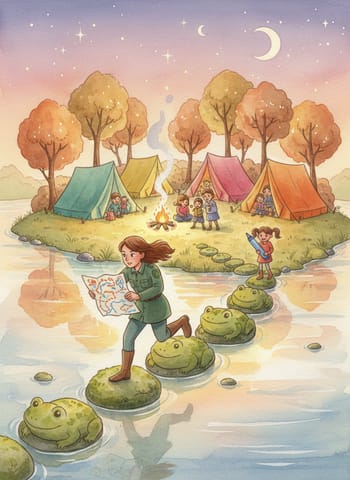
Gabi follows the wall alone. It ends exactly where the arrow says, in a tumble of mossy blocks that disappear into the current. The first stone lies just below the surface, flat and dark and slippery. She steps onto it with both arms out like a child on a balance beam. The second stone is easier. The third is further than the map suggests, so she jumps, and a splash fills her left boot with cold water.
Gabi mengikuti tembok itu sendirian. Tembok itu berakhir persis di tempat yang ditunjukkan panah, pada tumpukan balok berlumut yang menghilang ke dalam arus. Batu pertama berada tepat di bawah permukaan, datar, gelap, dan licin. Ia melangkah ke atasnya dengan kedua lengan terentang seperti anak kecil di atas balok keseimbangan. Batu kedua lebih mudah. Batu ketiga lebih jauh daripada yang digambarkan peta, jadi ia melompat, dan cipratan air memenuhi sepatu botnya yang kiri dengan air dingin.
She does not stop. The river is wider here than it looks from the office, and the current pulls gently at her trousers. Stone four is wide and solid. Stone five has a tiny zigzag drawn beside it on the map, and Gabi remembers the word wobbles a moment too late. She tests the surface with her toe, feels it rock, and moves her weight to the very edge, where the stone rests against the gravel. It holds.
Ia tidak berhenti. Sungai di sini lebih lebar daripada kelihatannya dari kantor, dan arus menarik celananya dengan lembut. Batu keempat lebar dan kokoh. Di samping batu kelima ada zigzag kecil yang digambar di peta, dan Gabi teringat kata goyang sedikit terlambat. Ia menguji permukaannya dengan ujung kaki, merasakannya bergoyang, lalu memindahkan berat badannya ke tepi paling pinggir, tempat batu itu bersandar pada kerikil. Batu itu bertahan.
Stone six. Stone seven. Then a bank of soft mud, a wall of reeds and, somewhere behind them, the sound of children laughing. Gabi checks her watch. It is 4:36.
Batu keenam. Batu ketujuh. Lalu hamparan lumpur lembut, dinding alang-alang, dan, di suatu tempat di baliknya, suara anak-anak tertawa. Gabi memeriksa jam tangannya. Pukul 4.36.
The first family she finds is cooking supper on a small gas stove. A man in a straw hat looks up with a spoon in his hand and watches a wet, breathless stranger push through the reeds.
Keluarga pertama yang ia temui sedang memasak makan malam di atas kompor gas kecil. Seorang pria bertopi jerami mendongak dengan sendok di tangan dan melihat orang asing yang basah dan terengah-engah menerobos alang-alang.
"I am the warden," Gabi says between breaths. "The water company opens the sluice at five. The river will rise, and the bridge will flood. You must bring everything to the meadow now."
"Saya pengawas perkemahan," kata Gabi di sela napasnya. "Perusahaan air membuka pintu air pukul lima. Sungai akan naik, dan jembatan akan terendam. Bapak harus membawa semuanya ke padang rumput sekarang."
"At five? That gives us twenty minutes," the man says.
"Pukul lima? Berarti kita punya dua puluh menit," kata pria itu.
"Twenty-four, if we hurry."
"Dua puluh empat, kalau kita cepat."
He puts the spoon down at once. Within a minute the island is full of voices. Gabi goes from tent to tent, repeating the same few sentences. The families answer her with the quick, practical calm of people who have decided not to panic. A woman pulls pegs from the ground two at a time. At ten to five the last branch of the willow falls. The tree surgeons switch off their saws and wave the families through along the bank path. Two teenagers carry sleeping bags across the planks in great squashed armfuls. A small girl drags a bucket of toys behind her, refusing every offer of help.
Ia langsung meletakkan sendoknya. Dalam semenit, pulau itu penuh suara. Gabi berpindah dari tenda ke tenda, mengulang beberapa kalimat yang sama. Keluarga-keluarga itu menjawabnya dengan ketenangan yang cepat dan praktis, seperti orang yang memutuskan untuk tidak panik. Seorang wanita mencabuti pasak dari tanah dua sekaligus. Pukul lima kurang sepuluh, dahan terakhir pohon dedalu itu jatuh. Para tukang pangkas pohon mematikan gergaji mereka dan melambaikan tangan agar keluarga-keluarga itu lewat di jalan setapak tepi sungai. Dua remaja membawa kantong tidur melintasi papan dalam pelukan besar yang penyok. Seorang gadis kecil menyeret seember mainan di belakangnya, menolak setiap tawaran bantuan.
There are fourteen people in total, four tents and a surprising number of cooking pots. Gabi counts the planks of the bridge as they cross, and she counts the minutes too. At 4:50 the last tent is folded. At 4:54 the bridge is still dry, with only a thin dark line of water creeping towards its lowest board. At 4:57 the last family steps onto the meadow, and the man in the straw hat turns back to shake Gabi's hand.
Totalnya ada empat belas orang, empat tenda, dan panci masak yang jumlahnya mengejutkan. Gabi menghitung papan jembatan saat mereka menyeberang, dan ia juga menghitung menit. Pukul 4.50 tenda terakhir sudah dilipat. Pukul 4.54 jembatan masih kering, hanya ada garis air tipis yang gelap merayap ke arah papan terendahnya. Pukul 4.57 keluarga terakhir menginjak padang rumput, dan pria bertopi jerami itu berbalik untuk menjabat tangan Gabi.
She is the last person off the island. She walks the planks slowly, one hand on the rail. A hard knot of worry loosens in her chest as the grass finally appears under her feet.
Gabi orang terakhir yang meninggalkan pulau. Ia berjalan pelan di atas papan, satu tangan berpegangan pada pagar. Simpul keras kecemasan di dadanya mengendur ketika akhirnya rumput terasa di bawah kakinya.
On the meadow, the campers have gathered in a loose crowd. Bo's father stands in the middle with a hand on his son's shoulder. Bo himself stands beside the camp bell, with the rope wrapped carefully around his fist. He looks at Gabi, then at the clock on the office wall, then at Gabi again.
Di padang rumput, para pekemah telah berkumpul dalam kerumunan longgar. Ayah Bo berdiri di tengah dengan tangan di bahu putranya. Bo sendiri berdiri di samping lonceng perkemahan, dengan tali terlilit hati-hati di kepalan tangannya. Ia menatap Gabi, lalu jam di dinding kantor, lalu Gabi lagi.
"Is it time?" he whispers.
"Sudah waktunya?" bisiknya.
"Almost."
"Hampir."
They all stand in silence and look upstream, where the river still lies flat and silver in the afternoon light. A duck paddles past. Gabi finds that she is smiling, and that her left boot is still full of water, and that she does not mind.
Mereka semua berdiri diam dan memandang ke arah hulu, tempat sungai masih terbentang datar dan keperakan dalam cahaya sore. Seekor bebek berenang melintas. Gabi mendapati dirinya tersenyum, dan sepatu bot kirinya masih penuh air, dan ia tidak keberatan.
"Now," she says.
"Sekarang," katanya.
Bo pulls the rope with both hands. The bell sings out over the meadow, and far away, beyond the bend, the first brown water begins to slide down the river.
Bo menarik tali dengan kedua tangan. Lonceng berdentang di atas padang rumput, dan jauh di sana, di balik tikungan, air cokelat pertama mulai meluncur menuruni sungai.