One Ball of Green Yarn
Uma história gratuita em inglês de nível A1 para estudantes, para ler online em 7 idiomas, com opção de ouvir no app gratuito Storyteller.
Two strangers take turns knitting one scarf in a library basket and leave notes for each other.
Essa foi a prévia! Ouça a história completa no app gratuito Storyteller. Baixar o app
O áudio não está disponível no momento.
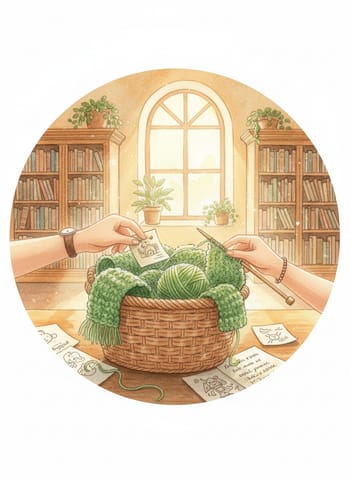
The town library had a basket by the window. In it sat a big ball of green yarn. A card said, "Please knit a little. Please pass it on."
A biblioteca da cidade tinha uma cesta perto da janela. Dentro dela havia um grande novelo de lã verde. Um cartão dizia: "Por favor, tricote um pouco. Por favor, passe adiante."
Olive saw the basket on a Tuesday. She loved to knit. She sat down in the soft chair. She took out her needles and began a long scarf.
Olive viu a cesta numa terça-feira. Ela adorava tricotar. Sentou-se na poltrona macia. Pegou as agulhas e começou um cachecol comprido.
She knitted for one hour. Then she put the yarn back. On a small paper, she wrote, "Hello, whoever you are. I knit on Tuesdays. Please be kind to my scarf." She put the paper in the basket. Then she went home.
Ela tricotou por uma hora. Depois guardou a lã de volta. Num pedacinho de papel, escreveu: "Olá, quem quer que você seja. Eu tricoto às terças. Por favor, seja gentil com o meu cachecol." Colocou o papel na cesta. Depois foi para casa.
On Thursday, Saul came to the library. He was new in town. He wanted books about fish. He saw the basket, and he saw the scarf. It was good, but the stitches were very tight.
Na quinta-feira, Saul foi à biblioteca. Ele era novo na cidade. Queria livros sobre peixes. Viu a cesta e viu o cachecol. Era bonito, mas os pontos eram muito apertados.
Saul knew how to knit. His aunt taught him as a boy. He sat down and knitted for an hour. Then he took a pencil. He wrote on the paper, "Hello. I knit on Thursdays. Your stitches are very tight. Do you ever relax?"
Saul sabia tricotar. Sua tia o havia ensinado quando ele era menino. Ele se sentou e tricotou por uma hora. Depois pegou um lápis. Escreveu no papel: "Olá. Eu tricoto às quintas. Seus pontos são muito apertados. Você nunca relaxa?"
He smiled and left the basket on the table.
Ele sorriu e deixou a cesta sobre a mesa.
Next Tuesday, Olive came back. She read the note and laughed out loud. The librarian looked up from her desk. Olive covered her mouth.
Na terça seguinte, Olive voltou. Ela leu o bilhete e riu alto. A bibliotecária levantou os olhos da mesa. Olive cobriu a boca.
She wrote, "My stitches are not tight. Yours are loose! Your side looks like a net." Then she knitted a new row, very tight.
Ela escreveu: "Meus pontos não são apertados. Os seus é que são frouxos! O seu lado parece uma rede." Depois tricotou uma carreira nova, bem apertada.
On Thursday, Saul read it and laughed too. He wrote, "My loose side is warm and soft. Yours is a board." He knitted a row, very loose.
Na quinta, Saul leu o bilhete e também riu. Escreveu: "Meu lado frouxo é quentinho e macio. O seu é uma tábua." Tricotou uma carreira bem frouxa.
The librarian saw the basket every day. She said nothing. Each week, she moved it closer to the sunny window.
A bibliotecária via a cesta todos os dias. Não dizia nada. A cada semana, ela a movia mais para perto da janela ensolarada.
So the weeks went by. The scarf grew longer. It was tight, then loose, then tight, then loose. It looked funny, like green waves. The notes grew longer too. Olive wrote about her day. Saul wrote about the fish book. She asked about his town. He asked about her cat.
Assim as semanas foram passando. O cachecol foi ficando mais comprido. Era apertado, depois frouxo, depois apertado, depois frouxo. Parecia engraçado, como ondas verdes. Os bilhetes também foram ficando mais longos. Olive escrevia sobre o seu dia. Saul escrevia sobre o livro de peixes. Ela perguntava sobre a cidade dele. Ele perguntava sobre o gato dela.
One day, Olive wrote a new line. "I like your notes more than your knitting." Saul read it and his face went hot. He wrote, "I like yours too. Maybe we can say hello in person."
Um dia, Olive escreveu uma linha nova. "Eu gosto mais dos seus bilhetes do que do seu tricô." Saul leu e seu rosto ficou quente. Ele escreveu: "Eu também gosto dos seus. Talvez a gente possa se dizer olá pessoalmente."
He did not know what to do next. He stood at the basket for a long time. Then he wrote, "Come on Wednesday. I will bring tea."
Ele não sabia o que fazer depois. Ficou um bom tempo parado junto à cesta. Então escreveu: "Venha na quarta. Eu levo o chá."
On Wednesday, Saul sat in the soft chair. He had two cups of tea. His hands were cold. Every time the door opened, he looked up.
Na quarta, Saul se sentou na poltrona macia. Tinha duas xícaras de chá. Suas mãos estavam frias. Toda vez que a porta se abria, ele levantava os olhos.
At three o'clock, Olive came in. She stopped. She looked at the scarf in his hands. Then she looked at his face.
Às três horas, Olive entrou. Ela parou. Olhou para o cachecol nas mãos dele. Depois olhou para o rosto dele.
"You are the loose one," she said.
"Você é o frouxo", disse ela.
"And you are the tight one," said Saul.
"E você é a apertada", disse Saul.
They laughed. The librarian said, "Shh!" But she smiled too.
Eles riram. A bibliotecária fez "Shh!". Mas ela também sorriu.
Olive sat down next to him. She took a cup of tea. The scarf lay between them. It was long and green. The tight and loose stitches lay side by side.
Olive sentou-se ao lado dele. Pegou uma xícara de chá. O cachecol ficou entre os dois. Era comprido e verde. Os pontos apertados e os frouxos estavam lado a lado.
Saul found the end of the scarf. He gave it to her.
Saul encontrou a ponta do cachecol. Entregou-a a ela.
"Your turn," he said.
"Sua vez", disse ele.