The Word We Swap on Fridays
Una historia gratuita en inglés de nivel A1 para estudiantes, para leer en línea en 7 idiomas, con opción de escucharla en la app gratuita Storyteller.
Two students meet every Friday at a campus language table, and a special word changes their quiet hour.
¡Ese fue el avance! Escucha la historia completa en la app gratuita Storyteller. Descargar la app
El audio no está disponible en este momento.
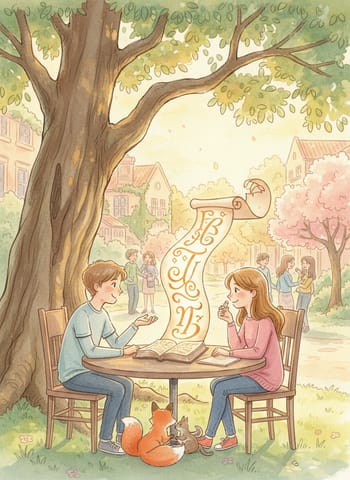
On the university campus, there is a language exchange table. It sits in the corner of the student café. A paper sign hangs above it: "Teach one word. Learn one word."
En el campus de la universidad hay una mesa de intercambio de idiomas. Está en un rincón de la cafetería de los estudiantes. Encima cuelga un letrero de papel: «Enseña una palabra. Aprende una palabra».
Ximena sees the sign in September. She is from Mexico. She wants to practice her English. She sits down at the table with her tea.
Ximena ve el letrero en septiembre. Es de México. Quiere practicar su inglés. Se sienta a la mesa con su té.
A boy comes and sits across from her. He has a green notebook. "Hello," he says. "I am Yoon. I speak Korean. I want to learn Spanish."
Un chico llega y se sienta frente a ella. Tiene un cuaderno verde. —Hola —dice—. Soy Yoon. Hablo coreano. Quiero aprender español.
"I am Ximena," she says. "I speak Spanish. I want to learn English. Can we help each other?"
—Soy Ximena —dice ella—. Hablo español. Quiero aprender inglés. ¿Nos ayudamos?
"Yes," says Yoon. He smiles.
—Sí —dice Yoon. Sonríe.
They start slowly. Yoon points to his cup. "Coffee," he says. "In Korean, it is also coffee. But we say it a little different."
Empiezan despacio. Yoon señala su taza. —Coffee —dice—. En coreano también es «coffee». Pero lo decimos un poco distinto.
Ximena laughs. "In Spanish, it is café," she says.
Ximena se ríe. —En español es «café» —dice.
They write the words in the notebook. They draw little pictures of cups and trees and buses. Time passes fast. After an hour, they both know ten new words.
Escriben las palabras en el cuaderno. Dibujan tacitas, árboles y autobuses. El tiempo pasa rápido. Después de una hora, los dos saben diez palabras nuevas.
"Same time on Friday?" Yoon asks.
—¿A la misma hora el viernes? —pregunta Yoon.
"Yes," says Ximena.
—Sí —dice Ximena.
They meet every Friday. Each week, they pick a theme. One week, it is food. Another week, it is family. Yoon learns "hermano" for brother and "abuela" for grandmother. Ximena learns how to say "thank you" in Korean. Her pronunciation is very bad. Yoon tries not to laugh, but his shoulders shake.
Se reúnen todos los viernes. Cada semana eligen un tema. Una semana es la comida. Otra semana es la familia. Yoon aprende «hermano» y «abuela». Ximena aprende a decir «gracias» en coreano. Su pronunciación es muy mala. Yoon trata de no reírse, pero le tiemblan los hombros.
"Again," he says, and she says it again and again.
—Otra vez —dice, y ella lo dice una y otra vez.
After a month, they speak in simple sentences. Ximena tells him about her small town. Yoon tells her about his mother's kitchen. He also tells her about his cold-day soup.
Al cabo de un mes, hablan con frases sencillas. Ximena le cuenta de su pueblo pequeño. Yoon le cuenta de la cocina de su mamá. También le habla de su sopa para los días fríos.
One Friday in November, the café is nearly empty. Snow falls outside. Ximena arrives late, with snow on her hat.
Un viernes de noviembre, la cafetería está casi vacía. Afuera cae nieve. Ximena llega tarde, con nieve en el gorro.
"I have a surprise," says Yoon. "Today, we choose one special word each."
—Tengo una sorpresa —dice Yoon—. Hoy cada uno elige una palabra especial.
"Okay," says Ximena. "Who goes first?"
—Está bien —dice Ximena—. ¿Quién empieza?
"You," he says.
—Tú —dice él.
Ximena thinks for a moment. She opens the green notebook. She writes a Spanish word in big letters. The word is "gustar." She turns the notebook around.
Ximena piensa un momento. Abre el cuaderno verde. Escribe una palabra en español con letras grandes. La palabra es «gustar». Gira el cuaderno.
"It means: to like," she says. "You can like a song, a place, or a person."
—Significa: to like —dice—. Te puede gustar una canción, un lugar o una persona.
Yoon reads the word. He repeats it quietly. His ears turn pink.
Yoon lee la palabra. La repite en voz baja. Se le ponen rosadas las orejas.
"Now you," Ximena says.
—Ahora tú —dice Ximena.
Yoon takes the pen. He writes a Korean word in small letters. Then he writes it again in English letters. Now she can read it. The word is "joahae."
Yoon toma el bolígrafo. Escribe una palabra coreana con letras pequeñas. Luego la escribe otra vez con letras del alfabeto inglés. Ahora ella puede leerla. La palabra es «joahae».
"It means: I like it," he says. "Or: I like you. The meaning is in the voice."
—Significa: me gusta —dice él—. O: me gustas. El significado está en la voz.
Ximena looks at the word. She looks at Yoon. For a moment, the café is very quiet. The coffee machine hums. A student laughs somewhere far away.
Ximena mira la palabra. Mira a Yoon. Por un momento, la cafetería está muy callada. La máquina de café zumba. Un estudiante se ríe en algún lugar lejano.
"In what voice?" she asks.
—¿En qué voz? —pregunta ella.
"This one," he says, very softly. "Joahae."
—En esta —dice él, muy bajito—. Joahae.
"Me gustas," she says, just as softly. "That is the Spanish."
—Me gustas —dice ella, igual de bajito—. Eso es en español.
They smile at each other. Neither says anything for a long time.
Se sonríen. Ninguno dice nada durante un buen rato.
Then Yoon pushes the green notebook to the middle. "Next week, a new word," he says.
Entonces Yoon empuja el cuaderno verde hacia el centro de la mesa. —La próxima semana, una palabra nueva —dice.
Ximena takes the pen. She writes the date on the next page.
Ximena toma el bolígrafo. Escribe la fecha en la página siguiente.