The Tuesday Chair
Una historia gratuita en inglés de nivel A1 para estudiantes, para leer en línea en 7 idiomas, con opción de escucharla en la app gratuita Storyteller.
A clinic receptionist notices an old man who sits in the waiting room every Tuesday without an appointment.
¡Ese fue el avance! Escucha la historia completa en la app gratuita Storyteller. Descargar la app
El audio no está disponible en este momento.
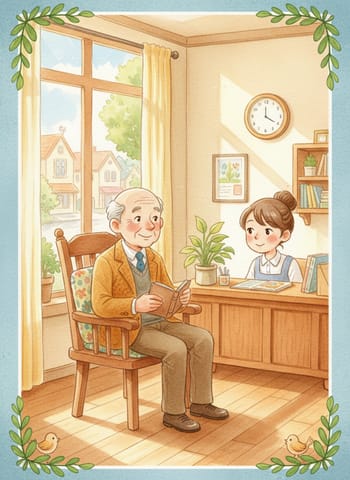
Odette is the receptionist at a small clinic. She sits at the front desk. She answers the phone. She gives people forms and a smile.
Odette es la recepcionista de una clínica pequeña. Se sienta en el mostrador de la entrada. Contesta el teléfono. Les da formularios a las personas, y una sonrisa.
Every Tuesday at ten, an old man comes in. Odette sees him through the glass door. She always says hello. He wears a grey coat and a brown hat. He does not go to the desk. He goes to the green chair by the window. He sits down. He opens a newspaper.
Todos los martes a las diez llega un anciano. Odette lo ve a través de la puerta de vidrio. Siempre lo saluda. Lleva un abrigo gris y un sombrero café. No va al mostrador. Va a la silla verde junto a la ventana. Se sienta. Abre un periódico.
He stays until noon. Then he folds the paper. He puts on his hat and goes home.
Se queda hasta el mediodía. Luego dobla el periódico. Se pone el sombrero y se va a casa.
He has no appointment. He does not see a doctor. He does not ask for tea or water. Odette checks the list every week. His name is never on it.
No tiene cita. No ve a ningún médico. No pide té ni agua. Odette revisa la lista cada semana. Su nombre nunca está en ella.
On the fourth Tuesday, Odette asks the nurse. The nurse is a kind woman called Pearl. She knows every patient in town.
El cuarto martes, Odette le pregunta a la enfermera. La enfermera es una mujer amable que se llama Pearl. Conoce a todos los pacientes del pueblo.
"Do you know the old man in the green chair?" Odette asks.
—¿Conoces al anciano de la silla verde? —pregunta Odette.
"I know him," says Pearl. "He comes every week. I think he waits for someone."
—Lo conozco —dice Pearl—. Viene todas las semanas. Creo que espera a alguien.
"Who?"
—¿A quién?
"I do not know," says Pearl.
—No lo sé —dice Pearl.
Odette thinks about it all morning. At eleven she fills a cup with tea. She walks to the window.
Odette lo piensa toda la mañana. A las once llena una taza de té. Camina hasta la ventana.
"Good morning," she says. "Would you like some tea?"
—Buenos días —dice—. ¿Le gustaría un poco de té?
The old man looks up. His eyes are pale and kind. "That is very nice," he says. "Thank you."
El anciano levanta la vista. Tiene los ojos claros y amables. —Es usted muy amable —dice—. Gracias.
Odette sits on the next chair. "Are you waiting for a doctor?"
Odette se sienta en la silla de al lado. —¿Está esperando a un médico?
"No," he says. He looks at his hands. "I am not here for the doctor."
—No —dice él. Se mira las manos—. No vengo por el médico.
Odette waits.
Odette espera.
"My wife had a test every Tuesday," he says. "For two years. We came here together. I sat in this chair and read the paper. She went in. Then she came out and we had lunch."
—Mi esposa se hacía un examen todos los martes —dice él—. Durante dos años. Veníamos juntos. Yo me sentaba en esta silla y leía el periódico. Ella entraba. Después salía y almorzábamos.
"I see," Odette says softly.
—Entiendo —dice Odette con suavidad.
"She died in the spring," he says. "On Tuesday I woke up. I did not know what to do. So I came here. I sat in the chair. It felt right."
—Murió en la primavera —dice—. Un martes me desperté. No supe qué hacer. Así que vine aquí. Me senté en la silla. Se sintió bien.
Odette puts her hand on his arm. She does not speak. There are no words.
Odette le pone la mano en el brazo. No habla. No hay palabras.
"I am sorry to bother you," says the old man. "I know I have no reason to be here."
—Perdone la molestia —dice el anciano—. Sé que no tengo ningún motivo para estar aquí.
"You are not a bother," Odette says. "Please. Stay as long as you like."
—No es ninguna molestia —dice Odette—. Por favor. Quédese todo el tiempo que quiera.
At noon he folds the paper. He puts on his hat. He stops at the door.
Al mediodía dobla el periódico. Se pone el sombrero. Se detiene en la puerta.
"The tea was good," he says. "Thank you."
—El té estaba bueno —dice—. Gracias.
That night Odette cannot stop thinking about the green chair. She thinks about the empty hours. She thinks about other people in town. Some of them sit alone.
Esa noche Odette no puede dejar de pensar en la silla verde. Piensa en las horas vacías. Piensa en otras personas del pueblo. Algunas se sientan solas.
The next morning she talks to Pearl and the doctor. They listen. Then they smile.
A la mañana siguiente habla con Pearl y con el doctor. Ellos escuchan. Luego sonríen.
On Tuesday at nine, Odette moves a small table. She puts it by the green chair. She puts a plate of biscuits on it. She writes a sign with a blue pen. It says, "Tuesday Tea. Everyone is welcome."
El martes a las nueve, Odette mueve una mesita. La pone junto a la silla verde. Pone encima un plato de galletas. Escribe un letrero con un bolígrafo azul. Dice: «Té de los martes. Todos son bienvenidos».
At ten the old man comes in. He stops at the door and reads the sign. Then he looks at the table. His mouth moves, but no words come.
A las diez llega el anciano. Se detiene en la puerta y lee el letrero. Luego mira la mesa. Mueve los labios, pero no le salen las palabras.
Odette is already pouring his tea.
Odette ya le está sirviendo el té.