The Painted Stones of Route Nine
Una historia gratuita en inglés de nivel A1 para estudiantes, para leer en línea en 7 idiomas, con opción de escucharla en la app gratuita Storyteller.
On a desert road trip, Nico and his aunt follow a trail of painted stones to a hidden pool.
¡Ese fue el avance! Escucha la historia completa en la app gratuita Storyteller. Descargar la app
El audio no está disponible en este momento.
Aunt Eliza stopped the car at a desert gas station. Nico got out and stretched. The air was hot and dry. There was nothing around but sand and sky.
La tía Eliza detuvo el coche en una gasolinera del desierto. Nico bajó y se estiró. El aire era caliente y seco. No había nada alrededor, solo arena y cielo.
"We have two hours of road left," Eliza said. "Go and buy some water."
—Nos quedan dos horas de camino —dijo Eliza—. Ve a comprar agua.
Nico walked to the shop. A small stone sat on the step. Someone painted it blue. It had a white star. He picked it up.
Nico caminó hacia la tienda. Una piedra pequeña descansaba en el escalón. Alguien la había pintado de azul. Tenía una estrella blanca. La recogió.
"Whose stone is this?" he asked the man at the desk.
—¿De quién es esta piedra? —le preguntó al hombre del mostrador.
The man smiled. "It is a trail stone. Follow the stones, and you find something nice."
El hombre sonrió. —Es una piedra de sendero. Sigue las piedras y encontrarás algo bonito.
"What do I find?"
—¿Qué voy a encontrar?
"I cannot tell you. You must go and see." He gave Nico two bottles of water.
—No puedo decírtelo. Tienes que ir a ver. —Le dio a Nico dos botellas de agua.
Nico showed the stone to his aunt. She laughed. "We have time," she said. "Let us look."
Nico le mostró la piedra a su tía. Ella se rio. —Tenemos tiempo —dijo—. Vamos a mirar.
Behind the shop, a red stone sat on a rock. It had a yellow sun on it. Nico saw a third stone by a dry bush. They walked to it. The ground was hot under their shoes.
Detrás de la tienda, una piedra roja descansaba sobre una roca. Tenía un sol amarillo. Nico vio una tercera piedra junto a un arbusto seco. Caminaron hacia ella. El suelo estaba caliente bajo sus zapatos.
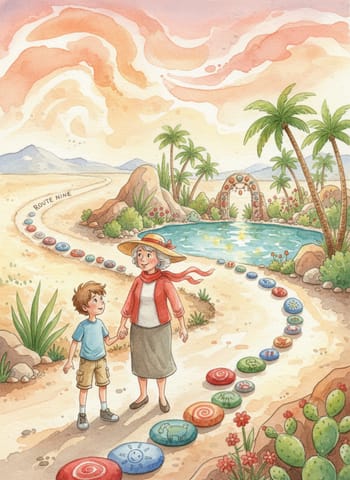
The stones led them along a dusty path. Every stone had a different picture. One had a fish. One had a moon. One had a tiny house.
Las piedras los llevaron por un sendero polvoriento. Cada piedra tenía un dibujo distinto. Una tenía un pez. Otra, una luna. Otra, una casita diminuta.
"Can I keep this one?" Nico asked. He held up the fish.
—¿Puedo quedarme con esta? —preguntó Nico. Levantó la del pez.
"No," said Eliza. "Other people want to find it too. Take a photo."
—No —dijo Eliza—. Otras personas también quieren encontrarla. Tómale una foto.
Nico took a photo of every stone. Then he put each one back in its place.
Nico tomó una foto de cada piedra. Luego puso cada una de vuelta en su lugar.
After twenty minutes, the path went down between big rocks. It was cool and dark there. Nico stopped. He heard a sound.
Después de veinte minutos, el sendero bajaba entre grandes rocas. Allí hacía fresco y estaba oscuro. Nico se detuvo. Oyó un sonido.
"Is that water?" he asked.
—¿Eso es agua? —preguntó.
"In the desert? No," said Eliza. But she listened too. "Yes. It is water!"
—¿En el desierto? No —dijo Eliza. Pero ella también escuchó—. Sí. ¡Es agua!
They walked on. Below the rocks, a small pool shone green and clear. Palm trees stood around it. An old woman sat in a chair. She wore a big hat. Next to her was a table. It had pots of paint and empty stones.
Siguieron caminando. Debajo de las rocas, una pequeña laguna brillaba verde y clara. Había palmeras alrededor. Una anciana estaba sentada en una silla. Llevaba un sombrero grande. A su lado había una mesa. Tenía botes de pintura y piedras vacías.
"Hello," she said. "You found my pool."
—Hola —dijo—. Encontraron mi laguna.
"Are these your stones?" Nico asked.
—¿Son suyas estas piedras? —preguntó Nico.
"Yes. Every week I paint new ones. I put them on the road. Most people drive past. They never look down."
—Sí. Cada semana pinto otras nuevas. Las pongo en la carretera. La mayoría de la gente pasa de largo. Nunca miran hacia abajo.
"Why do you do it?" said Eliza.
—¿Por qué lo hace? —preguntó Eliza.
"The road is long," said the woman.
—El camino es largo —dijo la mujer.
"People get tired."
—La gente se cansa.
"A cool pool is a good surprise."
—Una laguna fresca es una buena sorpresa.
Nico took off his shoes. He put his feet in the water. It was so cold that he shouted. The old woman laughed. Eliza sat down next to him and closed her eyes.
Nico se quitó los zapatos. Metió los pies en el agua. Estaba tan fría que gritó. La anciana se rio. Eliza se sentó junto a él y cerró los ojos.
They stayed for an hour. The woman gave them orange slices. She told them about the birds at the pool. She showed them small fox footprints in the sand.
Se quedaron una hora. La mujer les dio rodajas de naranja. Les contó sobre las aves de la laguna. Les mostró pequeñas huellas de zorro en la arena.
Then she gave Nico a white stone and a brush.
Luego le dio a Nico una piedra blanca y un pincel.
"Paint one," she said. "Then put it on the path for the next person."
—Pinta una —dijo—. Después ponla en el sendero para la próxima persona.
Nico thought for a long time. He painted a small red car. Inside the car, he drew two people. One of them wore a big hat. Eliza looked at it and laughed.
Nico pensó durante mucho tiempo. Pintó un pequeño coche rojo. Dentro del coche dibujó a dos personas. Una de ellas llevaba un sombrero grande. Eliza lo miró y se rio.
"I do not wear a hat like that," she said.
—Yo no uso un sombrero así —dijo.
"You do now," said Nico.
—Ahora sí —dijo Nico.
At last, Eliza looked at her watch. "We must go. Our hotel is far."
Por fin, Eliza miró su reloj. —Tenemos que irnos. Nuestro hotel está lejos.
They said goodbye to the old woman. She waved her hat. Nico and Eliza walked back along the dusty path. The sun was lower now, and the sand was orange.
Se despidieron de la anciana. Ella agitó su sombrero. Nico y Eliza regresaron por el sendero polvoriento. El sol estaba más bajo ahora y la arena se veía anaranjada.
Nico put his painted car on the red rock. Then he took the blue stone with the star. He put it back on the step.
Nico puso su coche pintado sobre la roca roja. Luego tomó la piedra azul con la estrella. La devolvió al escalón.
"Now it is someone else's turn," he said.
—Ahora le toca a otra persona —dijo.
Eliza started the car. Nico looked back one more time. Far away, a small truck stopped at the gas station.
Eliza arrancó el coche. Nico miró hacia atrás una vez más. Muy lejos, una camioneta pequeña se detuvo en la gasolinera.