The Long Table at the Lantern Festival
Una historia gratuita en inglés de nivel A1 para estudiantes, para leer en línea en 7 idiomas, con opción de escucharla en la app gratuita Storyteller.
At a lantern festival in a foreign town, Kasia shares a long table with a friendly stranger named Leandro.
¡Ese fue el avance! Escucha la historia completa en la app gratuita Storyteller. Descargar la app
El audio no está disponible en este momento.
Kasia arrived in the old town on festival night. She came alone. She did not know the language. Her phone had no battery.
Kasia llegó a la ciudad vieja la noche del festival. Venía sola. No sabía el idioma. A su teléfono se le había acabado la batería.
The streets were full of people. Paper lanterns hung from every window. They were red, gold, and white. Music played from a small stage. The air smelled of fried food.
Las calles estaban llenas de gente. De todas las ventanas colgaban faroles de papel. Eran rojos, dorados y blancos. Sonaba música en un pequeño escenario. El aire olía a fritura.
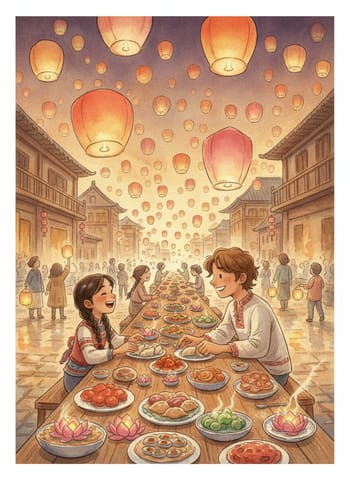
A very long table stood in the square. Hundreds of people sat at it. A woman in an apron pointed at an empty chair. "Sit, sit," she said in simple English. "Eat."
En la plaza había una mesa larguísima. Cientos de personas estaban sentadas a ella. Una mujer con delantal señaló una silla vacía. «Siéntese, siéntese», dijo en un inglés sencillo. «Coma».
Kasia sat down. A man sat in the chair next to hers. He had a camera and a kind face. He spoke to her. She did not know the words. She shook her head and smiled.
Kasia se sentó. Un hombre se sentó en la silla de al lado. Tenía una cámara y una cara amable. Le habló. Ella no entendió las palabras. Negó con la cabeza y sonrió.
"Sorry," she said. "I do not understand."
«Lo siento», dijo. «No entiendo».
The man laughed. "Me too," he said in English. "I do not understand anyone here."
El hombre se rió. «Yo tampoco», dijo en inglés. «No entiendo a nadie aquí».
"You speak English," said Kasia.
«Usted habla inglés», dijo Kasia.
"A little. My name is Leandro. I am from far away."
«Un poco. Me llamo Leandro. Vengo de muy lejos».
"I am Kasia."
«Yo soy Kasia».
A boy brought two big bowls of noodles. The noodles were hot, and the soup was red. Kasia took one bite and her eyes filled with water.
Un niño trajo dos tazones grandes de fideos. Los fideos estaban calientes y el caldo era rojo. Kasia dio un bocado y se le llenaron los ojos de lágrimas.
"It is very hot," she said.
«Pica mucho», dijo.
Leandro tried his. He went red in the face. He drank a whole glass of water. Kasia laughed. She could not hold her spoon.
Leandro probó los suyos. Se puso rojo. Se bebió un vaso entero de agua. Kasia se rió. No podía sostener la cuchara.
An old man across the table watched them. He said a word and pointed at their bowls. Then he pointed at a plate of white bread. He pushed the plate toward them.
Un anciano al otro lado de la mesa los observaba. Dijo una palabra y señaló sus tazones. Luego señaló un plato de pan blanco. Empujó el plato hacia ellos.
"Bread," said Leandro. "It stops the fire."
«Pan», dijo Leandro. «Apaga el fuego».
"Thank you," said Kasia. She put a small piece in her mouth. It helped a lot.
«Gracias», dijo Kasia. Se metió un trocito en la boca. Ayudó mucho.
The old man smiled and said a word again. This time Kasia repeated it. The old man laughed and clapped. Soon five people at the table taught her words. She learned "thank you," "very good," and "moon." Leandro learned "friend."
El anciano sonrió y volvió a decir una palabra. Esta vez Kasia la repitió. El anciano se rió y aplaudió. Pronto cinco personas en la mesa le enseñaban palabras. Aprendió «gracias», «muy bueno» y «luna». Leandro aprendió «amigo».
"Friend," he said. "This one is easy."
«Amigo», dijo él. «Esta es fácil».
The bowls were empty. A girl came with a tray of lanterns. Each one was small and white. A thin pen lay next to each one.
Los tazones quedaron vacíos. Una muchacha llegó con una bandeja de faroles. Cada uno era pequeño y blanco. Junto a cada uno había un lápiz fino.
"For wishes," said the woman in the apron. "Write a wish. Then we send it up."
«Para los deseos», dijo la mujer del delantal. «Escriban un deseo. Luego lo mandamos al cielo».
Kasia looked at the white paper. She did not know what to write. She looked at Leandro. He held his pen over the paper.
Kasia miró el papel blanco. No sabía qué escribir. Miró a Leandro. Él sostenía su lápiz sobre el papel.
"What do you write?" she asked.
«¿Qué escribes?», preguntó ella.
"I cannot tell you," he said. "A wish is a secret."
«No puedo decírtelo», dijo él. «Un deseo es un secreto».
"Then I write mine, and you cannot see."
«Entonces escribo el mío y tú no puedes verlo».
They bent over their lanterns. Kasia wrote three words and covered them with her hand. Leandro wrote a longer line. Then they both stopped and looked at each other.
Se inclinaron sobre sus faroles. Kasia escribió tres palabras y las cubrió con la mano. Leandro escribió una línea más larga. Luego los dos se detuvieron y se miraron.
The whole square walked to the river. A man lit each lantern with a small flame. One by one, the lanterns rose into the dark sky. They were soft golden dots that went higher and higher. Hundreds of them floated over the river.
Toda la plaza caminó hasta el río. Un hombre encendió cada farol con una llama pequeña. Uno por uno, los faroles subieron al cielo oscuro. Eran suaves puntos dorados que subían cada vez más alto. Cientos de ellos flotaban sobre el río.
Kasia held her lantern with both hands. It was warm. "Ready?" said Leandro. They counted together, "One, two, three," and let go.
Kasia sostenía su farol con ambas manos. Estaba tibio. «¿Lista?», dijo Leandro. Contaron juntos: «Uno, dos, tres», y lo soltaron.
Their lanterns rose side by side. For a long time, they stayed close. Then the wind took one a little to the left.
Sus faroles subieron lado a lado. Durante un buen rato se mantuvieron cerca. Luego el viento llevó uno un poco hacia la izquierda.
"Mine goes away," said Kasia.
«El mío se va», dijo Kasia.
"No," said Leandro. "Look. It comes back."
«No», dijo Leandro. «Mira. Vuelve».
She watched. It was true. Her lantern came back toward his. The two lights flew up together.
Ella miró. Era verdad. Su farol volvía hacia el de él. Las dos luces subieron juntas.
Kasia turned to him. "Leandro, I have no battery in my phone," she said. "Can you take my photo?"
Kasia se volvió hacia él. «Leandro, mi teléfono no tiene batería», dijo. «¿Puedes tomarme una foto?»
He lifted his camera. She stood by the river. The sky was golden behind her.
Él levantó su cámara. Ella se paró junto al río. El cielo estaba dorado detrás de ella.
"Say 'friend,'" said Leandro, and he pressed the button.
«Di “amigo”», dijo Leandro, y apretó el botón.