The Handless Clock in the Canteen
Una historia gratuita en inglés de nivel B1 para estudiantes, para leer en línea en 7 idiomas, con opción de escucharla en la app gratuita Storyteller.
A salvaged clock with no hands ticks on a building site, and two workers discover why lunch will not cook.
¡Ese fue el avance! Escucha la historia completa en la app gratuita Storyteller. Descargar la app
El audio no está disponible en este momento.
The wall clock in the building site canteen fell off its nail at half past seven. It hit the floor, spun twice and lost both its hands. Nobody was sad about it. The clock had been wrong for years.
El reloj de pared de la cantina de la obra se cayó de su clavo a las siete y media. Golpeó el suelo, giró dos veces y perdió las dos manecillas. A nadie le dio pena. El reloj llevaba años equivocado.
Neha was the new apprentice joiner, and she had been on the site for just two weeks. The foreman gave her a simple job. She had to find something to hang in the gap. Forty workers needed to see when their break ended.
Neha era la nueva aprendiz de carpintería, y llevaba solo dos semanas en la obra. El capataz le dio una tarea sencilla. Tenía que encontrar algo para colgar en el hueco. Cuarenta trabajadores necesitaban ver cuándo terminaba su descanso.
She went to the salvage shed behind the cabins. It was full of things the crew had saved from the old cinema they were pulling down. There were brass door handles, torn velvet seats and a box of dusty light bulbs. At the bottom of a crate, wrapped in a cinema curtain, she found a round clock.
Fue al cobertizo de recuperación detrás de las casetas. Estaba lleno de cosas que la cuadrilla había rescatado del viejo cine que estaban demoliendo. Había manijas de puerta de latón, butacas de terciopelo rotas y una caja de bombillas polvorientas. En el fondo de un cajón, envuelto en una cortina de cine, encontró un reloj redondo.
It was heavy and beautiful. The case was dark wood, and the glass was clean. But the face was completely empty. There were no numbers, no marks and no hands at all. And yet, when she held it to her ear, it ticked.
Era pesado y hermoso. La caja era de madera oscura, y el vidrio estaba limpio. Pero la carátula estaba completamente vacía. No tenía números, ni marcas, ni manecillas de ningún tipo. Y sin embargo, cuando se lo acercó al oído, hacía tictac.
"It works," she said to nobody.
«Funciona», dijo a nadie.
She carried it to the canteen and found Kai, who helped the cook on weekdays. Kai was seventeen, and he spent most mornings stirring a pot that was bigger than he was.
Lo llevó a la cantina y encontró a Kai, que ayudaba al cocinero entre semana. Kai tenía diecisiete años, y pasaba la mayoría de las mañanas revolviendo una olla más grande que él.
"That is the strangest clock I have ever seen," he said. "How do you read it?"
«Es el reloj más raro que he visto», dijo. «¿Cómo se lee?».
"I do not think you do," said Neha. "But it is better than a hole in the wall."
«Creo que no se lee», dijo Neha. «Pero es mejor que un hueco en la pared».
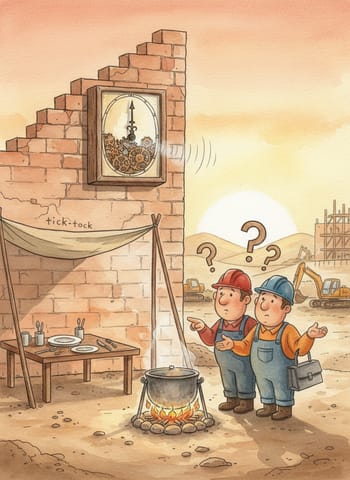
She hung it on the nail and stepped back. The ticking filled the room, slow and deep, like a heartbeat in a very large animal. Kai shrugged and went back to his soup.
Lo colgó en el clavo y retrocedió. El tictac llenó la sala, lento y profundo, como el latido de un animal muy grande. Kai se encogió de hombros y volvió a su sopa.
At ten o'clock, the cook left to collect the delivery, and Kai was alone. He had started the lentil soup early. The pot sat on the biggest flame, and the flame was as high as it could go. By eleven, the pot should have been bubbling. It was not.
A las diez, el cocinero salió a recibir el pedido, y Kai quedó solo. Había empezado temprano la sopa de lentejas. La olla estaba sobre el fuego más grande, y la llama estaba al máximo. Para las once, la olla debería estar hirviendo. No lo estaba.
By half past eleven, the soup was only warm. Kai put his hand over the pot, and then he took it away again, puzzled. The steam rose very, very slowly. It curled up from the surface like smoke in a dream. Then it hung above the cooker.
A las once y media, la sopa estaba apenas tibia. Kai puso la mano sobre la olla, y luego la retiró, desconcertado. El vapor subía muy, muy despacio. Se enroscaba desde la superficie como humo en un sueño. Luego quedaba suspendido sobre la cocina.
Neha came in at a quarter to twelve for a drink of water. She stopped in the doorway.
Neha entró a las doce menos cuarto a tomar un poco de agua. Se detuvo en la puerta.
"Why is it so quiet in here?" she asked.
«¿Por qué hay tanto silencio aquí?», preguntó.
"I don't know," said Kai. "But my soup has not boiled, and the break starts in fifteen minutes."
«No sé», dijo Kai. «Pero mi sopa no ha hervido, y el descanso empieza en quince minutos».
"Fifteen minutes by whose watch?" asked Neha. She looked at the clock, and the ticking seemed to answer her.
«¿Quince minutos según el reloj de quién?», preguntó Neha. Miró el reloj, y el tictac pareció responderle.
Kai picked up a wooden spoon from the counter. For a joke, he let it go. It did not drop. It sank toward the floor so slowly that he could have read the tiny letters on its handle. Neha watched it with her mouth open.
Kai tomó una cuchara de madera del mostrador. Para bromear, la soltó. No cayó. Se hundió hacia el piso tan despacio que podría haber leído las diminutas letras de su mango. Neha la miró con la boca abierta.
"Did you do that?" she whispered.
«¿Hiciste tú eso?», susurró.
"I just let go," said Kai.
«Solo la solté», dijo Kai.
They stared at each other. Outside the window, they could hear the usual noise of the site. The cement mixer turned, and a man shouted about a ladder. Inside, everything moved like honey. A fly floated by the window and seemed to forget how to fly.
Se miraron fijamente. Fuera de la ventana, se oía el ruido habitual de la obra. La mezcladora de cemento daba vueltas, y un hombre gritaba por una escalera. Adentro, todo se movía como miel. Una mosca flotaba junto a la ventana y parecía haber olvidado cómo volar.
"The clock," said Neha slowly. "The ticking is slower than my pulse. What if it is slowing down the room?"
«El reloj», dijo Neha despacio. «El tictac es más lento que mi pulso. ¿Y si está frenando la sala?».
Kai laughed, but it was a nervous laugh. "Time does not slow down in canteens."
Kai se rió, pero fue una risa nerviosa. «El tiempo no se frena en las cantinas».
"Then explain the spoon," said Neha.
«Entonces explica la cuchara», dijo Neha.
He could not. The spoon was still falling.
No pudo. La cuchara seguía cayendo.
The workers began to arrive at five to twelve, the way they always did. They came in loud and hungry, with dust on their boots. Within seconds, they went quiet. Some of them blinked, and some looked at their watches. A man in a yellow helmet said that the door felt heavier than usual.
Los trabajadores empezaron a llegar a las doce menos cinco, como siempre. Entraban ruidosos y hambrientos, con polvo en las botas. En pocos segundos, se quedaron callados. Algunos parpadeaban, y algunos miraban sus relojes. Un hombre con casco amarillo dijo que la puerta se sentía más pesada que de costumbre.
"Lunch is not ready," Kai announced. His voice came out higher than he wanted. "Give me a minute."
«El almuerzo no está listo», anunció Kai. Su voz salió más aguda de lo que quería. «Denme un minuto».
"We only have thirty," said the foreman from the doorway. "You know that."
«Solo tenemos treinta», dijo el capataz desde la puerta. «Tú lo sabes».
Kai looked at the soup. Neha looked at the clock. A very clear idea arrived, the way a nail finds its place when you stop pushing.
Kai miró la sopa. Neha miró el reloj. Llegó una idea muy clara, como un clavo que encuentra su lugar cuando dejas de empujar.
"If the clock is the problem," she said, "then the answer is simple. We take it out."
«Si el problema es el reloj», dijo, «entonces la respuesta es simple. Lo sacamos».
She dragged a chair to the wall and stood on it. The clock was warm now, almost like a living thing. She lifted it off its nail with both hands. The ticking changed at once and became faster and lighter. The sound of the room snapped back around her.
Arrastró una silla hasta la pared y se subió. El reloj estaba tibio ahora, casi como un ser vivo. Lo levantó de su clavo con las dos manos. El tictac cambió de inmediato y se volvió más rápido y ligero. El sonido de la sala volvió a ajustarse a su alrededor.
Kai's spoon hit the floor with a clatter. The fly shot out of the window. The soup gave a great, rolling bubble. A cloud of steam rose from the pot and filled the kitchen with the smell of garlic.
La cuchara de Kai golpeó el piso con estrépito. La mosca salió disparada por la ventana. La sopa dio una gran burbuja rodante. Una nube de vapor subió de la olla y llenó la cocina con olor a ajo.
"Right," said the foreman, who had not noticed anything strange. "Now we're talking."
«Muy bien», dijo el capataz, que no había notado nada extraño. «Así sí».
Neha carried the clock out through the back door and across the yard. She did not know where to put it. In the end, she hung it on the wire fence beside the window. It looked lost there, a dark wooden circle against the grey mesh and the bright, empty sky.
Neha sacó el reloj por la puerta de atrás y cruzó el patio. No sabía dónde ponerlo. Al final, lo colgó en la cerca de alambre junto a la ventana. Se veía perdido ahí, un círculo de madera oscura contra la malla gris y el cielo brillante y vacío.
Behind her, the canteen came alive. Trays banged, chairs scraped, and somebody asked for more rice. Kai ladled out soup as fast as he could. He passed Neha a bowl through the open window without a word. She ate it standing in the yard, with the clock ticking beside her.
Detrás de ella, la cantina cobró vida. Chocaron las bandejas, rasparon las sillas, y alguien pidió más arroz. Kai servía sopa lo más rápido que podía. Le pasó a Neha un plato por la ventana abierta sin decir palabra. Ella lo comió de pie en el patio, con el reloj haciendo tictac a su lado.
The break lasted exactly thirty minutes. For once, nobody ran late.
El descanso duró exactamente treinta minutos. Por una vez, nadie se atrasó.
When the afternoon shift began, the workers went back to the cranes and the scaffolding. Neha helped Kai clean the pots, and they washed up in a tired silence. At last Kai dried his hands and leaned on the sink.
Cuando empezó el turno de la tarde, los trabajadores volvieron a las grúas y los andamios. Neha ayudó a Kai a limpiar las ollas, y lavaron en un cansado silencio. Por fin Kai se secó las manos y se apoyó en el fregadero.
"We cannot tell anyone about this," he said.
«No podemos contarle esto a nadie», dijo.
"They would not believe us," said Neha.
«No nos creerían», dijo Neha.
"Maybe we can use it," said Kai. "A clock that slows time. Imagine what it could do on Friday afternoons."
«Quizás podamos usarlo», dijo Kai. «Un reloj que frena el tiempo. Imagina lo que podría hacer los viernes por la tarde».
"Or on a Monday morning," said Neha, and she smiled for the first time all day.
«O un lunes por la mañana», dijo Neha, y sonrió por primera vez en todo el día.
They left it on the fence for the rest of the afternoon, to be safe. At five o'clock, the site went silent, and the crew drove home in their dusty vans. The foreman locked the gate. Neha and Kai stayed behind to turn off the last lights.
Lo dejaron en la cerca el resto de la tarde, por seguridad. A las cinco, la obra quedó en silencio, y la cuadrilla se fue a casa en sus furgonetas polvorientas. El capataz cerró la puerta con llave. Neha y Kai se quedaron para apagar las últimas luces.
The sun was low and gold when they stood in the yard. The fence cast long shadows across the gravel, and the cranes stood still above the empty building. The handless clock hung on its wire, ticking slowly in the evening air.
El sol estaba bajo y dorado cuando se pararon en el patio. La cerca proyectaba largas sombras sobre la grava, y las grúas se alzaban inmóviles sobre el edificio vacío. El reloj sin manecillas colgaba de su alambre, haciendo tictac despacio en el aire de la tarde.
A swallow flew past the canteen window. For a moment, it seemed to stay in the air a little longer than it should. Then it passed over the roof and was gone.
Una golondrina pasó junto a la ventana de la cantina. Por un momento, pareció quedarse en el aire un poco más de lo debido. Luego pasó sobre el techo y se fue.
Neha watched it go. Beside her, the clock kept its own quiet time, and the long day seemed to rest.
Neha la vio irse. A su lado, el reloj marcaba su propio tiempo tranquilo, y el largo día pareció descansar.