The Calendar Stuck in March
Una historia gratuita en inglés de nivel B1 para estudiantes, para leer en línea en 7 idiomas, con opción de escucharla en la app gratuita Storyteller.
A new worker at a tram depot carries a strange calendar from person to person until it finds its owner.
¡Ese fue el avance! Escucha la historia completa en la app gratuita Storyteller. Descargar la app
El audio no está disponible en este momento.
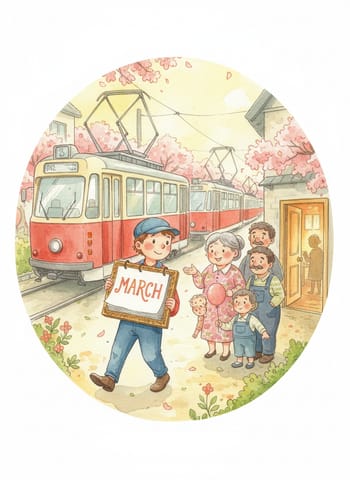
Luca found the calendar on his third day at the tram depot. It hung behind a pile of signal lamps in the back office. The paper had turned yellow, and the picture showed a stone bridge in spring.
Luca encontró el calendario en su tercer día en la cochera de tranvías. Colgaba detrás de una pila de lámparas de señales en la oficina del fondo. El papel se había puesto amarillo, y la imagen mostraba un puente de piedra en primavera.
"March," Luca said to the empty room. "It is still March."
«Marzo», le dijo Luca a la sala vacía. «Todavía es marzo».
He checked his phone. It was late October. He tried to turn the page, but it did not move. It was not glued down. It felt like thin metal that someone had printed to look like paper.
Revisó su teléfono. Era fines de octubre. Intentó pasar la hoja, pero no se movió. No estaba pegada. Se sentía como un metal delgado que alguien había impreso para que pareciera papel.
Cosmo came in with a heavy toolbox and a tired face. He had worked at the depot for six years, and he mostly worked alone.
Cosmo entró con una pesada caja de herramientas y una cara cansada. Llevaba seis años trabajando en la cochera, y casi siempre trabajaba solo.
"Are you still hunting for lamps?" Cosmo asked.
«¿Sigues buscando lámparas?», preguntó Cosmo.
"I am hunting for a reason," Luca said. "Look at this calendar."
«Estoy buscando una razón», dijo Luca. «Mira este calendario».
Cosmo glanced at it and shrugged. "It was here before I came. Nobody touches it. The last foreman said it was bad luck to throw it away."
Cosmo le echó un vistazo y se encogió de hombros. «Ya estaba aquí antes de que yo llegara. Nadie lo toca. El último capataz decía que daba mala suerte tirarlo».
"Why would it be bad luck? It is only a calendar."
«¿Por qué daría mala suerte? Es solo un calendario».
"Ask someone who has stayed here longer than me," Cosmo said. He picked up his box and left.
«Pregúntale a alguien que lleve aquí más tiempo que yo», dijo Cosmo. Levantó su caja y se fue.
Luca lifted the calendar off its nail. It came away easily, and it weighed almost nothing. He turned it over. On the back, a line of faint pencil said, "Give me to the one who needs me."
Luca levantó el calendario de su clavo. Se despegó con facilidad, y casi no pesaba nada. Le dio la vuelta. Atrás, una línea de lápiz tenue decía: «Dame a quien me necesite».
He read the line three times. Then he put the calendar under his arm and went to find someone who needed it.
Leyó la línea tres veces. Luego se puso el calendario bajo el brazo y salió a buscar a alguien que lo necesitara.
The first person he found was the clerk. She kept the depot records in a room full of grey cabinets. She looked up from a pile of timetables with a patient smile.
La primera persona que encontró fue la secretaria. Guardaba los registros de la cochera en un cuarto lleno de archivadores grises. Levantó la vista de un montón de horarios con una sonrisa paciente.
"Could you hold this for a moment?" Luca asked. "I think it wants an owner."
«¿Podría sostener esto un momento?», preguntó Luca. «Creo que quiere un dueño».
The clerk laughed, but she took it. She held it in both hands and waited.
La secretaria se rio, pero lo tomó. Lo sostuvo con las dos manos y esperó.
For a few seconds, nothing happened. Then the clock above her desk began to tick backward. The second hand slid from twelve to eleven, to ten, to nine. The clerk stared at it with her mouth open.
Durante unos segundos, no pasó nada. Entonces el reloj sobre su escritorio empezó a hacer tic hacia atrás. El segundero se deslizó de las doce a las once, a las diez, a las nueve. La secretaria lo miró con la boca abierta.
"That is not normal," she said.
«Eso no es normal», dijo.
"No," Luca said. "But is the calendar yours?"
«No», dijo Luca. «¿Pero el calendario es suyo?».
The clerk looked at the page. It still said March. It still would not turn. "I have never lost anything in March," she said slowly. "I think it belongs to somebody who has."
La secretaria miró la página. Seguía diciendo marzo. Seguía sin querer pasar. «Nunca he perdido nada en marzo», dijo despacio. «Creo que pertenece a alguien que sí».
She gave it back, and the clock jumped forward to the correct time. Luca thanked her and walked on.
Se lo devolvió, y el reloj saltó hacia adelante a la hora correcta. Luca le dio las gracias y siguió caminando.
The second person was the electrician, who was fixing a cable under the old turntable. He was a calm man with a pencil behind his ear. Luca explained everything while the electrician wiped oil from his hands.
La segunda persona fue el electricista, que arreglaba un cable bajo la vieja plataforma giratoria. Era un hombre tranquilo con un lápiz detrás de la oreja. Luca le explicó todo mientras el electricista se limpiaba el aceite de las manos.
"Let me see it," the electrician said.
«Déjame verlo», dijo el electricista.
He held the calendar up to the work lamp. The paper began to hum, very softly, like a fridge in a quiet kitchen. A line of tiny numbers appeared along the edge of the page. They counted down from fourteen to one and then stopped.
Levantó el calendario hacia la lámpara de trabajo. El papel empezó a zumbar, muy suavemente, como un refrigerador en una cocina silenciosa. Una línea de números diminutos apareció a lo largo del borde de la página. Contaron hacia atrás de catorce a uno y luego se detuvieron.
"That is the number of a tram car," the electrician said. "Car fourteen. It is the one at the back of the yard."
«Ese es el número de un vagón de tranvía», dijo el electricista. «El vagón catorce. Es el del fondo del patio».
"I checked its wiring last year," he added. "It is not my problem. Try someone who works on the brakes."
«Revisé su cableado el año pasado», añadió. «No es mi problema. Prueba con alguien que trabaje en los frenos».
"Thank you."
«Gracias».
"One more thing," the electrician said. He lowered his voice. "If the page turns, don't read what is on the other side alone. Take a witness."
«Una cosa más», dijo el electricista. Bajó la voz. «Si la hoja pasa, no leas lo que hay del otro lado a solas. Lleva un testigo».
Luca nodded, although he did not understand. He tucked the calendar under his arm again and stepped into the yard.
Luca asintió, aunque no entendía. Se metió el calendario bajo el brazo otra vez y salió al patio.
The evening sun lay low across the tracks. At the very back, behind two trams without wheels, car fourteen waited in the long grass. A single bell hung above its front window.
El sol de la tarde yacía bajo sobre las vías. Al fondo de todo, detrás de dos tranvías sin ruedas, el vagón catorce esperaba entre el pasto largo. Una sola campana colgaba sobre su ventana delantera.
Luca walked around it slowly. The calendar grew warmer under his arm. When he reached the front step, the paper trembled, and he nearly dropped it.
Luca lo rodeó despacio. El calendario se fue calentando bajo su brazo. Cuando llegó al estribo delantero, el papel tembló, y casi se le cayó.
"You found it," someone said behind him.
«Lo encontraste», dijo alguien detrás de él.
Luca turned. Cosmo stood at the gate with his toolbox in one hand and a sandwich in the other. He looked like a man who had not planned to follow anyone.
Luca se volvió. Cosmo estaba en la entrada con su caja de herramientas en una mano y un sándwich en la otra. Parecía un hombre que no había planeado seguir a nadie.
"I saw you walk past the window with that thing," Cosmo said. "I thought you might hurt yourself."
«Te vi pasar por la ventana con esa cosa», dijo Cosmo. «Pensé que podrías lastimarte».
"The clerk could not use it," Luca said. "The electrician could not use it either. It keeps pointing here."
«La secretaria no pudo usarlo», dijo Luca. «El electricista tampoco. Sigue señalando hacia aquí».
"Pointing where?"
«¿Señalando adónde?».
"To this tram. Car fourteen." Luca held the calendar out. "I think you should hold it."
«A este tranvía. Vagón catorce». Luca le tendió el calendario. «Creo que deberías sostenerlo tú».
Cosmo laughed, but the laugh sounded thin. "Why me?"
Cosmo se rio, pero la risa sonó débil. «¿Por qué yo?».
"Because I do not know anybody else who has a reason to come out here."
«Porque no conozco a nadie más que tenga una razón para venir aquí».
Cosmo said nothing for a while. He put his sandwich on the step. Then, very carefully, he took the calendar from Luca.
Cosmo no dijo nada durante un rato. Dejó su sándwich en el estribo. Luego, con mucho cuidado, tomó el calendario de manos de Luca.
The paper stopped trembling. It lay in his hands like a sleeping animal.
El papel dejó de temblar. Yacía en sus manos como un animal dormido.
"I worked on this car before I was a full mechanic," Cosmo said at last. "The foreman asked me to check the third bolt on the brake arm. It was a small job. I wrote it on this calendar, and I meant to do it on Thursday."
«Trabajé en este vagón antes de ser mecánico de planta», dijo Cosmo por fin. «El capataz me pidió que revisara el tercer perno del brazo del freno. Era un trabajo pequeño. Lo anoté en este calendario, y pensaba hacerlo el jueves».
"And did you?" Luca asked.
«¿Y lo hiciste?», preguntó Luca.
"I forgot." Cosmo rubbed his forehead. "Nothing happened. The car was already out of service, so nobody was hurt. But I always wondered what I had missed."
«Se me olvidó». Cosmo se frotó la frente. «No pasó nada. El vagón ya estaba fuera de servicio, así que nadie salió lastimado. Pero siempre me pregunté qué había dejado pasar».
"Then maybe the calendar has been waiting for you to finish it."
«Entonces quizás el calendario te ha estado esperando para que lo termines».
Cosmo looked at the page. He put one finger on the corner. This time the paper lifted at once, as lightly as a leaf.
Cosmo miró la hoja. Puso un dedo en la esquina. Esta vez el papel se levantó de inmediato, tan ligero como una hoja de árbol.
"Wait," Luca said. "The electrician said we should not look alone. So I am here."
«Espera», dijo Luca. «El electricista dijo que no deberíamos mirar a solas. Así que aquí estoy».
"Good," Cosmo said. "Stay."
«Bien», dijo Cosmo. «Quédate».
Underneath was the month of April. The picture showed a small tram crossing the same stone bridge, with tiny people at the windows. Across the top, someone had written a message in blue pencil.
Debajo estaba el mes de abril. La imagen mostraba un pequeño tranvía cruzando el mismo puente de piedra, con gente diminuta en las ventanas. Arriba de todo, alguien había escrito un mensaje con lápiz azul.
Cosmo read it out loud. His voice was careful and low.
Cosmo lo leyó en voz alta. Su voz era cuidadosa y baja.
"Third bolt, brake arm, car fourteen. Check it before you turn the page."
«Tercer perno, brazo del freno, vagón catorce. Revísalo antes de pasar la hoja».
"That is your job," Luca said. "Is it your handwriting?"
«Ese es tu trabajo», dijo Luca. «¿Es tu letra?».
"No." Cosmo frowned. "It looks like the foreman's. But he left years ago."
«No». Cosmo frunció el ceño. «Parece la del capataz. Pero se fue hace años».
They climbed onto the step together. Cosmo opened his toolbox and chose a short spanner. He crawled under the front of the car while Luca held the work lamp. The metal was cold and gritty, and the third bolt had a thin crack across its head.
Subieron juntos al estribo. Cosmo abrió su caja de herramientas y eligió una llave corta. Se arrastró bajo el frente del vagón mientras Luca sostenía la lámpara de trabajo. El metal estaba frío y arenoso, y el tercer perno tenía una fina grieta en la cabeza.
"It is loose," Cosmo called from below. "It has been loose for years. If anybody had moved this car, the arm could have slipped."
«Está flojo», gritó Cosmo desde abajo. «Ha estado flojo durante años. Si alguien hubiera movido este vagón, el brazo podría haberse soltado».
"So the calendar was warning you."
«Así que el calendario te estaba advirtiendo».
"Or reminding me." Cosmo tightened the bolt with a slow, steady turn. It made a satisfying click, like a key in a lock. Then he slid out from under the car with dust on his sleeves.
«O recordando». Cosmo apretó el perno con un giro lento y firme. Hizo un clic satisfactorio, como una llave en una cerradura. Luego salió deslizándose de debajo del vagón con polvo en las mangas.
High above the front window, the small brass bell gave one clear note, although nobody had touched it.
Muy arriba, sobre la ventana delantera, la pequeña campana de bronce dio una nota clara, aunque nadie la había tocado.
"Did you hear that?" Luca whispered.
«¿Oíste eso?», susurró Luca.
"I heard it," Cosmo said.
«Lo oí», dijo Cosmo.
Luca picked up the calendar from the step. The page for April had slid back by itself, and a new sheet lay on top. It showed a different bridge, with a wide river under it. The paper felt like ordinary paper now.
Luca recogió el calendario del estribo. La hoja de abril se había deslizado hacia atrás sola, y una hoja nueva yacía encima. Mostraba otro puente, con un ancho río debajo. El papel se sentía como papel normal ahora.
"May," Luca said. "It finally moved."
«Mayo», dijo Luca. «Por fin se movió».
"Then my job is done."
«Entonces mi trabajo está hecho».
"Is it?" Luca held up the calendar so the lamp shone through the page. A circle of pencil had appeared around one date in May. Next to it, in handwriting that looked exactly like Cosmo's own, a single word was written.
«¿Lo está?». Luca levantó el calendario para que la lámpara brillara a través de la hoja. Un círculo de lápiz había aparecido alrededor de una fecha de mayo. Junto a él, con una letra que parecía exactamente la de Cosmo, había una sola palabra escrita.
"Again?" Cosmo read, and his shoulders sank. "What does that mean?"
«¿Otra vez?», leyó Cosmo, y los hombros se le hundieron. «¿Qué significa eso?».
Luca did not answer. Behind them, in the dark yard, another tram bell began to ring.
Luca no respondió. Detrás de ellos, en el patio oscuro, otra campana de tranvía empezó a sonar.