The Salt Flat Crossing
Một truyện tiếng Anh miễn phí trình độ C1 cho người học, đọc trực tuyến bằng 4 ngôn ngữ, có thể nghe qua ứng dụng Storyteller miễn phí.
Over two days on foot across a vast salt flat, a woman loses her sense of distance and slowly discovers a different reason for having come.
Hết phần nghe thử! Nghe trọn truyện trong ứng dụng Storyteller miễn phí. Tải app
Hiện chưa thể phát audio.
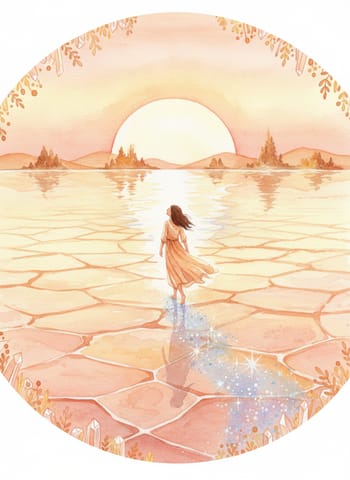
At dawn the flat is not white but the colour of the inside of a shell. Svea, standing at its edge in boots that still smell of the shop, cannot find a single thing to look at. The guide, a lean man who has already said everything he intends to say about safety, ties a cloth across his face and starts walking. She follows. Under each step the crust gives a thin, dry crack, like ice that has decided not to break.
Lúc bình minh, cánh đồng muối không trắng mà mang màu bên trong một chiếc vỏ sò. Svea, đứng ở mép nó trong đôi bốt vẫn còn mùi cửa hàng, không tìm thấy một thứ gì để nhìn. Người hướng dẫn, một người đàn ông gầy đã nói hết mọi điều ông định nói về an toàn, buộc một mảnh vải ngang mặt và bắt đầu bước đi. Cô theo sau. Dưới mỗi bước chân, lớp vỏ muối nứt ra một tiếng mỏng và khô, như băng đã quyết định không vỡ.
By ten the horizon has stopped behaving. A dark line that looked like a hill an hour ago turns, as they approach, into a scatter of stones the size of fists, and the hill is somewhere else. "Distance here is a rumour," the guide says, in the tone of a man who has said it to many people and is still faintly pleased with it. Svea drinks at the intervals he sets, tastes the mineral edge of salt that has crept inside her lips, and finds that she has stopped estimating anything at all.
Đến mười giờ, đường chân trời thôi cư xử đúng mực. Một vệt tối mà một giờ trước trông như quả đồi, khi họ tiến gần, hóa ra là một đám đá to bằng nắm tay, còn quả đồi thì ở đâu khác. "Ở đây khoảng cách chỉ là tin đồn," người hướng dẫn nói, bằng giọng của một người đã nói câu ấy với nhiều người và vẫn hơi hài lòng về nó. Svea uống nước theo những quãng ông định, nếm vị khoáng của muối đã len vào môi, và nhận ra mình đã thôi ước lượng bất cứ thứ gì.
She had come, she told people at home, for the photographs. It was a believable reason and she had rehearsed it. The truer one she had not rehearsed, because it would not fit into a sentence. It was a postcard that had hung above her father's desk for thirty years, a white plain under a white sky, and the way he said "one day" whenever he looked at it. She has the postcard in her inside pocket now. It is, she is beginning to see, a poor likeness; it has no sound in it.
Cô đến đây, cô nói với mọi người ở nhà, vì những bức ảnh. Đó là một lý do đáng tin và cô đã tập dượt nó. Lý do thật hơn thì cô chưa tập, vì nó không vừa trong một câu. Đó là một tấm bưu thiếp đã treo trên bàn làm việc của cha cô ba mươi năm, một đồng bằng trắng dưới bầu trời trắng, và cách ông nói "một ngày nào đó" mỗi khi nhìn nó. Giờ cô đang giữ tấm bưu thiếp trong túi trong. Cô bắt đầu thấy nó là một bức chân dung nghèo nàn; nó không có âm thanh.
Noon is the worst of it. No shadow falls anywhere, and the glare rises from the ground as much as it falls from the sky, so she walks with her hat brim low and watches only her boots: left, right, left. Time stretches the way it does in waiting rooms. She checks her watch and finds that eleven minutes have passed, and later, that it has been two hours, and neither figure seems more believable than the other.
Buổi trưa là tệ nhất. Không nơi nào có bóng đổ, và ánh chói dội lên từ mặt đất nhiều như rơi xuống từ bầu trời, nên cô đi với vành mũ hạ thấp và chỉ nhìn đôi bốt của mình: trái, phải, trái. Thời gian giãn ra như trong phòng chờ. Cô xem đồng hồ và thấy mười một phút đã qua, rồi sau đó, thấy đã hai giờ, và con số nào cũng không đáng tin hơn con số kia.
They camp where nothing marks the spot. The guide cooks flat bread on a stove no bigger than a fist and eats with his back to the wind. When the sun goes, it goes quickly, leaving a violet band along the edge of the world and then, abruptly, stars in numbers that seem almost rude. Lying on her back, Svea finds she is holding the postcard against her chest. If her father had come, he would have talked the whole way across, she thinks, and she would still be hearing him. What she feels, instead, is how little of this a desk could ever have shown him.
Họ cắm trại ở nơi chẳng có gì đánh dấu. Người hướng dẫn nướng bánh mì dẹt trên một cái bếp không lớn hơn nắm tay và ăn quay lưng ra gió. Khi mặt trời tắt, nó tắt nhanh, để lại một dải tím dọc mép thế giới rồi bỗng nhiên, những vì sao nhiều đến mức gần như thô lỗ. Nằm ngửa, Svea thấy mình đang ép tấm bưu thiếp lên ngực. Nếu cha cô đã đến, ông hẳn đã nói suốt đường băng qua, cô nghĩ, và cô vẫn còn nghe ông. Thay vào đó, điều cô cảm nhận là một chiếc bàn làm việc không thể cho ông thấy được bao nhiêu thứ ở đây.
On the second day the reason changes without consulting her. She no longer wants to have seen the place; she wants to be walking through it, one boot after the other, with the silence ringing faintly in her ears like a struck glass. Not until mid-afternoon does she realise she has not taken a single photograph. The camera swings against her hip, forgotten as a limb.
Sang ngày thứ hai, lý do đổi thay mà không hỏi ý cô. Cô không còn muốn đã thấy nơi này; cô muốn đang đi qua nó, từng bước giày một, với sự im lặng ngân khẽ trong tai như một chiếc ly bị gõ. Mãi đến giữa chiều cô mới nhận ra mình chưa chụp một tấm ảnh nào. Chiếc máy ảnh đung đưa bên hông, bị quên như một chi.
Late in the day she asks how much further. The guide lifts his chin towards a dark smudge so far away that it might be a mark on the lens. "That," he says. To Svea it looks like an hour; to him, she suspects, it looks like four. She takes the postcard out, looks at it once, slides it back into her pocket with its face against her ribs, and starts walking before he does.
Cuối ngày, cô hỏi còn bao xa. Người hướng dẫn hất cằm về một vết mờ tối ở xa đến mức có thể là một vết trên ống kính. "Kia," ông nói. Với Svea, nó trông như một giờ đi; với ông, cô ngờ, nó trông như bốn giờ. Cô lấy tấm bưu thiếp ra, nhìn một lần, rồi trượt nó lại vào túi, mặt úp vào xương sườn, và bắt đầu bước trước khi ông kịp đi.