The Salt Flat Crossing
一个面向英语学习者的免费 C1 级英语故事,可用 7 种语言在线阅读,也可以在免费的 Storyteller 应用中收听。
Over two days on foot across a vast salt flat, a woman loses her sense of distance and slowly discovers a different reason for having come.
试听结束!在免费的 Storyteller 应用中收听完整故事。 下载应用
音频暂时无法播放。
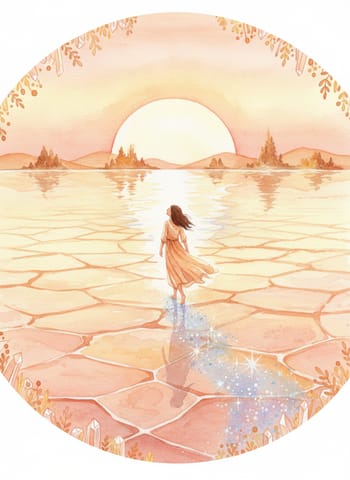
At dawn the flat is not white but the colour of the inside of a shell. Svea, standing at its edge in boots that still smell of the shop, cannot find a single thing to look at. The guide, a lean man who has already said everything he intends to say about safety, ties a cloth across his face and starts walking. She follows. Under each step the crust gives a thin, dry crack, like ice that has decided not to break.
黎明时分,盐滩不是白色的,而是贝壳内侧的颜色。斯韦娅站在盐滩边上,脚上的靴子还带着店里的味道,她找不到任何一样可看的东西。向导是个精瘦的男人,关于安全该说的话他都已经说完了,他把一块布系在脸上,开始往前走。她跟了上去。每迈一步,脚下的盐壳都发出一声轻薄干燥的脆响,像是下定决心不裂开的冰。
By ten the horizon has stopped behaving. A dark line that looked like a hill an hour ago turns, as they approach, into a scatter of stones the size of fists, and the hill is somewhere else. "Distance here is a rumour," the guide says, in the tone of a man who has said it to many people and is still faintly pleased with it. Svea drinks at the intervals he sets, tastes the mineral edge of salt that has crept inside her lips, and finds that she has stopped estimating anything at all.
到十点,地平线已经不守规矩了。一个钟头前看着像一座小山的黑线,走近了才变成一堆拳头大小的石头,而那座山却在别的地方。“这里的距离只是个传闻,”向导说,语气像是个对许多人说过这句话、却仍然有点得意的人。斯韦娅按他定的间隔喝水,尝到悄悄钻进嘴唇里的盐的矿物味,发现自己已经什么都不再估算了。
She had come, she told people at home, for the photographs. It was a believable reason and she had rehearsed it. The truer one she had not rehearsed, because it would not fit into a sentence. It was a postcard that had hung above her father's desk for thirty years, a white plain under a white sky, and the way he said "one day" whenever he looked at it. She has the postcard in her inside pocket now. It is, she is beginning to see, a poor likeness; it has no sound in it.
她对家里人说,她来是为了拍照。这是个可信的理由,她还预先练习过。更真实的那个理由她没有练习过,因为一句话装不下它。那是一张明信片,在她父亲的书桌上方挂了三十年,上面是白色天空下的一片白色平原,还有他每次看着它时,总会说的那句“有一天”。此刻,那张明信片就在她的内兜里。她渐渐看出来,它是一幅很差的写照;里面没有声音。
Noon is the worst of it. No shadow falls anywhere, and the glare rises from the ground as much as it falls from the sky, so she walks with her hat brim low and watches only her boots: left, right, left. Time stretches the way it does in waiting rooms. She checks her watch and finds that eleven minutes have passed, and later, that it has been two hours, and neither figure seems more believable than the other.
正午是最难熬的时候。哪里都没有影子,眩光从地面升起,几乎和从天上落下的一样多,所以她把帽檐压得低低的,只看着自己的靴子:左,右,左。时间像在候诊室里那样被拉长。她看了看表,发现才过去了十一分钟,后来再看,已经过去了两个小时,这两个数字,似乎都没有哪个更可信。
They camp where nothing marks the spot. The guide cooks flat bread on a stove no bigger than a fist and eats with his back to the wind. When the sun goes, it goes quickly, leaving a violet band along the edge of the world and then, abruptly, stars in numbers that seem almost rude. Lying on her back, Svea finds she is holding the postcard against her chest. If her father had come, he would have talked the whole way across, she thinks, and she would still be hearing him. What she feels, instead, is how little of this a desk could ever have shown him.
他们在没有任何标记的地方扎营。向导在一只不比拳头大的炉子上烤薄饼,背对着风吃。太阳落下时,落得很快,在世界的边缘留下一道紫色的带子,然后,星星突然冒了出来,多得近乎无礼。斯韦娅仰面躺着,发现自己正把那张明信片按在胸口。要是父亲来了,她想,他会一路说个不停,而她现在也许还听得见他的声音。而此刻她感受到的却是,一张书桌能让他看到的这一切,是多么微不足道。
On the second day the reason changes without consulting her. She no longer wants to have seen the place; she wants to be walking through it, one boot after the other, with the silence ringing faintly in her ears like a struck glass. Not until mid-afternoon does she realise she has not taken a single photograph. The camera swings against her hip, forgotten as a limb.
第二天,她来的理由悄悄变了,没有同她商量。她不再想着“看过”这个地方,而是想在其中行走,一步接一步,寂静在她耳中轻轻回响,像一只被敲响的玻璃杯。直到下午过半,她才意识到自己一张照片都没拍。相机在她的胯边晃荡,被遗忘得像是身体的一部分。
Late in the day she asks how much further. The guide lifts his chin towards a dark smudge so far away that it might be a mark on the lens. "That," he says. To Svea it looks like an hour; to him, she suspects, it looks like four. She takes the postcard out, looks at it once, slides it back into her pocket with its face against her ribs, and starts walking before he does.
傍晚,她问还有多远。向导抬了抬下巴,指向一个那么遥远的暗点,远得像是镜头上的一个污迹。“那儿,”他说。在斯韦娅看来,那像是一个小时的路;在他看来,她猜,那是四个小时。她把明信片掏出来,看了一眼,又把它塞回口袋,正面贴着肋骨,然后抢在他前面迈开了步子。