The Salt Flat Crossing
Cerita bahasa Inggris gratis level C1 untuk pelajar, bisa dibaca online dalam 5 bahasa, dengan pilihan untuk mendengarkannya di aplikasi Storyteller gratis.
Over two days on foot across a vast salt flat, a woman loses her sense of distance and slowly discovers a different reason for having come.
Itu cuplikannya! Dengarkan cerita lengkapnya di aplikasi Storyteller gratis. Unduh aplikasi
Audio belum tersedia saat ini.
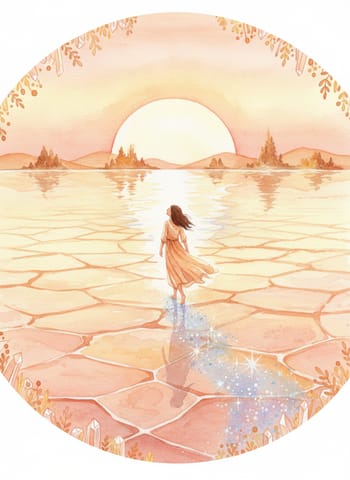
At dawn the flat is not white but the colour of the inside of a shell. Svea, standing at its edge in boots that still smell of the shop, cannot find a single thing to look at. The guide, a lean man who has already said everything he intends to say about safety, ties a cloth across his face and starts walking. She follows. Under each step the crust gives a thin, dry crack, like ice that has decided not to break.
Saat fajar, hamparan itu bukan putih melainkan berwarna seperti bagian dalam kerang. Svea, berdiri di tepinya dengan sepatu bot yang masih berbau toko, tak menemukan satu hal pun untuk dipandang. Sang pemandu, pria kurus yang sudah mengatakan semua yang hendak ia katakan tentang keselamatan, mengikatkan kain di wajahnya dan mulai berjalan. Svea mengikutinya. Di bawah setiap langkah, kerak garam itu retak tipis dan kering, seperti es yang memutuskan untuk tidak pecah.
By ten the horizon has stopped behaving. A dark line that looked like a hill an hour ago turns, as they approach, into a scatter of stones the size of fists, and the hill is somewhere else. "Distance here is a rumour," the guide says, in the tone of a man who has said it to many people and is still faintly pleased with it. Svea drinks at the intervals he sets, tastes the mineral edge of salt that has crept inside her lips, and finds that she has stopped estimating anything at all.
Pada pukul sepuluh, cakrawala berhenti berperilaku baik. Garis gelap yang sejam lalu tampak seperti bukit berubah, saat mereka mendekat, menjadi sebaran batu sebesar kepalan tangan, dan bukitnya ada di tempat lain. "Jarak di sini cuma desas-desus," kata sang pemandu, dengan nada orang yang sudah mengucapkannya kepada banyak orang dan masih sedikit bangga akan kalimat itu. Svea minum pada selang waktu yang ditetapkannya, mengecap garam mineral yang menyelinap ke dalam bibirnya, dan mendapati bahwa ia sudah berhenti memperkirakan apa pun.
She had come, she told people at home, for the photographs. It was a believable reason and she had rehearsed it. The truer one she had not rehearsed, because it would not fit into a sentence. It was a postcard that had hung above her father's desk for thirty years, a white plain under a white sky, and the way he said "one day" whenever he looked at it. She has the postcard in her inside pocket now. It is, she is beginning to see, a poor likeness; it has no sound in it.
Ia datang, katanya kepada orang-orang di rumah, demi foto-foto. Itu alasan yang masuk akal dan ia sudah melatihnya. Alasan yang lebih benar tidak ia latih, karena tak akan muat dalam satu kalimat. Itu adalah sebuah kartu pos yang tergantung di atas meja ayahnya selama tiga puluh tahun, hamparan putih di bawah langit putih, dan cara ayahnya mengucapkan "suatu hari nanti" setiap kali menatapnya. Kartu pos itu kini ada di saku dalamnya. Kartu itu, ia mulai menyadari, adalah gambaran yang buruk; tak ada suara di dalamnya.
Noon is the worst of it. No shadow falls anywhere, and the glare rises from the ground as much as it falls from the sky, so she walks with her hat brim low and watches only her boots: left, right, left. Time stretches the way it does in waiting rooms. She checks her watch and finds that eleven minutes have passed, and later, that it has been two hours, and neither figure seems more believable than the other.
Tengah hari adalah bagian terburuknya. Tak ada bayangan jatuh di mana pun, dan silau naik dari tanah sama banyaknya dengan yang turun dari langit, sehingga ia berjalan dengan pinggiran topi diturunkan dan hanya memperhatikan sepatu botnya: kiri, kanan, kiri. Waktu memanjang seperti di ruang tunggu. Ia melihat jam tangannya dan mendapati sebelas menit telah berlalu, dan kemudian, bahwa dua jam telah lewat, dan tak satu pun angka itu tampak lebih bisa dipercaya dari yang lain.
They camp where nothing marks the spot. The guide cooks flat bread on a stove no bigger than a fist and eats with his back to the wind. When the sun goes, it goes quickly, leaving a violet band along the edge of the world and then, abruptly, stars in numbers that seem almost rude. Lying on her back, Svea finds she is holding the postcard against her chest. If her father had come, he would have talked the whole way across, she thinks, and she would still be hearing him. What she feels, instead, is how little of this a desk could ever have shown him.
Mereka berkemah di tempat yang tak ditandai apa pun. Sang pemandu memasak roti pipih di atas kompor sekecil kepalan tangan dan makan dengan membelakangi angin. Ketika matahari pergi, ia pergi dengan cepat, meninggalkan pita ungu di tepi dunia lalu, tiba-tiba, bintang-bintang dalam jumlah yang terasa nyaris tidak sopan. Berbaring telentang, Svea mendapati dirinya memeluk kartu pos itu di dadanya. Seandainya ayahnya ikut, pikirnya, dia akan bicara sepanjang jalan, dan ia masih akan terus mendengarnya. Yang ia rasakan justru betapa sedikit dari semua ini yang pernah bisa ditunjukkan sebuah meja kepadanya.
On the second day the reason changes without consulting her. She no longer wants to have seen the place; she wants to be walking through it, one boot after the other, with the silence ringing faintly in her ears like a struck glass. Not until mid-afternoon does she realise she has not taken a single photograph. The camera swings against her hip, forgotten as a limb.
Pada hari kedua, alasannya berubah tanpa meminta pendapatnya. Ia tak lagi ingin sudah melihat tempat itu; ia ingin berjalan menyusurinya, sepatu bot demi sepatu bot, dengan keheningan berdenging samar di telinganya seperti gelas yang dipukul. Baru menjelang tengah sore ia sadar bahwa ia belum mengambil satu foto pun. Kamera itu berayun di pinggulnya, terlupakan seperti anggota badan.
Late in the day she asks how much further. The guide lifts his chin towards a dark smudge so far away that it might be a mark on the lens. "That," he says. To Svea it looks like an hour; to him, she suspects, it looks like four. She takes the postcard out, looks at it once, slides it back into her pocket with its face against her ribs, and starts walking before he does.
Menjelang sore, ia bertanya seberapa jauh lagi. Sang pemandu mengangkat dagunya ke arah noda gelap yang begitu jauh sehingga bisa saja berupa noda pada lensa. "Itu," katanya. Bagi Svea itu tampak seperti satu jam; baginya, ia menduga, itu tampak seperti empat. Ia mengeluarkan kartu pos itu, memandangnya sekali, menyelipkannya kembali ke saku dengan sisi gambarnya menempel pada tulang rusuk, dan mulai berjalan sebelum sang pemandu.