The Hilltop Shelter and the Wrong Shoes
Uma história gratuita em inglês de nível B2 para estudantes, para ler online em 7 idiomas, com opção de ouvir no app gratuito Storyteller.
The new chairman of a village running club discovers, twenty-five minutes before his first race, that he is wearing two completely different shoes.
Essa foi a prévia! Ouça a história completa no app gratuito Storyteller. Baixar o app
O áudio não está disponível no momento.
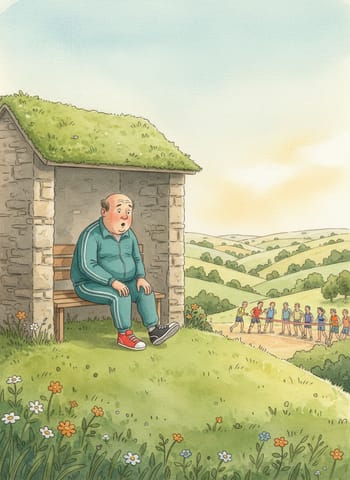
At twenty-five to seven on the morning of the Hill Dash, Hendrik arrives at the bus shelter on top of the hill. He carries a starting flag and a stopwatch, and he has a feeling that he has forgotten something. He is the new chairman of the village running club, and this is his first race as the person in charge. He has laid out his clothes the night before. He has set two alarms. He has rehearsed his welcome speech in the bathroom mirror until his toothbrush looks bored.
Às seis e vinte e cinco da manhã da Corrida da Colina, Hendrik chega ao ponto de ônibus no alto do morro. Leva uma bandeira de largada e um cronômetro, e tem a sensação de que esqueceu alguma coisa. Ele é o novo presidente do clube de corrida do vilarejo, e esta é a primeira prova em que está no comando. Separou a roupa na noite anterior. Programou dois despertadores. Ensaiou o discurso de boas-vindas diante do espelho do banheiro até a escova de dentes parecer entediada.
The shelter is an odd place for a race finish, but it is the only building for a mile. It is a small brick box with a tin roof and a long wooden bench. A notice board is crowded with posters for lost cats and yoga classes. Nobody has waited for a bus here for years. Instead the village uses it as a meeting point, a lookout and, once a month, a collection point for the school's shoe drive.
O abrigo é um lugar estranho para a chegada de uma corrida, mas é o único prédio num raio de um quilômetro e meio. É uma caixinha de tijolos com telhado de zinco e um longo banco de madeira. Um mural está lotado de cartazes de gatos perdidos e aulas de ioga. Ninguém espera ônibus ali há anos. Em vez disso, o vilarejo o usa como ponto de encontro, mirante e, uma vez por mês, ponto de coleta da campanha de sapatos da escola.
Giulia is already there, standing next to a big blue crate with a hand-painted sign that says OUTGROWN SHOES, PLEASE. She runs the shoe drive, and she also chairs the Hill Dash committee. She has a clipboard, a flask of coffee and the unhurried air of someone who has done this before.
Giulia já está lá, ao lado de uma grande caixa azul com uma placa pintada à mão que diz SAPATOS QUE NÃO SERVEM MAIS, POR FAVOR. Ela cuida da campanha de sapatos e também preside a comissão da Corrida da Colina. Tem uma prancheta, uma garrafa térmica de café e o ar tranquilo de quem já fez isso antes.
"Good morning, Chairman," she says. "You are early."
"Bom dia, Presidente", diz ela. "Você chegou cedo."
"I like to be prepared," Hendrik says, with dignity.
"Gosto de estar preparado", diz Hendrik, com dignidade.
He strides up to the bench, sets down his flag and checks his watch. Then he sits, stretches out his legs and looks at his feet.
Ele marcha até o banco, larga a bandeira e confere o relógio. Depois se senta, estica as pernas e olha para os pés.
On his left foot he is wearing a heavy brown leather walking boot. On his right foot he is wearing a thin white running shoe with a bright green stripe.
No pé esquerdo, está usando uma pesada bota de couro marrom para caminhada. No pé direito, um fino tênis de corrida branco com uma faixa verde-vivo.
For a few seconds he does not move at all. Perhaps it is a trick of the early light, he thinks. He closes his eyes and opens them again, and the shoes are still different.
Por alguns segundos ele não se mexe. Talvez seja um truque da luz da manhã, pensa. Fecha os olhos e os abre de novo, e os calçados continuam diferentes.
"Giulia," he says carefully. "How long have you been standing there?"
"Giulia", diz com cuidado. "Há quanto tempo você está aí?"
"Since six," Giulia says. "I noticed the shoes when you came up the lane. I thought it might be a fashion choice."
"Desde as seis", diz Giulia. "Reparei nos sapatos quando você subiu a trilha. Achei que fosse uma escolha de moda."
"It is not a fashion choice."
"Não é uma escolha de moda."
"Then it is a very confident mistake."
"Então é um erro muito confiante."
Hendrik looks down the hill. Far below, on the village green, a small crowd is already gathering at the starting line. There are runners in bright shirts, children on their parents' shoulders and a man with a trumpet. The race begins at seven. The starter must give the signal from the top. The starter must be Hendrik, because the club rules say so, and he wrote them himself.
Hendrik olha morro abaixo. Lá embaixo, na praça do vilarejo, uma pequena multidão já se reúne na linha de largada. Há corredores de camisetas coloridas, crianças nos ombros dos pais e um homem com um trompete. A corrida começa às sete. O sinal de largada deve ser dado do alto. Quem dá o sinal tem de ser Hendrik, porque o regulamento do clube diz isso, e ele mesmo o escreveu.
"It was dark in the kitchen," he says, in a thin voice. "I dressed quietly because my family was still asleep. I picked up two shoes by the back door, and I did not look."
"Estava escuro na cozinha", diz ele, com a voz fina. "Me vesti em silêncio porque minha família ainda dormia. Peguei dois sapatos perto da porta dos fundos e não olhei."
"Don't worry," Giulia says. "It happens. Last year the mayor wore two different socks, and nobody said a word."
"Não se preocupe", diz Giulia. "Acontece. No ano passado o prefeito usou duas meias diferentes, e ninguém disse nada."
"Because he is the mayor."
"Porque ele é o prefeito."
"Because they were too busy laughing."
"Porque estavam ocupados demais rindo."
Hendrik puts his head in his hands. Then, because there is nothing else to do, he walks to the notice board and back, to find out how bad it really is. It is very bad. The boot is too stiff, the shoe is too light, and the result is a slow, lopsided limp that makes him look like a pirate. A boy of about ten, who has just reached the top of the hill with his mother, stops dead and stares.
Hendrik põe a cabeça entre as mãos. Depois, como não há mais nada a fazer, anda até o mural e volta, para descobrir como a situação está ruim de verdade. Está muito ruim. A bota é dura demais, o tênis é leve demais, e o resultado é um mancar lento e torto que o faz parecer um pirata. Um menino de uns dez anos, que acabou de chegar ao alto do morro com a mãe, para de repente e fica olhando.
"Why is that man wearing a boot on one foot?" the boy asks, loudly.
"Por que aquele homem está com uma bota num pé só?", pergunta o menino, bem alto.
"He is a very dedicated runner," Giulia says, without blinking.
"Ele é um corredor muito dedicado", diz Giulia, sem piscar.
Hendrik sits down again and unlaces both shoes. For a moment he considers going home, but home is forty minutes away on foot, and the race starts in twenty. He considers starting the race in his socks. He considers moving to another country.
Hendrik se senta de novo e desamarra os dois calçados. Por um momento, considera ir para casa, mas casa fica a quarenta minutos a pé, e a corrida começa em vinte. Considera largar a prova de meias. Considera se mudar para outro país.
"Wait," Giulia says. She puts down her coffee and looks at the blue crate. "What size do you take?"
"Espere", diz Giulia. Ela pousa o café e olha para a caixa azul. "Que número você calça?"
"Forty-five."
"Quarenta e cinco."
"Hmm. That is large for a school shoe drive. But let's see."
"Hmm. É grande para uma campanha de sapatos escolares. Mas vamos ver."
They kneel together on the concrete floor and begin to lift out the shoes. The crate is full of the small, hopeful objects that children leave behind as they grow. There are tiny sandals, football boots with the studs worn flat and a single glittery slipper with no partner. Giulia pulls out a pair of ballet shoes and holds them up to Hendrik's foot. They are the size of his hand.
Eles se ajoelham juntos no chão de concreto e começam a tirar os sapatos. A caixa está cheia dos pequenos objetos esperançosos que as crianças deixam para trás ao crescer. Há sandálias minúsculas, chuteiras com as travas gastas e uma única sapatilha de glitter sem o par. Giulia tira um par de sapatilhas de balé e o segura junto ao pé de Hendrik. São do tamanho da mão dele.
"Not those," he says.
"Esses não", diz ele.
"No. Probably not those."
"Não. Provavelmente esses não."
By a quarter to seven, the floor of the shelter is covered with shoes in a wide, colourful circle. The boy and his mother have settled on the bench to watch. He offers advice. He suggests a rubber boot. He suggests tying the walking boot to the running shoe with string and wearing them as a pair. Hendrik thanks him, politely, for neither.
Às seis e quarenta e cinco, o chão do abrigo está coberto de sapatos num amplo círculo colorido. O menino e a mãe se acomodaram no banco para assistir. Ele dá conselhos. Sugere uma bota de borracha. Sugere amarrar a bota de caminhada ao tênis com barbante e usá-los como um par. Hendrik agradece, educadamente, por nenhuma das duas.
At ten minutes to seven, Giulia says, "Oh."
Às seis e cinquenta, Giulia diz: "Ah."
She is holding a pair of faded blue running shoes, very large and slightly cracked at the toes. She turns one over and reads the label inside the tongue, where someone has written a name in black marker.
Ela segura um par de tênis de corrida azuis desbotados, muito grandes e um pouco rachados nas pontas. Vira um deles e lê a etiqueta dentro da língua, onde alguém escreveu um nome com caneta preta.
"Hendrik," she says slowly, "these are yours."
"Hendrik", diz ela devagar, "estes são seus."
He takes the shoe from her hand and looks. It is true. His own handwriting stares back at him. He remembers now. Last month he bought a new pair, and his wife told him to be sensible about the old ones. So he dropped them into this very crate on his way to the shop. He had felt rather noble about it. He had told the story twice at dinner.
Ele pega o tênis da mão dela e olha. É verdade. A própria letra o encara de volta. Agora ele se lembra. No mês passado, comprou um par novo, e a esposa lhe disse para ser sensato com os antigos. Então ele os largou nesta mesma caixa a caminho da loja. Tinha se sentido bem nobre. Contou a história duas vezes no jantar.
"I gave away my own shoes," he says, "and now I have come to take them back."
"Eu doei os meus próprios sapatos", diz ele, "e agora vim buscá-los de volta."
"Technically," Giulia says, "you are borrowing them. The school will get the new ones."
"Tecnicamente", diz Giulia, "você os está pegando emprestados. A escola vai receber os novos."
"I don't understand."
"Não entendo."
"You will leave a donation in the tin for a replacement pair. The children lose nothing, and you lose a little pride. It is a fair arrangement."
"Você deixa uma doação no cofrinho para um par de reposição. As crianças não perdem nada, e você perde um pouco de orgulho. É um acordo justo."
Hendrik considers this, then nods. He takes two coins from his pocket, drops them in the tin on the bench, and adds a third for the boy's good advice. He laces up the blue shoes with quick, steady fingers, and they feel like old friends who forgive everything. He stuffs the walking boot and the white running shoe into his bag, to be dealt with later at home.
Hendrik pensa nisso e assente. Tira duas moedas do bolso, deixa-as no cofrinho sobre o banco e acrescenta uma terceira pelos bons conselhos do menino. Amarra os tênis azuis com dedos rápidos e firmes, e eles parecem velhos amigos que perdoam tudo. Enfia a bota de caminhada e o tênis branco na mochila, para resolver mais tarde em casa.
At two minutes to seven he stands at the edge of the hill and looks down. The crowd has become a bright blur of colour. Somebody blows a note on the trumpet. Giulia stands beside him with her coffee, and the boy stands beside her. All three of them watch the second hand of the stopwatch crawl towards the top.
Dois minutos antes das sete, ele está na beira do morro e olha para baixo. A multidão virou um borrão colorido. Alguém sopra uma nota no trompete. Giulia está ao lado dele com o café, e o menino está ao lado dela. Os três observam o ponteiro dos segundos do cronômetro se arrastar em direção ao topo.
Hendrik takes the starting flag in both hands, lifts it high above his head, and waits for every face below to turn up towards him.
Hendrik pega a bandeira de largada com as duas mãos, ergue-a bem acima da cabeça e espera que todos os rostos lá embaixo se voltem para ele.
Then he brings it down.
Então a abaixa.