The Dead Battery Above the Pharmacy
Uma história gratuita em inglês de nível B2 para estudantes, para ler online em 7 idiomas, com opção de ouvir no app gratuito Storyteller.
A dance teacher traces her flat megaphone back through three borrowers to find out who drained its battery before a recital.
Essa foi a prévia! Ouça a história completa no app gratuito Storyteller. Baixar o app
O áudio não está disponível no momento.
The megaphone dies on a Wednesday morning, three days before the biggest recital of the year, and Fatou takes it personally.
O megafone morre numa manhã de quarta-feira, três dias antes do maior recital do ano, e Fatou leva isso para o lado pessoal.
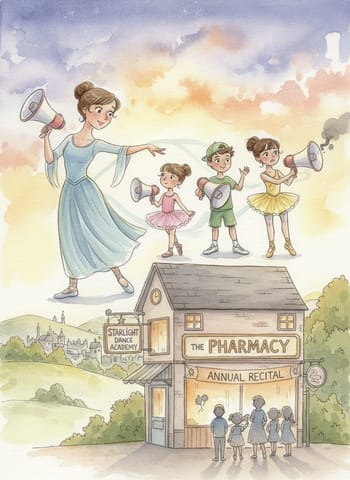
She stands in the middle of her dance studio, which sits on the first floor above a pharmacy. For the fourth time, she presses the trigger. Nothing comes out. The little light stays dark. Thirty small children are due in an hour, and they cannot hear a human voice over their own excitement, let alone Fatou's.
Ela está no meio do estúdio de dança, que fica no primeiro andar, em cima de uma farmácia. Pela quarta vez, aperta o gatilho. Nada sai. A luzinha continua apagada. Trinta crianças pequenas chegam em uma hora, e elas não conseguem ouvir uma voz humana por cima da própria empolgação, quanto mais a de Fatou.
"Five, six, seven, eight," she says into the empty room, just to prove to herself that she has a voice. It sounds feeble and rather sad.
"Cinco, seis, sete, oito", diz ela para a sala vazia, só para provar a si mesma que ainda tem voz. Soa fraca e meio triste.
The megaphone was working on Monday night. She is certain of that, because she used it at the end of the evening class to call the final stretch. The sound bounced off the mirrors so loudly that a woman in the back row clapped her hands over her ears. It lives in the open cupboard by the door, where anyone can reach it. So where did the battery go?
O megafone estava funcionando na segunda à noite. Ela tem certeza disso, porque o usou no fim da aula noturna para chamar a última sequência. O som ricocheteou nos espelhos tão alto que uma mulher da última fileira tapou os ouvidos com as mãos. Ele fica no armário aberto perto da porta, onde qualquer um pode pegá-lo. Então, para onde foi a bateria?
Fatou is a person who solves things. She teaches fourteen classes a week, and she keeps the studio keys, the music and a spare pair of shoes in every size. She does not accept that a battery can die on its own. Somebody has used her megaphone, and she intends to find out who.
Fatou é uma pessoa que resolve as coisas. Ela dá quatorze aulas por semana e guarda as chaves do estúdio, a música e um par de sapatos reserva de cada tamanho. Ela não aceita que uma bateria possa morrer sozinha. Alguém usou o megafone dela, e ela pretende descobrir quem.
She tucks the dead megaphone under her arm and starts with a list on the back of an attendance sheet. Between Monday night and this morning, the megaphone passed through three sets of hands. She knows that because she asked the cleaner, who laughed and asked her to stop investigating her own cupboard.
Ela enfia o megafone morto debaixo do braço e começa com uma lista no verso de uma folha de presença. Entre a noite de segunda e esta manhã, o megafone passou por três pares de mãos. Ela sabe disso porque perguntou ao faxineiro, que riu e pediu que ela parasse de investigar o próprio armário.
The first name on the list is the ballroom teacher, who rents the studio on Tuesday evenings. Fatou finds her in the corridor, wrapping a scarf around her neck.
O primeiro nome da lista é o da professora de dança de salão, que aluga o estúdio nas noites de terça. Fatou a encontra no corredor, enrolando um cachecol no pescoço.
"Yes, I borrowed it," the ballroom teacher says at once. "For about four minutes. I needed to shout over a very loud waltz. Then I put it straight back in the cupboard."
"Sim, eu peguei emprestado", diz a professora de dança de salão na mesma hora. "Por uns quatro minutos. Eu precisava gritar por cima de uma valsa altíssima. Depois coloquei de volta no armário imediatamente."
"Did it work properly when you finished?"
"Estava funcionando direitinho quando você terminou?"
"Of course it did. I even took a photograph of it, because the battery light was green and I wanted to show my husband how modern we are."
"Claro que estava. Eu até tirei uma foto, porque a luz da bateria estava verde e eu queria mostrar ao meu marido como somos modernos."
She scrolls through her phone and finds the picture. A green light, three solid bars, time stamped half past seven on Tuesday. Fatou studies it with the grim attention of a detective in a film.
Ela rola a tela do celular e encontra a imagem. Uma luz verde, três barras cheias, com horário de sete e meia da noite de terça. Fatou a examina com a atenção severa de uma detetive de cinema.
"That is useful," she says. "Thank you."
"Isso é útil", diz ela. "Obrigada."
"Is it a crime?" the ballroom teacher asks hopefully.
"É um crime?", pergunta a professora de dança de salão, esperançosa.
"Not yet," says Fatou.
"Ainda não", diz Fatou.
The second name is the courier, a young man with a bicycle. He delivers prescriptions for the pharmacy and sometimes uses the studio stairwell as a shortcut. Fatou catches him in the middle of lifting his bike up the stairs.
O segundo nome é o do entregador, um rapaz com uma bicicleta. Ele entrega receitas para a farmácia e às vezes usa a escada do estúdio como atalho. Fatou o pega no meio do caminho, erguendo a bicicleta escada acima.
He goes slightly pale when she says the word megaphone.
Ele fica um pouco pálido quando ela diz a palavra megafone.
"I did take it," he admits, "but only for a minute. A dog escaped from a van outside and started running around the car park. I stood on the steps and shouted at it. It ignored me completely."
"Eu peguei, sim", admite ele, "mas só por um minuto. Um cachorro fugiu de uma van lá fora e começou a correr pelo estacionamento. Eu subi nos degraus e gritei com ele. Ele me ignorou completamente."
"What did you do with the megaphone afterwards?"
"O que você fez com o megafone depois?"
"I put it on the shelf by the pharmacy door. The one in the back corridor, next to the boxes. I thought it would be safer there." He looks at his shoes. "Was that wrong?"
"Coloquei na prateleira perto da porta da farmácia. Aquela do corredor dos fundos, ao lado das caixas. Achei que ficaria mais seguro ali." Ele olha para os próprios sapatos. "Foi errado?"
Fatou writes on the sheet: Courier, Tuesday, about eight. Moved it to the pharmacy shelf. Then, because she is fair, she writes: Why did it come back to my cupboard?
Fatou escreve na folha: Entregador, terça, por volta das oito. Levou para a prateleira da farmácia. Então, porque é justa, escreve: Por que ele voltou para o meu armário?
"Someone must have carried it up to me," she says. "Someone who knew whose it was."
"Alguém deve ter trazido para mim", diz ela. "Alguém que sabia de quem era."
The courier shrugs. Fatou watches him carry his bicycle away.
O entregador dá de ombros. Fatou o observa carregar a bicicleta para longe.
That leaves the third person, and he is the one she was trying not to think about. He is the pharmacist, a tall, patient, untidy man named Nikos. He sells her cough sweets and cheerfully complains about her music through the ceiling every afternoon. The two of them have been neighbours for four years, and she has never once suspected him of anything worse than a bad singing voice.
Isso deixa a terceira pessoa, e ele é aquele em quem ela vinha tentando não pensar. É o farmacêutico, um homem alto, paciente e desarrumado chamado Nikos. Ele vende pastilhas para tosse a ela e reclama alegremente da música dela, através do teto, toda tarde. Os dois são vizinhos há quatro anos, e ela nunca suspeitou dele de nada pior do que uma voz ruim para cantar.
She finds him behind the counter, writing a label with great care. His eyes are tired. There is a long queue in front of him, and she can see that the queue is not cheerful.
Ela o encontra atrás do balcão, escrevendo uma etiqueta com muito cuidado. Seus olhos estão cansados. Há uma fila comprida na frente dele, e ela percebe que a fila não está nada animada.
"Nikos," she says. "A word."
"Nikos", diz ela. "Uma palavrinha."
"Fatou, I would love to, but as you can see, I am drowning." He waves at the line of customers. "The number machine broke on Tuesday, and since then everybody has been standing in a heap and arguing about who arrived first."
"Fatou, eu adoraria, mas, como você pode ver, estou me afogando." Ele acena para a fila de clientes. "A máquina de senhas quebrou na terça, e desde então todo mundo fica aglomerado discutindo quem chegou primeiro."
Fatou stops. Something in her head clicks, the way a key clicks into a lock.
Fatou para. Algo na cabeça dela faz clique, como uma chave encaixando numa fechadura.
"Nikos, when did the number machine break?"
"Nikos, quando a máquina de senhas quebrou?"
"Tuesday afternoon. Why?"
"Terça à tarde. Por quê?"
"And how did you call the customers on Tuesday evening?"
"E como você chamou os clientes na terça à noite?"
He opens his mouth and closes it again. He looks suddenly like a man who has been caught eating the last biscuit. "I had a little help," he says. "From the back corridor shelf."
Ele abre a boca e a fecha de novo. De repente parece um homem pego comendo o último biscoito. "Eu tive uma ajudinha", diz ele. "Da prateleira do corredor dos fundos."
"There is a megaphone on that shelf."
"Tem um megafone naquela prateleira."
"There was a megaphone on that shelf. It was very useful. It has a lovely loud voice."
"Tinha um megafone naquela prateleira. Foi muito útil. Ele tem uma voz linda e alta."
"Nikos," Fatou says, with enormous calm, "where is it now?"
"Nikos", diz Fatou, com enorme calma, "onde ele está agora?"
She does not wait for his answer. She lifts the dead megaphone from under her arm and sets it on the counter between them. Nikos looks at it the way a man looks at an old photograph of himself. Then he bends closer and points at the trigger, where a sticky grey stripe shows that clear tape was once wound around it. Beside the stripe, a ragged scrap of paper still clings to the plastic. On it, in the pharmacy's thick black marker, are two words: NEXT, PLEASE.
Ela não espera pela resposta. Tira o megafone morto de debaixo do braço e o coloca sobre o balcão entre os dois. Nikos olha para ele como um homem olha para uma foto antiga de si mesmo. Então se inclina e aponta para o gatilho, onde uma listra cinzenta e pegajosa mostra que antes havia fita adesiva transparente enrolada ali. Ao lado da listra, um pedaço de papel rasgado ainda gruda no plástico. Nele, com o marcador preto grosso da farmácia, estão duas palavras: PRÓXIMO, POR FAVOR.
"That is my label," he says weakly. "And that is my tape."
"Essa é a minha etiqueta", diz ele, fraco. "E essa é a minha fita."
"You taped the trigger down," Fatou says.
"Você prendeu o gatilho com fita", diz Fatou.
"Only so that I would not have to hold it." Nikos is turning an interesting shade of pink. "I peeled the tape off before I brought it back, because I thought you would never notice. But it was not turned off properly when I carried it to the stockroom last night. I left it humming on the shelf. All night."
"Só para não precisar ficar segurando." Nikos está ficando de um tom interessante de rosa. "Eu tirei a fita antes de devolver, porque achei que você nunca ia perceber. Mas ele não foi desligado direito quando o levei para o depósito ontem à noite. Deixei ele zumbindo na prateleira. A noite inteira."
"All night, calling for the next customer in an empty pharmacy."
"A noite inteira, chamando o próximo cliente numa farmácia vazia."
"I am told it was a very polite night."
"Dizem que foi uma noite muito educada."
In the line, someone laughs. Another customer starts to clap, slowly. Fatou presses her lips together, because she does not want to give him the satisfaction. A smile is creeping up on her, and she cannot stop it.
Na fila, alguém ri. Outro cliente começa a bater palmas, devagar. Fatou aperta os lábios, porque não quer dar a ele essa satisfação. Um sorriso vai subindo no rosto dela, e ela não consegue impedi-lo.
"Three people," she says. "Three people, and the one I should have started with was downstairs the whole time."
"Três pessoas", diz ela. "Três pessoas, e a que eu deveria ter procurado primeiro estava lá embaixo o tempo todo."
"In my defence," Nikos says, "I did bring it back to you. I left it in your cupboard this morning, at six, before you came."
"Em minha defesa", diz Nikos, "eu devolvi para você. Deixei no seu armário hoje de manhã, às seis, antes de você chegar."
"Dead."
"Morto."
"Humbly dead. I apologise." He pushes the megaphone an inch towards her across the counter. "I will buy you new batteries. I will buy you twelve of them, with a ribbon. And I will stand in the front row on Saturday and call every dance step you want."
"Humildemente morto. Peço desculpas." Ele empurra o megafone uns dois centímetros na direção dela pelo balcão. "Vou comprar pilhas novas para você. Vou comprar doze, com um laço. E vou ficar na primeira fila no sábado e chamar todos os passos de dança que você quiser."
"That," Fatou says, "is the best offer I have had all week."
"Essa", diz Fatou, "é a melhor oferta que recebi a semana toda."
"Left foot, right foot," says Nikos, lifting the dead megaphone to his lips and speaking into it with great seriousness. "Next customer, please."
"Pé esquerdo, pé direito", diz Nikos, levando o megafone morto à boca e falando nele com grande seriedade. "Próximo cliente, por favor."